

Bitfront was never meant to last. It showed up in 2018 promising something rare: a crypto exchange that actually welcomed U.S. customers. Back then, most platforms either blocked Americans outright or made them jump through hoops just to deposit. Bitfront said it was different. It offered live chat in over 15 languages, supported major coins like Bitcoin and Ethereum, and claimed to be built for everyday users. But by early 2022, the website was gone. No announcement. No warning. Just a 404 error. And now, in 2026, Bitfront is officially dead.
What Bitfront Actually Offered
At its peak, Bitfront traded just seven cryptocurrencies: BTC, ETH, BCH, LINK, PAX, TUSD, and USDT. That’s it. No Solana. No Polygon. No Dogecoin. No futures. No staking. No NFT marketplace. Compared to Binance’s 350+ coins or Coinbase’s 200+, Bitfront felt like a stripped-down version of what the market had already moved past. Its main selling point? Trading pairs were all against BTC. If you wanted to buy Ethereum with U.S. dollars, you had to first buy Bitcoin, then trade it for ETH. That added cost, time, and risk.
The platform had no mobile app. No API for automated trading. No advanced charting tools. If you were a beginner trying to buy your first Bitcoin, it was simple enough. But if you knew what a limit order was, or wanted to set up a grid strategy, you were out of luck. It wasn’t built for traders. It was built for people who just wanted to dip their toes in.
The Regulatory Trap
Bitfront’s biggest mistake wasn’t the limited coin list. It wasn’t the lack of an app. It was trying to serve U.S. users without getting licensed. The U.S. Securities and Exchange Commission (SEC) started cracking down hard in 2021. Platforms that didn’t register as broker-dealers or money transmitters got hit with fines, cease-and-desist orders, or outright shutdowns. Bitfront never filed the paperwork. It didn’t need to - or so it thought.
But the SEC didn’t care about your “US-friendly” marketing. If you accepted U.S. IP addresses, processed U.S. bank transfers, or offered services to U.S. residents without a license, you were breaking the law. In 2021 alone, the SEC filed 217% more enforcement actions against unregistered exchanges than the year before. Bitfront was one of them.
Experts like Dr. Elena Rodriguez from Delphi Digital called it a “classic case of regulatory wishful thinking.” She pointed out that exchanges like Bitfront assumed they could fly under the radar. But in the crypto world, that’s not how it works. If you’re targeting Americans, you play by American rules - or you disappear.
Why Users Got Frustrated
People who used Bitfront had mixed feelings. Some praised the multilingual support. One Reddit user said, “Their Spanish team actually spoke Spanish - not Google Translate garbage.” That was rare. Most exchanges had bots pretending to be human.
But the problems were worse than the perks. Withdrawals took forever. One user on Trustpilot said it took 11 business days to get $1,200 out of their account. No explanation. No updates. Just silence. Another user reported a 72-hour delay just to verify their ID. That’s longer than some banks take to clear a wire.
Deposit addresses sometimes didn’t generate. Funds vanished into limbo. Customer service was responsive - but only if you caught them during their 7-day live chat window. Outside of that? No email replies. No ticket system. No follow-up. By late 2021, Reddit threads like “Is Bitfront still operational?” were getting dozens of comments from people who couldn’t access their money.
The Numbers Didn’t Lie
Bitfront’s trading volume tells the real story. In September 2021, it hit $488 million in 24-hour volume. That sounds impressive - until you compare it to Coinbase’s $15.2 billion or Binance’s $42.7 billion on the same day. By December 2021, Bitfront’s volume had dropped to $356 million. A 27% decline in just three months. That’s not a market dip. That’s a collapse in trust.
Its user base was tiny. Estimates put active users between 50,000 and 75,000. Coinbase had 7.4 million U.S. users alone. Bitfront had no brand recognition, no advertising budget, no partnerships. It was a small platform trying to compete with giants - without the tools, the compliance, or the scale.
The Confusion With LINE’s BITFRONT
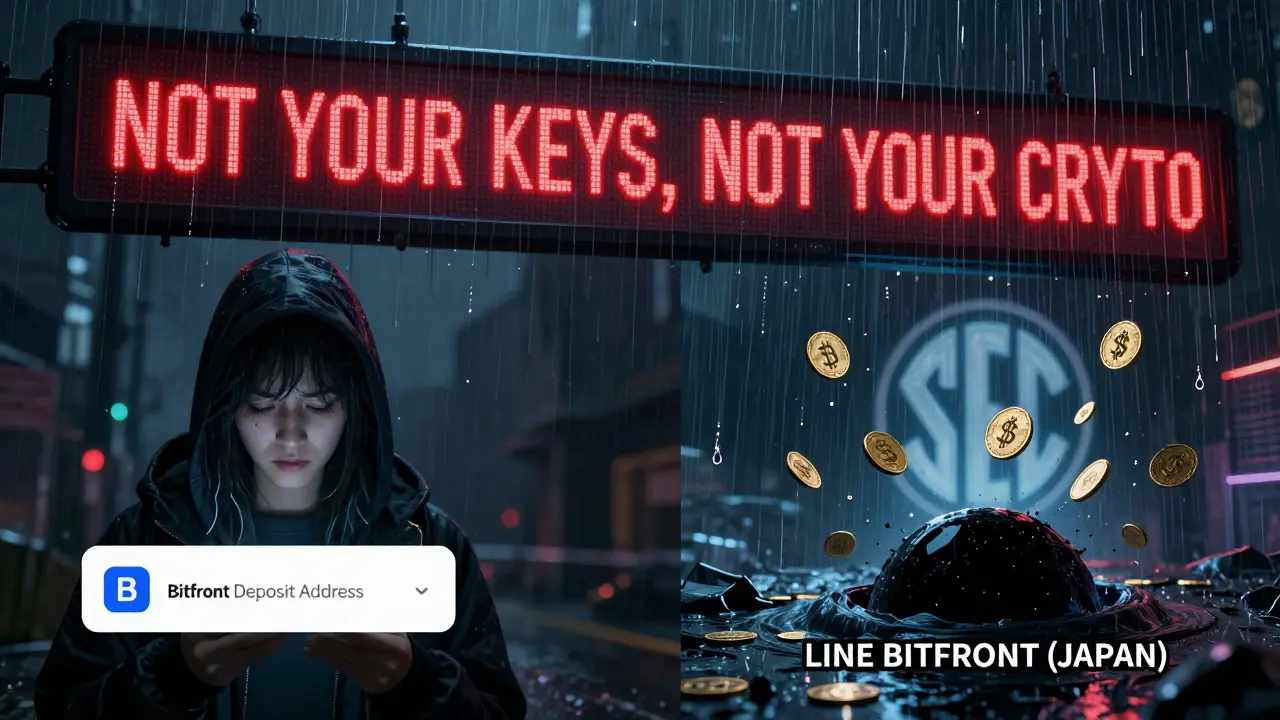
Here’s where things get messy. There’s another exchange called BITFRONT - run by LINE, the Japanese messaging app company. It’s still active in 2026. It handles tokens from the LINE Blockchain Platform. It has a 4.1/5 rating. It’s completely separate from the U.S.-based Bitfront.
But Google doesn’t know the difference. If you search “Bitfront crypto,” you’ll see results for both. Many users got confused. Some even sent funds to the wrong platform. LINE’s BITFRONT doesn’t serve U.S. users. The U.S. Bitfront didn’t serve Asia. They shared a name, but nothing else.
Why It Failed - And What It Teaches Us
Bitfront didn’t fail because it was badly built. It failed because it ignored the one thing that matters in crypto: regulation. It thought it could be “US-friendly” without being legal. It assumed users wouldn’t care if it wasn’t licensed. It believed volume and customer service could make up for missing compliance.
It didn’t work. The SEC didn’t wait for it to grow. It didn’t give it time to fix things. It just shut it down. And when the website vanished, so did thousands of users’ funds - permanently.
Bitfront’s story is a warning. If you’re a trader, don’t use an exchange that doesn’t clearly state its regulatory status. If you’re a new user, ask: “Is this exchange registered with the SEC or FinCEN?” If the answer is no - walk away. Even if it looks safe. Even if it has good support. Even if it’s the only one that accepts your bank.
There are better options now. Coinbase, Kraken, and Gemini are all licensed in the U.S. They have apps, APIs, staking, and real customer support. You don’t need to gamble on a ghost platform.
What Happens to Your Money When an Exchange Dies?
When Bitfront shut down, users lost access to their wallets. There was no recovery process. No refunds. No official statement. The domain expired. The servers were turned off. The money? Gone.
Unlike banks, crypto exchanges don’t have FDIC insurance. There’s no government backstop. If the exchange collapses, your assets vanish unless you held them in your own wallet. Bitfront never told users to move their coins off-platform. That was a fatal oversight.
Always remember: Not your keys, not your crypto. If you’re storing funds on any exchange - even a big one - you’re trusting them with your money. But with a dead exchange? You’re trusting a ghost.
Is Bitfront still operating in 2026?
No, Bitfront is permanently closed. Its website has been inaccessible since early 2022, and the domain now redirects to a parking page. Cryptowisser’s Exchange Graveyard and other industry trackers list it as "dead." There is no revival plan.
Can I recover my funds from Bitfront?
No. Once Bitfront shut down, its servers were decommissioned, and no official recovery process was ever offered. Any funds left on the platform are lost. This is why it’s critical to withdraw your crypto to a personal wallet - never leave large amounts on an exchange, especially one with questionable regulatory standing.
Was Bitfront a scam?
It wasn’t a scam in the traditional sense - it didn’t steal money on purpose. But it operated without proper U.S. regulatory approval while actively marketing to American users. That’s a legal violation, not a technical failure. The SEC’s enforcement actions against unregistered exchanges make it clear: Bitfront’s model was unsustainable from day one.
How was Bitfront different from LINE’s BITFRONT?
They’re completely different. Bitfront (U.S.) was a centralized exchange for Bitcoin and Ethereum, targeting American users. LINE’s BITFRONT is a blockchain-based trading platform tied to Japan’s LINE messaging app, serving Asian markets. They share a name, but not infrastructure, ownership, or users. Confusing them led some users to send funds to the wrong platform.
What should I look for in a crypto exchange today?
Look for three things: 1) Regulatory status - is it licensed in your country? 2) Transparency - does it publish security audits and reserve proofs? 3) Features - does it offer an app, API, staking, and real customer support? Stick to exchanges like Coinbase, Kraken, or Gemini in the U.S. Avoid platforms that don’t clearly state their compliance status.
Steven Lefebvre
March 5, 2026 AT 13:31Bitfront was never going to win against Binance or Coinbase, but I still feel bad for the users who lost access to their funds. No warning, no notice - just a 404. That’s not how you treat people who trusted you with their crypto.
Drago Fila
March 6, 2026 AT 21:59I remember using Bitfront back in 2019. The live chat actually worked. No bots. Real humans who spoke Spanish and French. That was rare. But yeah, the withdrawal delays killed it. Took 10 days to get $500 out. By then, I’d already moved everything to Kraken.
Christina Young
March 7, 2026 AT 23:02It wasn’t a scam, but it was a walking regulatory violation. If you’re targeting U.S. users without a license, you’re asking for trouble. No sympathy here.
nalini jeyapalan
March 8, 2026 AT 07:08People keep acting like Bitfront was some underdog hero. It wasn’t. It was a glorified middleman with zero compliance. The SEC didn’t shut it down because they’re evil - they shut it down because it was illegal. Simple.
Megan Lutz
March 10, 2026 AT 02:33The real tragedy isn’t that Bitfront shut down. It’s that so many users didn’t know to withdraw their coins. The phrase ‘not your keys, not your crypto’ isn’t a meme - it’s a survival rule. And yet, people still leave everything on exchanges like it’s a savings account.
Jesse VanDerPol
March 12, 2026 AT 02:19Confusing Bitfront with LINE’s version is so common it’s almost funny. I’ve seen people send ETH to the wrong one and then panic. Google needs to fix this. Or someone should’ve trademarked the name properly.
jonathan swift
March 12, 2026 AT 03:48SEC didn’t shut Bitfront down. The deep state did. They’re scared of crypto because it can’t be controlled. This was a targeted hit. The ‘regulatory violation’ is just the cover story. They didn’t want Americans to have a simple, multilingual option. They want you locked into Coinbase with their fees and surveillance. 🤫👁️
Datta Yadav
March 12, 2026 AT 07:22You think Bitfront was the only one? Let me tell you about the 17 other U.S.-targeting exchanges that vanished between 2020 and 2023 - all because they thought they could outsmart regulators. This isn’t a lesson about one platform - it’s a systemic failure of the entire amateur crypto operator class. They didn’t lack tech - they lacked humility. They thought they were innovators when they were just lawbreakers with a website. And now? Their users are stuck with empty wallets while the big boys laugh from their SEC-approved bunkers. The entire ecosystem is a pyramid scheme built on ignorance.
Lydia Meier
March 12, 2026 AT 10:33While the article presents a comprehensive analysis of Bitfront’s operational shortcomings, it is worth noting that the absence of formal regulatory compliance constitutes not merely a strategic misstep, but a fundamental breach of fiduciary responsibility to users.
Austin King
March 12, 2026 AT 23:24My cousin lost like $3K on Bitfront. Never heard from them again. I told him to move to Kraken. He didn’t listen. Now he’s learning the hard way. Don’t be him.
Bryanna Barnett
March 14, 2026 AT 13:08lol at people being mad about Bitfront. It was basically a glorified web form with a ‘live chat’ that took 48 hours to reply. If you thought this was a real exchange, you shouldn’t be touching crypto at all.
Josh Moorcroft-Jones
March 14, 2026 AT 18:47Let’s be clear: Bitfront didn’t just ‘fail’ - it was a ticking time bomb from day one. No mobile app? No API? No staking? No futures? And they expected to compete with Binance? That’s like opening a lemonade stand next to Starbucks and wondering why nobody shows up. Plus, the withdrawal delays? 11 business days? That’s not customer service - that’s a hostage situation. And the fact that they never told users to withdraw their coins? That’s not negligence - that’s criminal indifference. The SEC didn’t shut them down because they were ‘too aggressive’ - they shut them down because they were a clear and present danger to retail investors. And now? Thousands of people are out money. No refunds. No recourse. No apology. Just silence. And the worst part? This exact scenario is going to happen again. Because there are more Bitfronts out there right now - quietly operating, pretending to be legitimate, and waiting for the next crackdown. If you’re still using an unlicensed exchange? You’re not a trader. You’re a target.