
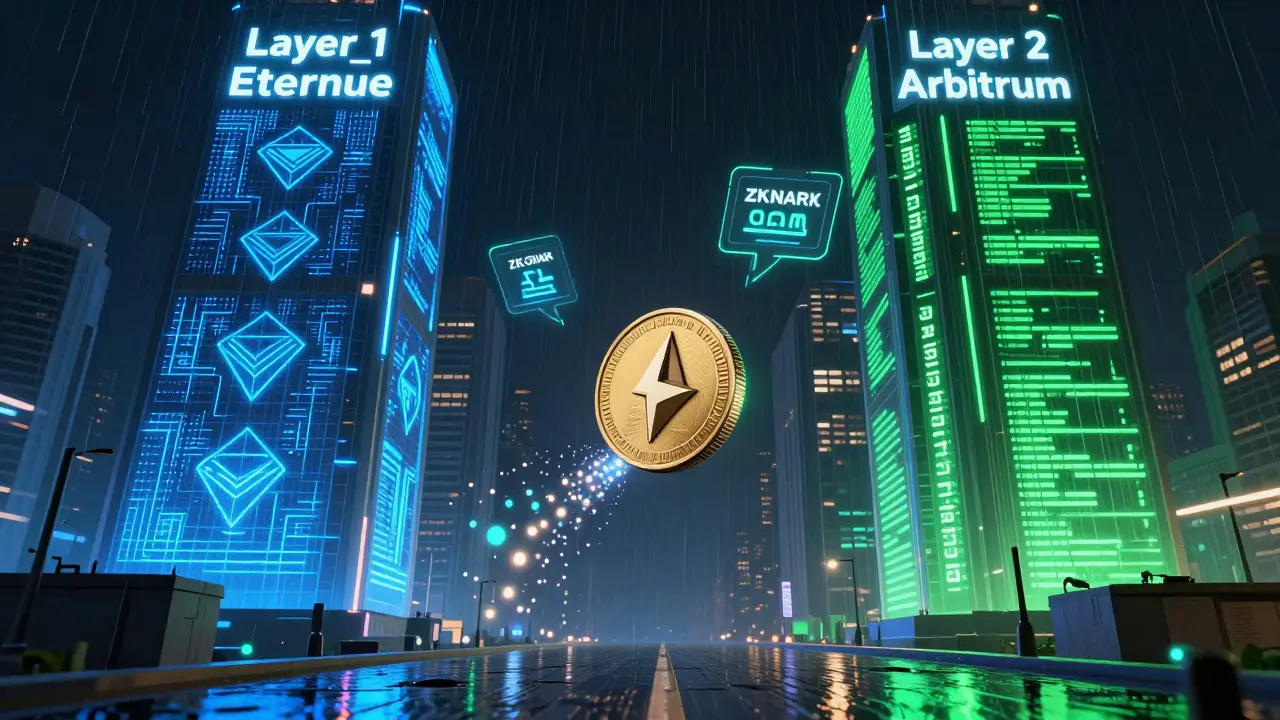
When you send ETH from your wallet to a DeFi app like Uniswap, you might not realize you're not actually using the Ethereum main chain anymore. That’s because most transactions today happen on a Layer 2 - a parallel system built on top of Ethereum’s original network, known as Layer 1. But how do these two layers talk to each other? That’s where the bridge comes in.
A blockchain bridge between Layer 1 and Layer 2 isn’t just a connector - it’s the glue that makes scaling possible. Without it, Layer 2 networks like Arbitrum or zkSync wouldn’t be able to inherit Ethereum’s security, process transactions cheaply, or let users move assets back and forth. This bridge is what turns Ethereum from a slow, expensive network into one that can handle thousands of transactions per second.
Why Layer 2 Exists at All
Ethereum’s Layer 1, the original blockchain, was never meant to be a global payment processor. It processes about 15 to 30 transactions per second (TPS). At peak times, gas fees spike to $15-$50. That’s fine for storing value or running a few smart contracts. But for everyday use - swapping tokens, minting NFTs, or playing a blockchain game - it’s unusable.
Layer 2 solutions were created to fix this. They take thousands of transactions off the main chain, bundle them up, and submit just one compressed proof back to Layer 1. This cuts fees by 99% and boosts speed dramatically. On Layer 2, gas fees average $0.01-$0.10. Transactions settle in seconds. The result? Over 1.2 billion transactions have been processed across Ethereum Layer 2s since 2021, according to Ethereum Foundation data.
But here’s the catch: if Layer 2 operated completely independently, it would be insecure. Hackers could fake transactions. Validators could disappear. That’s why every major Layer 2 solution - Optimism, Arbitrum, zkSync - connects directly back to Ethereum’s Layer 1 through a bridge. This bridge ensures that even though the work happens off-chain, the final truth still comes from Ethereum.
How the Bridge Actually Works
Think of the bridge as a two-way tunnel. On one side, you have Layer 2 doing the heavy lifting. On the other, Layer 1 acts as the ultimate judge. When you deposit ETH from your wallet into an L2 like Arbitrum, the bridge locks your ETH on Ethereum and mints an equivalent amount on the L2. When you want to withdraw, you send a request back through the bridge, and Layer 1 verifies it before releasing your funds.
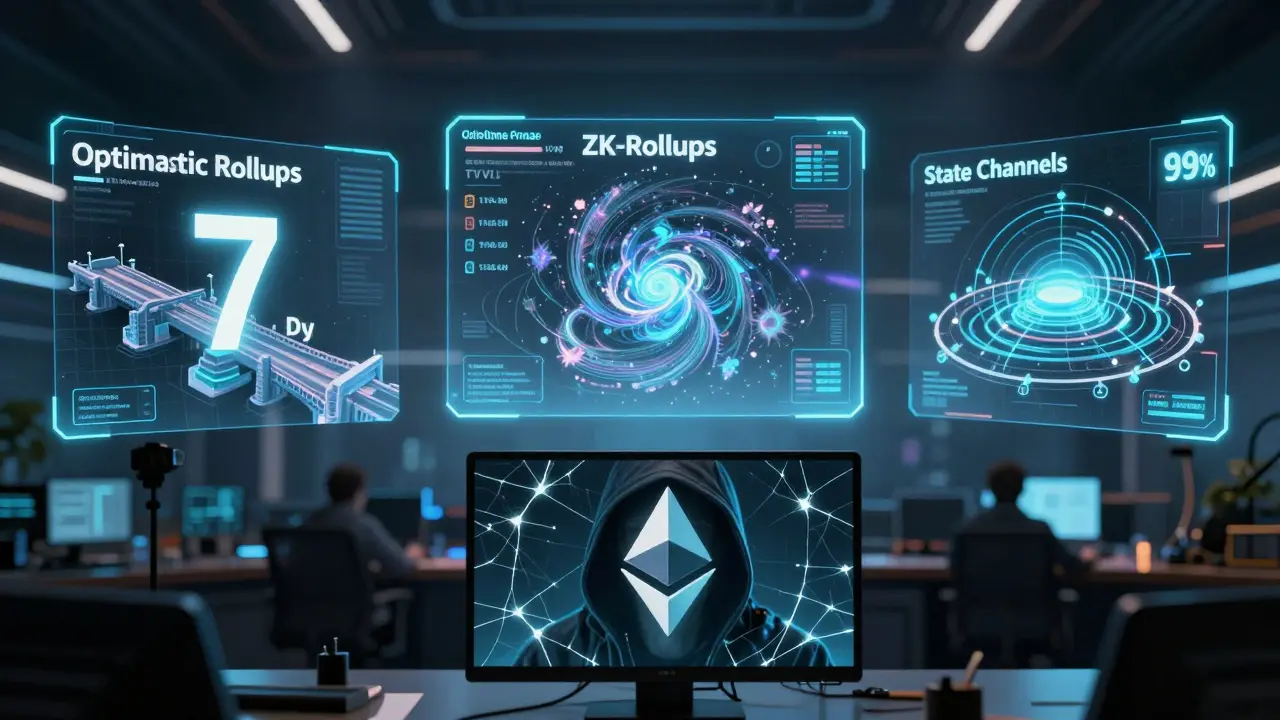
But not all bridges work the same way. There are three main designs:
- Optimistic Rollups (like Arbitrum and Optimism): These assume transactions are valid by default. If someone tries to cheat, anyone can submit a “fraud proof” during a 7-day challenge window. Back in 2021, this meant long waits. But with Arbitrum’s Nitro upgrade (September 2023), the challenge period dropped to as low as 4 hours. Still, if you’re in a hurry, it’s not instant.
- Zero-Knowledge Rollups (like zkSync and StarkNet): These use math - cryptographic proofs called zk-SNARKs - to prove every transaction is valid before it even hits Layer 1. No waiting. No disputes. Withdrawals take just 10-30 minutes. The trade-off? More complex code and higher computational costs. Each verification uses 300,000-500,000 gas on Ethereum.
- State Channels (like Connext): These let two or more users transact directly off-chain, only settling on Layer 1 when they’re done. They can handle up to 1 million TPS in closed tests. But they’re only useful for repeat users who trust each other - not for public DeFi apps.
Each method has trade-offs. Optimistic rollups are simpler for developers but require trust in the system’s honesty. Zk-rollups are cryptographically secure but harder to build. State channels are fast but limited in use.
Security: Why This Bridge Isn’t Like Other Cross-Chain Bridges
Not all bridges are created equal. Bridges that connect Ethereum to Solana or Polygon PoS - like Wormhole - operate as independent networks with their own validators. That’s risky. In 2022, Wormhole was hacked for $320 million because its validators weren’t backed by Ethereum’s security.
L1-L2 bridges are different. They don’t create new security models. They inherit Ethereum’s. Every proof, every withdrawal, every state update is verified by Ethereum’s consensus. Even if an L2’s operators go rogue, they can’t fake a transaction that Ethereum doesn’t accept. That’s why the total value locked (TVL) in Ethereum L2s hit $7.82 billion in October 2023 - users trust that their money is still anchored to Ethereum’s security.
Compare that to Polygon PoS, a sidechain with its own PoS validators. It’s faster than L2s, but it’s also less secure. In 2021, the Poly Network hack stole $600 million from a sidechain. That kind of thing can’t happen on an L1-L2 bridge. The bridge doesn’t have its own validators - it uses Ethereum’s.
Real-World Use and Adoption
The numbers don’t lie. As of October 2023:
- Arbitrum had $3.71 billion in TVL - the largest L2 by far.
- Optimism had $1.84 billion, powering major DeFi apps like Uniswap and Aave.
- zkSync had $623 million, popular for gaming and social apps thanks to faster withdrawals.
Institutional players are jumping in. JPMorgan uses Optimism for interbank settlements. Shopify integrated Polygon zkEVM for merchant payments. Even the European Union’s MiCA regulation, effective January 2024, treats L1-L2 bridges differently than cross-chain bridges - recognizing their inherited security as a key advantage.
But users aren’t all happy. On Reddit, 63% of 1,243 respondents in September 2023 said withdrawal delays were their biggest pain point. Waiting 7 days to move funds from Arbitrum to Ethereum feels like a step backward. Developers echo this - GitHub has over 247 open issues related to withdrawal timing on Optimism alone.
Meanwhile, DeFi power users love the savings. One user reported saving $1,850 in gas fees over three months while making over 1,200 trades on Uniswap via Optimism. For frequent traders, the delay is worth it.
What’s Next? The Future of Layer 2 Bridges
The next big changes are already on the horizon.
- Shorter withdrawal times: Arbitrum’s Stylus upgrade (Q1 2024) will cut challenge windows to 4 hours. Optimism is funding research to get below 24 hours.
- Ethereum’s Pectra upgrade: Scheduled for Q2 2024, it will increase the number of validators Ethereum can support, helping L2s process more data.
- Danksharding: Coming in 2024-2025, this will let Ethereum store more data from L2s at lower cost - a critical fix for data availability issues that could break bridges.
- Layer 3s: StarkWare’s CEO predicts we’ll soon see application-specific chains built on top of L2s - like a “Layer 3” for gaming or social media - all connected through L2 bridges. This could create a hierarchy: Layer 1 → Layer 2 → Layer 3.
Vitalik Buterin’s vision - outlined in his October 2023 blog post - is clear: by 2027, 99% of Ethereum activity will happen on Layer 2s. The bridge won’t just be a tool. It’ll be the default pathway.
What You Need to Know as a User
If you’re using DeFi, NFTs, or crypto apps today, you’re probably already on a Layer 2. Here’s how to navigate it:
- Always check which L2 you’re on. Wallets like MetaMask show this clearly.
- Withdrawals take time - plan ahead. Don’t expect instant access to funds on Layer 1.
- Use zk-rollups if speed matters. zkSync and StarkNet are better for gaming or trading where delays hurt.
- Stick with Optimism or Arbitrum if you’re doing high-volume DeFi. They have the most liquidity and app support.
- Never send tokens directly between chains. Always use the official bridge in your wallet. Sending ETH from Ethereum to Arbitrum via a third-party exchange can lose your funds.
And if you’re a developer? Learn Solidity. Understand Merkle trees. Test withdrawal flows. The bridge isn’t magic - it’s code. And bad code can break it.
Final Thoughts
The bridge between Layer 1 and Layer 2 isn’t just a technical feature. It’s the reason Ethereum has a future. It’s what lets the network scale without sacrificing security. It’s what turns Ethereum from a digital gold store into a global, usable platform.
Yes, there are delays. Yes, the tech is complex. Yes, some bridges still feel centralized. But the core idea - that security should never be traded for speed - is what makes this model work. And as the bridges get faster, cheaper, and smarter, they’ll become invisible. You won’t think about them. You’ll just use Ethereum - faster, cheaper, and without limits.
Dheeraj Singh
March 21, 2026 AT 11:15Also, 'zk-SNARKs'? More like zk-SNAKs. 😴
Mike Yobra
March 21, 2026 AT 12:33It’s like trading your bank for a credit union that’s owned by the same people who run the bank.
Also, ‘inherited security’? Sure. As long as you ignore the 17 documented front-running exploits on Optimism last year.
Mansoor ahamed
March 22, 2026 AT 02:26And zkSync withdrawals? 18 minutes. I’ve waited longer for my coffee.
Nicolette Lutzi
March 22, 2026 AT 06:02And you’re defending a system where a 19-year-old dev in Austin can change the withdrawal timer with a GitHub PR?
Wake up. This isn’t tech. It’s theology.
Alice Clancy
March 23, 2026 AT 18:45Shana Brown
March 25, 2026 AT 03:31And guess what? People are using Uber. 🚗💨
Marie Mapilar
March 27, 2026 AT 00:23Joshua T Berglan
March 27, 2026 AT 01:44Kevin Da silva
March 27, 2026 AT 07:31Kayla Thompson
March 28, 2026 AT 22:17Then what? Your 'secure bridge' turns into a dead end.
Also, I hate the word 'bridge'. It sounds like a tourist trap.
Brijendra Kumar
March 30, 2026 AT 07:58You think you’re saving gas? You’re just feeding the whales. And I know this because I used to work at a DeFi protocol. We manipulated the metrics. We’re all complicit.
Ananya Sharma
March 30, 2026 AT 08:19Florence Pardo
March 31, 2026 AT 13:54Alicia Speas
April 1, 2026 AT 10:34Tammy Stevens
April 2, 2026 AT 10:33Also, I just learned what a Merkle tree is. I feel smart now.
Justin Credible
April 2, 2026 AT 14:14Jeannie LaCroix
April 3, 2026 AT 06:26Domenic Dawson
April 3, 2026 AT 10:50