
Imagine you own Bitcoin, but you want to earn interest on it inside Ethereum’s DeFi ecosystem. You can’t just send BTC to a lending app like Aave - it doesn’t understand Bitcoin. So you wrap it. You lock your BTC in a vault, and in return, you get WBTC - a token on Ethereum that acts like Bitcoin but works with all the Ethereum apps. That’s wrapped tokens in a nutshell. But here’s the problem: wrapped tokens are a band-aid. They’re not the future. They’re the messy middle ground we’re stuck in right now.
How Wrapped Tokens Work - And Why They’re Necessary
Wrapped tokens exist because blockchains don’t talk to each other. Bitcoin runs on its own network. Ethereum runs on another. Solana, Avalanche, Polygon - each is its own island. But users don’t want to be stuck on one island. They want to move assets freely. That’s where wrapping comes in. The most common method is custodial wrapping. Take WBTC. BitGo, a trusted custodian, holds your real Bitcoin in a multi-signature wallet. When you request WBTC, they mint an equivalent amount on Ethereum. Every WBTC is backed 1:1 by Bitcoin. It’s simple, reliable, and trusted. Over 8.9 billion worth of WBTC is in circulation as of October 2024. That’s 71% of all wrapped Bitcoin. But there are other ways. Algorithmic wrapping, like WETH (Wrapped Ether), uses smart contracts instead of humans. ETH is automatically converted to WETH when you interact with ERC-20 apps. No middleman. Just code. Then there’s federated wrapping, where a group of validators (like Ren Protocol used to do) collectively sign off on transfers. These models vary in trust, speed, and cost. The result? Over $28.4 billion in wrapped tokens are locked across blockchains today. That’s up 187% in just one year. Wrapped tokens aren’t going away - yet. But they’re not the endgame.The Bridge Problem: Security, Speed, and Cost
To move wrapped tokens between chains, you need a bridge. And bridges are the weakest link in the whole system. In 2022 and 2023, hackers stole over $2.1 billion through bridge exploits. The Wormhole hack took $325 million. Ronin lost $625 million. These weren’t small glitches. They were systemic failures. Most bridges rely on centralized validators or multi-sig wallets. If a few keys are compromised, the whole system collapses. Speed is another headache. Transferring ETH from Ethereum to Polygon takes 7-8 minutes. But pulling it back? Seven days. That’s because Ethereum’s fraud-proof system requires a waiting period to catch malicious activity. Solana’s Wormhole transfers in 15 seconds - but only because it uses a different security model. And gas fees? Bridging from Ethereum mainnet costs $47 on average. On Polygon? $0.23. That’s not a feature - it’s a barrier. Developers hate bridges. A 2023 survey of 1,247 Ethereum developers found 78% had lost time debugging bridge integrations. On average, each integration took 16 hours of extra work. That’s 16 hours of lost productivity for every app trying to support cross-chain transfers. And users? Reddit’s r/defi community reports 34% have had failed bridge transactions. Twitter sentiment is overwhelmingly negative. People are tired of losing money and waiting days for their funds.What’s Coming Next? The End of Wrapping
The future isn’t better wrapped tokens. It’s no wrapped tokens at all. Ethereum’s EIP-6963, approved in July 2024, is a game-changer. It introduces native cross-chain messaging. Instead of wrapping ETH to move it to Arbitrum, you’ll be able to send ETH directly - no wrapping, no bridge, no custody risk. The Ethereum Foundation estimates this could reduce reliance on wrapped tokens by 40-60% within two years. Zero-knowledge proofs are another big leap. zkSync Era and Polygon zkEVM now let users prove ownership of assets across chains without trusting anyone. You don’t need to lock your BTC. You just prove you have it. That’s trustless interoperability. Polygon has committed $1 billion to ZK tech through 2026. Other chains are following. Then there’s intent-based architecture. Think of it like Uber for cross-chain swaps. You say: “I want to swap 1 BTC for 30 ETH on Solana.” The system finds the cheapest, fastest, safest path - no matter how many chains are involved. UniswapX and 1inch Fusion already processed $2.1 billion in swaps this way in September 2024. No user ever sees a bridge. No wallet needs to connect to multiple chains. It just works. Even Cosmos and Polkadot are moving toward native interoperability. Cosmos uses IBC - a protocol that lets 179 chains talk directly. Polkadot’s XCM lets 48 parachains share security and messages without wrapping. These aren’t bridges. They’re highways.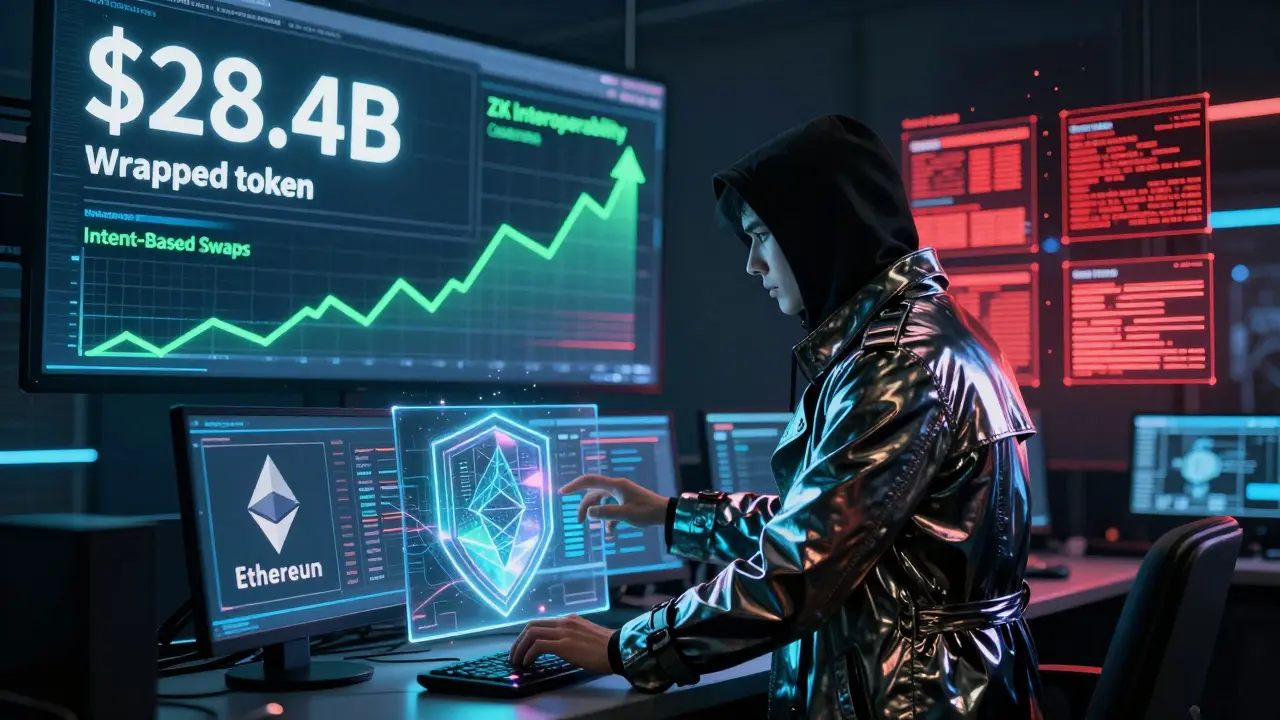
Who’s Winning? Ethereum, Solana, and the Rise of Layer 2s
Ethereum still dominates wrapped token usage. 89% of all wrapped token transactions happen on Ethereum-based protocols. That’s because DeFi started there. But the landscape is shifting. Layer 2s like Arbitrum, Optimism, and zkSync are exploding. There are now 67 active Ethereum Layer 2s. Each one needs its own bridge. That’s a nightmare for developers. That’s why Optimism’s Superchain vision is so important. It’s building one unified network of 15+ OP Stack chains that communicate natively. No wrapping needed. Solana’s approach is different. It’s not trying to wrap Bitcoin. It’s building fast, cheap, native bridges to other chains. Wormhole connects 23 blockchains. It’s not perfect - it’s been hacked - but it’s fast. And speed matters when you’re trading. Enterprise adoption is accelerating too. JPMorgan’s Onyx platform uses wrapped tokens to settle $300 billion in daily transactions. They’re not doing it because they love wrapping. They’re doing it because it’s the only way to move real-world assets on-chain right now. But they’re watching ZK tech closely. When native interoperability arrives, they’ll switch.Regulation Is Coming - And It Will Force Change
The EU’s MiCA regulation, effective since January 2024, requires wrapped token issuers to prove 1:1 backing every month. That means custodians like BitGo must publish audits. No more hiding. In the U.S., the Treasury Department is moving to classify wrapped tokens as securities if they’re too centralized. That could affect 73% of current wrapped token projects. If WBTC is deemed a security, it could be forced to restructure - or disappear from U.S. markets. This isn’t about stifling innovation. It’s about accountability. Right now, wrapped tokens operate in a gray zone. Regulators don’t know who’s responsible if things go wrong. That’s changing. And when regulators demand transparency, the custodial models will struggle. The trustless ones - ZK-based, intent-driven - will thrive.
What This Means for You
If you’re a user: stop thinking about wrapping as normal. It’s a temporary fix. Start learning about ZK bridges and native interoperability. Use apps that let you swap across chains without selecting a bridge manually. Look for platforms that say “intent-based” or “trustless.” If you’re a developer: stop building on top of old bridge protocols. Focus on integrating with EIP-6963, IBC, or ZK-based systems. Learn Solidity for cross-chain contracts. Study Polygon’s zkEVM or Starknet’s architecture. The next wave of DeFi won’t need bridges - it will bypass them. If you’re an investor: don’t bet on wrapped token projects that rely on centralized custody. Bet on the infrastructure underneath - ZK proof systems, Layer 2 ecosystems, and interoperability protocols like Axelar or Chainlink CCIP. Those are the real winners.The Bottom Line
Wrapped tokens got us from zero to $28 billion in DeFi activity. They made cross-chain trading possible. But they’re not sustainable. They’re slow, expensive, risky, and centralized. The future belongs to protocols that don’t need wrapping at all. By 2027, most wrapped tokens will be relics. Bitcoin will move directly to Ethereum via ZK proofs. ETH will flow freely between Layer 2s without being wrapped. Users won’t even know what a bridge is - they’ll just send assets and get them back, fast and safe. The end of wrapped tokens isn’t the end of interoperability. It’s the beginning of real, seamless blockchain connectivity. And that’s what we’ve been waiting for.What are wrapped tokens?
Wrapped tokens are digital assets from one blockchain that have been tokenized to work on another blockchain. For example, Bitcoin (BTC) is locked in a custodial wallet, and an equivalent amount of WBTC is minted on Ethereum. WBTC behaves like BTC but can be used in Ethereum-based DeFi apps. Every wrapped token is supposed to be backed 1:1 by the original asset.
Why are wrapped tokens considered insecure?
Most wrapped tokens rely on centralized custodians or validator networks to hold the original assets. If those entities are hacked or act maliciously, users lose their funds. Major hacks like Wormhole ($325M) and Ronin ($625M) exposed these flaws. Over 67% of current bridge protocols have known security vulnerabilities, according to MIT’s Digital Currency Initiative.
Will wrapped tokens disappear completely?
Not immediately, but their dominance will shrink. Native interoperability through zero-knowledge proofs, EIP-6963, and intent-based systems will make wrapping unnecessary. Experts like Vitalik Buterin and Anatoly Yakovenko predict most wrapped tokens will be obsolete by 2027. Institutional users will follow suit once regulatory and technical standards mature.
What’s the difference between a bridge and a wrapped token?
A wrapped token is the asset itself - like WBTC - that exists on a foreign chain. A bridge is the mechanism that moves assets between chains to create those wrapped tokens. For example, you use a bridge to lock BTC and mint WBTC. Bridges handle the transfer; wrapped tokens are the result.
What’s replacing wrapped tokens?
Zero-knowledge proofs (ZKPs), native cross-chain messaging (like Ethereum’s EIP-6963), and intent-based protocols (like UniswapX) are replacing wrapped tokens. These allow assets to move across chains without being locked, wrapped, or trusted to a third party. Users send ETH from Ethereum to Solana, and it arrives as native ETH - no wrapping needed.
How do regulations affect wrapped tokens?
Regulations like the EU’s MiCA require wrapped token issuers to prove 1:1 backing monthly. In the U.S., the Treasury may classify centralized wrapped tokens as securities. This forces custodians to audit more often and increases compliance costs. Projects that rely on centralized control will struggle - trustless, decentralized alternatives will gain favor.
What should I use instead of WBTC today?
If you need Bitcoin on Ethereum, WBTC is still the most trusted option. But if you’re looking ahead, explore ZK-based bridges like zkSync’s BTC bridge or native interoperability tools like LayerZero. For long-term use, consider Bitcoin Layer 2s like Lightning Network or Stacks, which let you use BTC without wrapping it at all.
Jack and Christine Smith
December 31, 2025 AT 06:45also who still trusts bitgo? lol.
Jackson Storm
December 31, 2025 AT 21:13also, eip-6963 is gonna be huge. devs are already building on it. you guys just need to start using the new tools.
Michelle Slayden
January 2, 2026 AT 11:52christopher charles
January 3, 2026 AT 02:56zksync’s btc bridge? yes please. i’m already using it. no more waiting 7 days. no more ‘transaction failed’ errors. just… works. thank you, devs.
Vernon Hughes
January 4, 2026 AT 10:49Alison Hall
January 5, 2026 AT 04:39Amy Garrett
January 6, 2026 AT 09:49Haritha Kusal
January 6, 2026 AT 11:31Mike Reynolds
January 8, 2026 AT 08:53dayna prest
January 9, 2026 AT 13:09Brooklyn Servin
January 9, 2026 AT 15:05also, MiCA is a win. centralized custodians are gonna crumble. ZK is the only way forward. I’m dumping all my WBTC. 💸🔥
Phil McGinnis
January 10, 2026 AT 01:09Ian Koerich Maciel
January 10, 2026 AT 10:04For so long, every cross-chain move felt like gambling. Now? It feels like… progress. Like the internet finally got a real protocol.
Thank you to everyone building ZK and intent-based systems. You’re quietly changing the world.
Andy Reynolds
January 11, 2026 AT 06:40to newbies: start with zkSync or Arbitrum. don’t touch WBTC unless you have to. you’ll thank me later.
Daniel Verreault
January 12, 2026 AT 20:23also, eip-6963 is the future. period. no more bridge contracts. just native asset routing. it’s beautiful.
Gavin Hill
January 14, 2026 AT 06:55SUMIT RAI
January 15, 2026 AT 22:52