
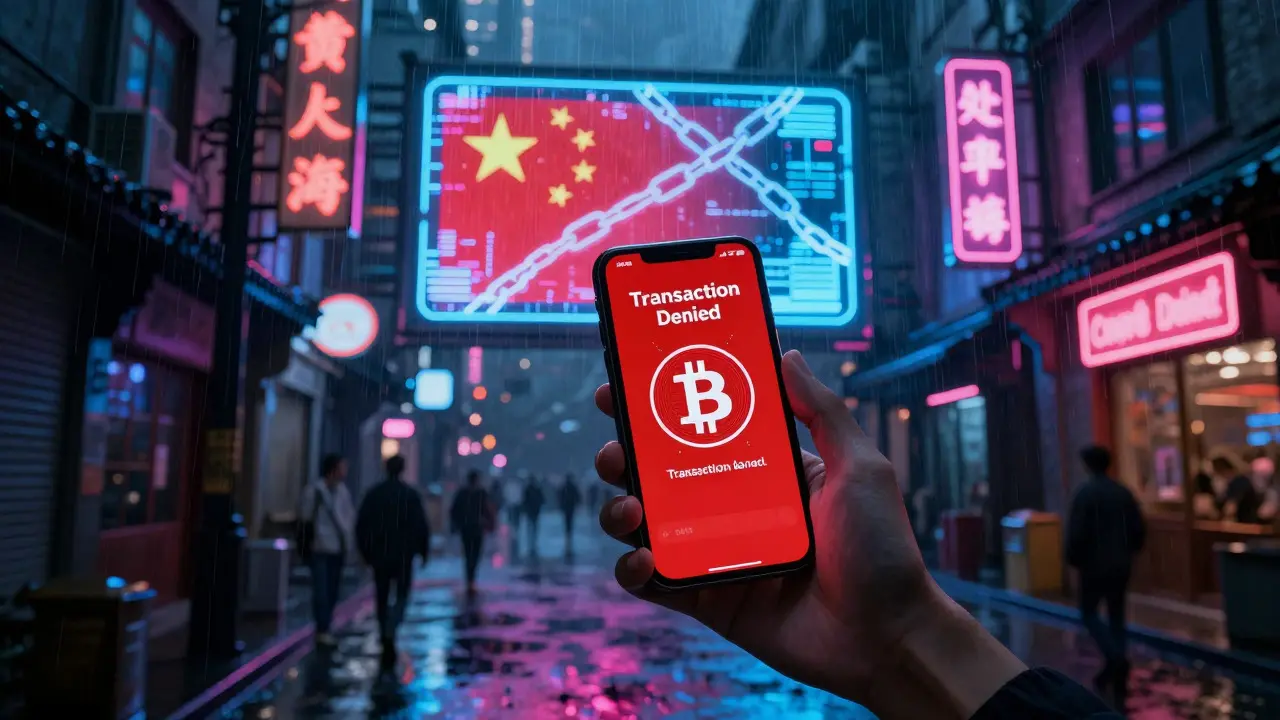
Imagine trying to buy a coffee with Bitcoin in Shanghai. You’d likely walk out of the shop empty-handed, and maybe even face legal trouble. If you are wondering are crypto payments allowed in China, the short answer is a hard no. As of mid-2026, mainland China maintains one of the strictest bans on cryptocurrency transactions in the world. But the story isn’t just about prohibition; it’s about control, innovation, and a very specific type of digital money that Beijing wants you to use instead.
The Complete Ban: What Actually Happened in 2025?
To understand where things stand today, we have to look at the massive regulatory shift that occurred recently. For years, China had a series of restrictions-banning banks from handling Bitcoin in 2013, shutting down exchanges in 2017, and cracking down on mining in 2021. But the game-changer came on May 30, 2025. The People's Bank of China (PBOC) issued a comprehensive decree that took effect on June 1, 2025.
This wasn't just a warning shot. It was a total shutdown. The ban explicitly covers trading, mining, and even individual ownership of cryptocurrencies like Bitcoin, Ethereum, or stablecoins. Before this, holding crypto was technically illegal but rarely prosecuted for small amounts. Now, owning these assets can trigger legal penalties. The government has moved from "watching" to "enforcing," with asset seizures and criminal charges for those involved in illegal fundraising or moving capital abroad using crypto.
If you are a business owner looking to accept crypto payments from customers in Beijing or Guangzhou, you’re out of luck. Legitimate crypto payment gateways simply cannot operate for domestic transactions here. The market for international providers like Coinbase Commerce or BitPay is effectively zero within mainland borders.
Why Is China So Strict?
You might ask, why go so far? Why ban something that other countries like Singapore or Hong Kong are embracing? It comes down to two main goals: financial stability and capital control.
China has a closed capital account. This means the government carefully controls how much money flows in and out of the country. Cryptocurrencies are the ultimate loophole for bypassing these controls. If people can easily convert Renminbi (RMB) into Bitcoin and send it overseas, the state loses its grip on monetary policy. By banning private crypto, the PBOC ensures that all financial activity remains visible and manageable.
There is also the fear of fraud. China has seen numerous cases of Ponzi schemes and fake ICOs (Initial Coin Offerings) that wiped out savings for ordinary citizens. By labeling all crypto activities as high-risk or illegal, the government shifts the blame away from itself if investors lose money. It’s a protective measure, albeit an extreme one.
The Exception: Blockchain Without the Coin
Here is where it gets interesting. While they hate the *coin*, China loves the *chain*. The government distinguishes between decentralized cryptocurrencies (which they view as speculative bubbles) and blockchain technology (which they see as useful infrastructure).
Companies in China are still encouraged to use blockchain for supply chain tracking, data security, and smart contracts. However, these systems must be permissioned-meaning only approved entities can join-and they usually don’t involve a native token that trades on open markets. Think of it as using the engine of a car without allowing anyone to sell tickets to ride in it.
This nuance is crucial for developers and enterprises. You can build a blockchain-based logistics platform in Shenzhen, but if your app lets users hold or trade tokens, you’re walking into a minefield. The Cyberspace Administration of China (CAC) keeps a close eye on data privacy and requires companies handling large amounts of personal data to report specific protection officers. If your blockchain project touches user data, you need to be compliant with these strict local laws.
| Jurisdiction | Domestic Crypto Trading | Mining Status | Cross-Border Use | Regulatory Body |
|---|---|---|---|---|
| Mainland China | Banned (since 2025) | Banned | Limited (State-approved sandboxes only) | PBOC, CAC |
| Singapore | Licensed & Regulated | Allowed | Fully Open | MAS |
| Hong Kong | Licensed Exchanges | Allowed | Liberalized | SFC |

The Real Alternative: Enter the e-CNY
If you can’t use Bitcoin, what do you use? The answer is the e-CNY, also known as the Digital Yuan. This is China’s Central Bank Digital Currency (CBDC), and it is the centerpiece of their digital finance strategy.
Unlike Bitcoin, which is decentralized and anonymous, the e-CNY is centralized and fully traceable. It is issued directly by the PBOC. When you spend e-CNY, the government knows exactly who sent it, who received it, and when. This aligns perfectly with their goal of maintaining control.
The e-CNY is currently in advanced pilot stages across multiple cities. It works through digital wallets on smartphones, allowing for instant transfers, offline payments (even without internet!), and integration with existing apps like WeChat Pay and Alipay. For the average Chinese citizen, the experience is smoother than traditional banking, but without the volatility of crypto.
For businesses, accepting e-CNY is not just allowed; it’s encouraged. Many merchants now prioritize e-CNY QR codes because transaction fees are lower than credit card processors, and settlements are instantaneous. If you are setting up a business in China, integrating e-CNY is a must-have, while integrating Bitcoin is a liability.
Cross-Border Loopholes: mBridge and Sandboxes
Is there any way to use blockchain for international payments involving China? Yes, but only through back doors. The most notable example is the mBridge project. This is a multi-CBDC pilot involving China, Hong Kong, Thailand, and the UAE. It allows for real-time settlement of cross-border transactions using blockchain technology.
mBridge has processed millions of dollars in trial settlements. It shows that China is willing to embrace blockchain for international trade efficiency, provided it doesn’t threaten domestic monetary sovereignty. These operations happen in "regulatory sandboxes"-controlled environments where rules are slightly relaxed for testing purposes.
If you are a multinational corporation looking to settle payments with Chinese partners using blockchain, you might explore these channels. But for the average person or small business? Forget it. These systems are designed for banks and large institutions, not for buying sneakers online.

What About Offshore Platforms and OTC Markets?
You might hear rumors that people in China still trade crypto. They do, but it’s risky. Over-the-counter (OTC) trading exists in gray areas. People meet privately or use offshore platforms accessible via VPNs. However, since the 2025 ban, enforcement has tightened significantly.
Banks in China now monitor accounts closely. If your bank account receives funds from a known crypto exchange or suspicious peer-to-peer transfer, your account could be frozen. In 2024 and 2025, there were numerous reports of arrests linked to unlicensed crypto activity. The risk/reward ratio for individuals has shifted dramatically. It’s no longer just a fine; it’s potential criminal record territory.
So, while the black market thrives, it’s shrinking under pressure. Most serious traders have moved their operations to jurisdictions like Dubai or Singapore, leaving behind a fragmented and dangerous landscape for those remaining in mainland China.
Future Outlook: Will the Ban Lift?
Looking ahead to late 2026 and beyond, experts suggest the domestic ban will remain absolute. The focus is firmly on e-CNY adoption. However, there are whispers of change regarding stablecoins and cross-border applications. Meetings held in Shanghai in July 2025 discussed strategic responses to global digital currency trends. Some analysts believe that if international competitors gain too much ground, China might soften its stance on specific types of regulated stablecoins for trade purposes.
But don’t bet on it anytime soon. The current administration prioritizes stability over innovation in this sector. Until the e-CNY becomes a dominant global reserve currency, China will likely keep its gates closed to private crypto competitors.
Can I legally own Bitcoin in China in 2026?
Technically, no. Since the May 2025 decree by the PBOC, individual ownership of cryptocurrencies carries legal risks, including potential asset seizure and criminal penalties. While enforcement varies, the official stance is a complete prohibition.
Is the e-CNY the same as Bitcoin?
No, they are opposites. Bitcoin is decentralized, anonymous, and volatile. The e-CNY (Digital Yuan) is centralized, fully traceable by the government, and pegged 1:1 to the Renminbi. The e-CNY is the state-approved alternative to private crypto.
Can businesses accept crypto payments in China?
No. Domestic businesses accepting crypto payments violate the 2025 ban. They should instead integrate e-CNY payment solutions, which are encouraged by the government and offer lower fees and instant settlement.
Are there any exceptions for blockchain technology?
Yes. China encourages the use of blockchain technology for enterprise applications like supply chain management and data security, provided it does not involve public trading of tokens or decentralized finance (DeFi). These projects often operate in state-approved sandboxes.
How does China's crypto ban compare to Singapore?
Singapore is highly permissive, regulating crypto through licenses issued by the Monetary Authority of Singapore (MAS). China is prohibitive, banning all retail and institutional crypto activities to maintain capital controls and promote the e-CNY.
What happens if my bank account is linked to crypto trading?
Your bank account may be frozen or restricted. Chinese banks actively monitor for transactions linked to crypto exchanges or suspicious OTC transfers. Repeated violations can lead to being blacklisted from the formal banking system.