

Imagine a crowded café with a large public tip jar. Dozens of people drop in identical $20 bills throughout the day. Later, each person reaches in and takes out a $20 bill. You get your money back, but it is almost certainly not the same piece of paper you put in. To anyone watching from the outside, it is impossible to tell which specific bill belongs to whom. This is exactly how cryptocurrency mixing services is a specialized tool designed to break the traceable path of blockchain transactions by pooling funds from multiple users and redistributing them to different addresses works. While this sounds like a great way to protect your financial privacy, it has become a primary weapon for state-sponsored actors, most notably those operating out of North Korea, to fund their regimes and bypass global sanctions.
The Mechanics of Digital Obfuscation
To understand why these services are so attractive to bad actors, you have to understand the nature of a blockchain. Most blockchains, like Bitcoin, are public ledgers. If you send coins to a friend, anyone with a block explorer can see that Address A sent funds to Address B. For a government trying to hide the origin of stolen funds, this transparency is a nightmare.
This is where Tumblers come in. These are another name for mixers. The process usually follows a specific sequence. First, users send their cryptocurrency to the mixer. The service collects these funds into a massive pool. Next, the mixer uses shuffling techniques to mix the coins from various users. Finally, the service sends the equivalent amount (minus a fee, usually between 1% and 3%) to new, predetermined addresses. By the time the money reaches its destination, the link between the original source and the final recipient is severed.
Centralized vs. Decentralized Mixers
Not all mixing services operate the same way. Depending on who is using them-a privacy-conscious individual or a state-level hacking group-they might choose between two very different architectures.
Centralized mixers are the older, more common variety. You trust a third-party company to handle the shuffle. The downside is that you are giving your keys or coins to a stranger. These services are honeypots for hackers and frequent targets for law enforcement. Because they are custodial, agencies like the Department of Justice can seize their servers and uncover logs that reveal exactly who used the service.
Decentralized mixers, on the other hand, use Smart Contracts to automate the process. There is no single company in charge. Instead, they often rely on Zero-Knowledge Proofs, a cryptographic method that allows one party to prove something is true without revealing the actual data. For a regime like North Korea, these are far more attractive because there is no central office to raid and no single point of failure.
| Feature | Centralized Mixers | Decentralized Mixers |
|---|---|---|
| Control | Managed by a company/operator | Automated via code/contracts |
| Trust Level | High trust required (Custodial) | Trustless (Non-custodial) |
| Privacy Risk | Operator may keep secret logs | Cryptographically shielded |
| Regulatory Target | Easy to shut down (Server seizure) | Hard to stop (Distributed network) |

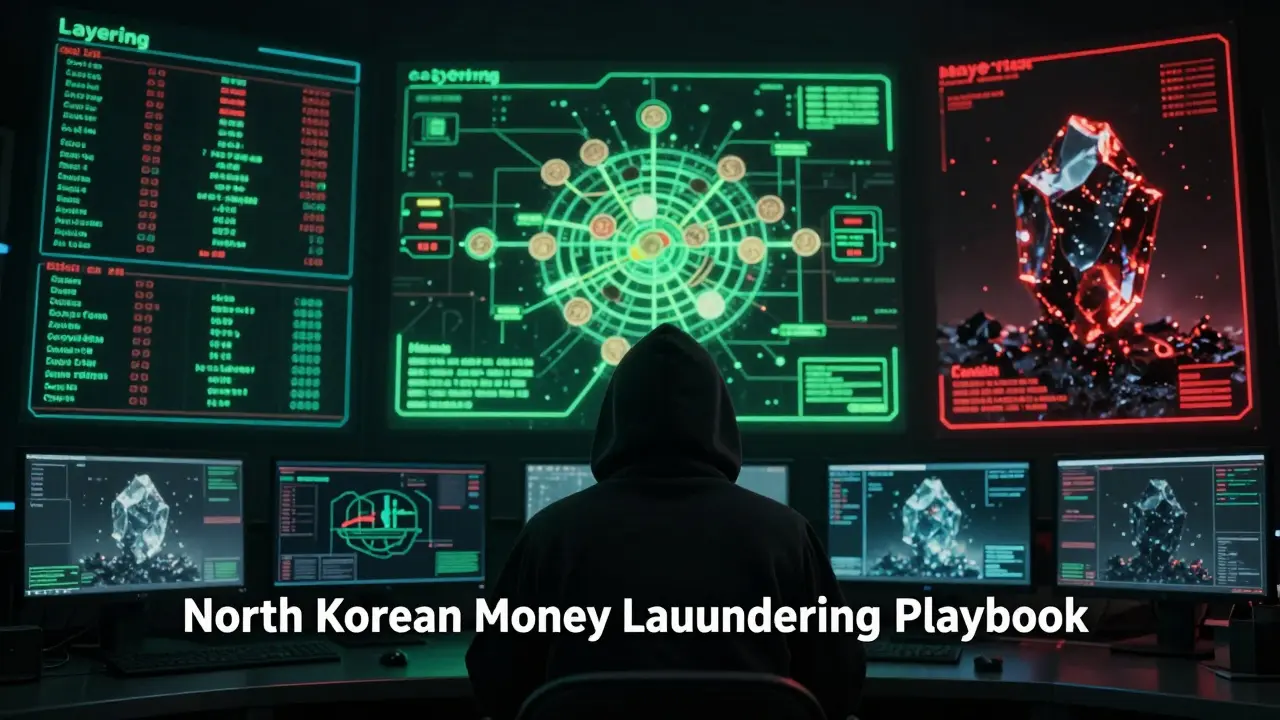
The North Korean Money Laundering Playbook
North Korea has a unique relationship with cryptocurrency. Due to heavy international sanctions, they cannot easily access the global banking system. To fund their weapons programs and government operations, they have turned to highly organized cyber-thefts. They don't just steal a few coins; they target massive exchanges and DeFi protocols.
Once the theft occurs, the funds are "hot," meaning every exchange in the world knows those specific coins are stolen. If they tried to sell them for cash immediately, the accounts would be frozen. This is where the mixing cycle begins. North Korean actors typically use a multi-stage laundering process:
- Layering: They move funds through a series of smaller wallets to create a complex web of transactions.
- Mixing: They push the funds through a mixer-often a combination of decentralized protocols and centralized tumblers-to wipe the history.
- Chain Hopping: They convert the cleaned Bitcoin into other assets, like Monero, which is designed for privacy from the ground up, before converting them back to a usable currency.
- Cashing Out: The final "clean" funds are moved to exchanges with weak AML Compliance (Anti-Money Laundering) rules, often in regions with lax regulation, where they are converted into fiat currency.
Why Traditional Law Enforcement Struggles
Catching a state-sponsored actor is much harder than catching a lone hacker. North Korea uses a strategy of "distributed liability." They employ hackers who may be living in other countries, using VPNs and encrypted communication, making it nearly impossible to pin the activity on a specific person in Pyongyang. Furthermore, the rise of CoinJoin protocols allows users to coordinate their own mixing without a central service, meaning there is no "company" for the government to sue or shut down.
We've seen the U.S. government try to fight back by indicting operators of services like Blender.io and Sinbad.io. However, these legal battles are often a game of whack-a-mole. When one mixer is shut down, three more appear in different jurisdictions, often using more advanced decentralized tech that makes the previous versions look primitive.
The Risk for Regular Users
You might think, "I'm not a North Korean agent, so why should I care?" The reality is that the use of these services by criminals brings heat to everyone. As regulators clamp down on mixers to stop money laundering, they often implement stricter rules for all crypto users. This includes more aggressive "Know Your Customer" (KYC) requirements and the potential for your funds to be frozen if they were ever linked to a mixer, even if you used it for legitimate privacy reasons.
Moreover, if you use a centralized mixer, you are taking a massive gamble. Many of these sites are simply exit scams. You send your coins, the "mixer" claims there is a technical error, and the operator disappears with your money. In the world of crypto, if a service promises total anonymity and high returns, it's usually a trap.
Are cryptocurrency mixers illegal?
Mixing services themselves occupy a legal gray area, but using them to hide the proceeds of a crime is illegal. In many jurisdictions, operating a mixer without registering as a Money Services Business (MSB) is a crime, which is why many centralized mixers are targeted by law enforcement.
Can law enforcement actually track mixed coins?
Yes, but it is much harder. Advanced blockchain analysis tools can sometimes use pattern recognition or "heuristic analysis" to guess where funds went. If a user makes a mistake-like sending a mixed amount to a wallet linked to their real identity-the entire chain can be unraveled.
How does North Korea benefit from these services?
North Korea uses mixers to convert stolen cryptocurrency into usable funds. By breaking the link between a high-profile hack and the final wallet, they can move millions of dollars into their treasury without triggering international alerts or sanctions.
What is the difference between a mixer and a privacy coin?
A mixer is a service that cleans existing coins on a public ledger. A privacy coin, like Monero, is a type of cryptocurrency where the privacy features are built into the protocol itself, meaning the sender and receiver are hidden by default without needing an external service.
What happens if I use a mixer and then send funds to a major exchange?
Many major exchanges use AML software that flags funds coming from known mixing services. Your account could be flagged for review, or your funds could be frozen until you provide a detailed explanation and proof of the source of the wealth.
What to do next
If you are concerned about your privacy but want to stay on the right side of the law, avoid custodial mixers. Instead, look into non-custodial tools or wallets that integrate privacy features natively. If you suspect you've encountered a scam service, report it to your local financial crimes authority immediately. For those in the industry, staying updated on the latest Financial Action Task Force (FATF) guidelines is the best way to ensure your business remains compliant while navigating the volatile world of digital assets.
Greg Reynolds
April 25, 2026 AT 11:47Actually, the distinction between centralized and decentralized mixers is slightly oversimplified here. Most people ignore the fact that even "decentralized" protocols often have admin keys or governance mechanisms that can be coerced by state actors, meaning the "trustless" nature is often a marketing myth.
Benjamin Forg
April 27, 2026 AT 06:17it all just proves the government wants us on a digital leash and these mixers are the only way to keep the panopticon from seeing every single cent you spend they probably run the mixers anyway just to trap people into a database
Eric Raines
April 27, 2026 AT 20:34I've already explained this in a dozen other threads, but you guys just don't get it. The real issue isn't the mixer, it's the lack of basic understanding of cryptographic primitives. It's honestly exhausting having to explain the basics of ZK-proofs to people who think a blockchain is just a magic internet ledger.
Paige Raulerson
April 27, 2026 AT 20:55This is such a basic overview. I mean, it's fine for someone who just discovered what a wallet is, but for anyone with actual intellectual curiosity, it barely scratches the surface of how sophisticated the North Korean Lazarus group actually is.
Jason M
April 28, 2026 AT 04:49Wow, the scale of this is absolutely terrifying! Imagine the sheer amount of coordination required for a state to run these operations. It's a wake-up call for every single person in the DeFi space to double-check their security protocols right now!
jill huyo-a
April 29, 2026 AT 02:37It would be interesting to see if there are ways to implement a hybrid system that protects individual privacy without providing a total cloak for state-sponsored crime.
Kyle Bush
April 30, 2026 AT 03:21USA needs to just shut down every single bridge that lets these thieves move money! 🇺🇸🇺🇸 Get rid of the mixers and lock them all up! 👊💥 Why are we letting this happen on our watch?! 😡
Gloris Young
May 1, 2026 AT 00:32Privacy is a human right.
Yvette P
May 1, 2026 AT 22:47Oh sure, because the FATF guidelines are totally known for being agile and cutting-edge in the face of rapid technological evolution. In reality, by the time a regulatory body even defines what a "mixing service" is in a legal document, the developers have already migrated to a new layer-2 solution with stealth addresses and atomic swaps that make the old tumblers look like a child's piggy bank. It's just adorable that people think a few indictments are going to stop a regime that treats hacking as a national industry. The latency between a protocol's deployment and its subsequent regulation is a feature, not a bug, for the actors involved here, and anyone pretending otherwise is just pretending they aren't drowning in a sea of obsolete compliance frameworks.
Matthew Morse
May 3, 2026 AT 19:29honestly just use monero and stop worrying about it
Jennifer L
May 4, 2026 AT 07:27It is truly heartbreaking that such technology is being used for such laurdered purposes!! We must strive for a world where digital tools promote peace and not weaponization of finances... it is just so sad to see the potential of blockchain be twisted this way 😭
praveen subbiah
May 4, 2026 AT 13:43India is also becoming a huge hub for tech development and we will definitely implement better systems to stop this kind of global crime! We are proud to contribute to a cleaner internet! 🇮🇳
Candace Sherrard
May 5, 2026 AT 17:44There is a certain poetic irony in the fact that the very transparency which was promised as the death knell of financial corruption has instead birthed a new, more opaque layer of obfuscation that allows the most secretive regimes on earth to flourish. It makes one wonder if the pursuit of a "trustless" system was ever actually about trust, or if it was simply about moving the goalposts of control to a place where the average person cannot see the game being played, while the elites and the state actors simply find a new way to hide in plain sight within the noise of a million meaningless transactions.
Ellie Drews
May 6, 2026 AT 19:49Just be careful everyone, definitely do your own research before trying any privacy tools so you don't accidentally flag your account!
Liz Ariza
May 6, 2026 AT 22:35Stay safe out there! 🌈 Using a legit non-custodial wallet is a total game changer for keeping your digital footprint sparkly and clean! ✨
Tara Aman
May 8, 2026 AT 07:58I totally agree that staying updated on the guidelines is the way to go! Let's all help each other stay compliant!
Mary Tawfall
May 10, 2026 AT 02:13It is great to see a detailed explanation like this. It really helps people avoid the traps that these scam mixers set up.
debashish sahu
May 10, 2026 AT 09:15The mention of chain hopping is quite accurate as it creates a significant barrier for analysts trying to trace the flow of funds across different blockchains.
Sara Ellis
May 10, 2026 AT 11:34just a way to hide money lol