

For many Iranians, cryptocurrency isn’t just a speculative asset-it’s a lifeline. With inflation eating away at the rial, banking access blocked by sanctions, and foreign currency out of reach, digital assets have become one of the few ways to protect savings and trade internationally. But as the government tightens control, centralized exchanges like Nobitex are no longer safe. That’s pushed users toward decentralized exchanges (DEXs)-but getting there isn’t simple.
Why Centralized Exchanges Are No Longer an Option
Nobitex used to be the go-to platform for over 11 million Iranians. It was fast, local, and easy to use. But after a $90 million hack in June 2025 and a massive Tether freeze in July 2025 that locked up 42 Iranian-linked wallets, trust collapsed. Many of those frozen wallets were tied to Nobitex and IRGC-linked addresses. Suddenly, users realized: if your money is on a centralized exchange, the government or U.S. sanctions can take it anytime. The Central Bank of Iran (CBI) now demands full access to every transaction, wallet, and user record. Anyone using crypto in Iran must get a license. That’s not just a formality-it’s surveillance. Your trading history, IP address, and even your device ID can be tracked. If you’re using Nobitex or any other licensed exchange, you’re not anonymous. You’re on a government ledger.What Are Decentralized Exchanges (DEXs) and Why They Matter
A decentralized exchange (DEX) doesn’t hold your money. It doesn’t ask for ID. It doesn’t report to the government. Instead, it runs on smart contracts-code that automatically executes trades when conditions are met. You connect your wallet, swap tokens directly with other users, and keep full control. No middleman. No freeze risk. For Iranians, this is the only way to avoid being caught in the crosshairs of sanctions or state control. DEXs like Uniswap, SushiSwap, and PancakeSwap exist on public blockchains. No one owns them. No one can shut them down. But you still need to get there.How Iranians Are Accessing DEXs Right Now
The biggest barrier isn’t technology-it’s access. Most DEXs are blocked inside Iran’s national internet firewall. So users rely on VPNs. Not just any VPN-reliable, fast ones with obfuscation features to dodge deep packet inspection. Many users report success with NordVPN, ExpressVPN, and Mullvad. Once connected, they use wallets like MetaMask or Trust Wallet. These wallets don’t need approval. You create them offline. You control the keys. No one else has access. But here’s the real trick: DAI on Polygon. After the Tether freezes, Iranian crypto communities shifted en masse from USDT to DAI-the decentralized stablecoin backed by collateral on Ethereum. And they didn’t use Ethereum’s slow, expensive network. They moved to Polygon, a faster, cheaper sidechain. DAI on Polygon costs pennies to swap and settles in seconds. It’s become the unofficial currency of Iranian crypto users. You can swap ETH or MATIC for DAI on QuickSwap (Polygon’s top DEX) or SushiSwap. From there, you can trade DAI for Bitcoin, Ethereum, or other tokens on other DEXs. It’s a chain: VPN → Wallet → Polygon → DAI → Other Assets.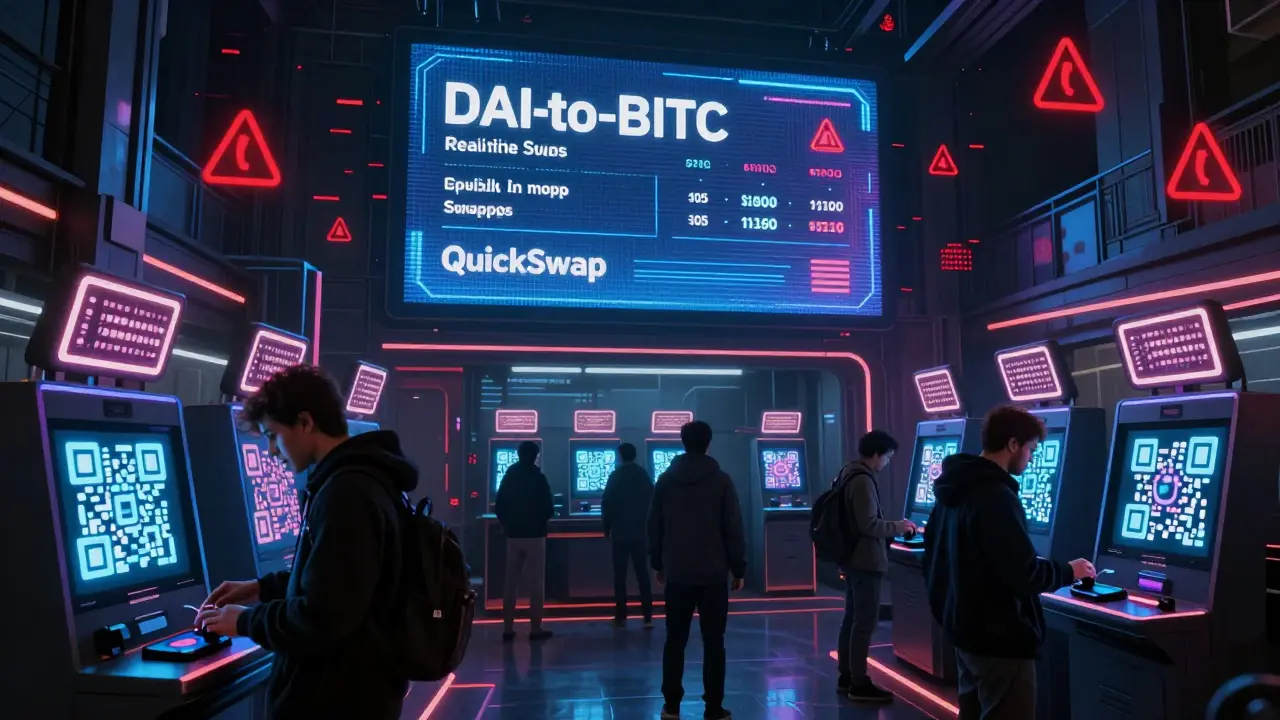
What You Need to Get Started
You don’t need a bank account. You don’t need to register anywhere. But you do need these five things:- A reliable VPN-one that works consistently in Iran. Avoid free options; they’re slow and often monitored.
- A non-custodial wallet-MetaMask is the most common. Install it as a browser extension or mobile app.
- Some crypto to start-you need a little ETH or MATIC to pay for gas fees. Many users buy small amounts from peer-to-peer traders via Telegram or local crypto groups.
- Access to Polygon-connect your wallet to the Polygon network in MetaMask. Add the RPC manually if needed: https://polygon-rpc.com
- A trusted DEX-QuickSwap (polygon.quickswap.exchange) or SushiSwap (mumbai.sushi.com) are the most popular for DAI swaps.
The Risks Are Real
Using DEXs isn’t risk-free. Iran’s Law on Taxation of Speculation and Profiteering, enacted in August 2025, now treats crypto gains like gold or forex. If caught, you could face fines or worse. The government has raided homes over mining operations and shut down underground rigs. They’re watching. Even using a DEX leaves traces. Your IP address, even through a VPN, can be logged. Your wallet address is public on-chain. If you ever connect to a licensed exchange like Nobitex, your DEX activity could be linked back to you. The safest approach? Keep your DEX usage separate from your local exchange activity. Never send funds from your DEX wallet to Nobitex. Use different wallets. Use different devices if possible. Treat your DEX wallet like a secret vault.What About Mining and Other Options?
Iran legalized mining in 2019-but only if you sell your coins to the Central Bank. That’s not useful if you want to hold Bitcoin or avoid government control. Energy tariffs are so high that most miners operate illegally. Power outages in late 2024 were blamed on unauthorized mining, and authorities cracked down hard. Some Iranians use mining to earn crypto, then immediately swap it on DEXs. But this is high-risk. If you’re caught mining without a license, you could be prosecuted. It’s not worth it for most people. The smarter path? Buy a small amount of crypto through peer-to-peer channels, swap it to DAI on Polygon, and hold. That’s it.
Is This Legal?
Technically, no. Iran’s government doesn’t recognize DEXs. They don’t exist on their radar because they can’t control them. But they also can’t stop them. The law says you need a license to trade crypto-but no one can issue a license for a DEX. So users operate in a gray zone: not officially legal, but technically impossible to fully block. The U.S. sanctions regime targets Iranian financial infrastructure, not individual users. So far, no Iranian citizen has been sanctioned just for using a DEX. The focus is on exchanges, banks, and laundering networks. That gives users some breathing room.What’s Next for Iranian Crypto Users?
The government is building CIMS-the Cross-Border Interbank Messaging System-to bypass SWIFT. It’s tied to Bank of Kunlun in China. This shows Iran knows crypto and digital finance are here to stay. They’re trying to control it, not kill it. Meanwhile, Iranian users are getting smarter. They’re moving away from USDT. They’re using Polygon. They’re avoiding Nobitex. They’re learning how to use DEXs without leaving a trail. The future won’t be about big exchanges. It’ll be about small, private, decentralized networks. Wallets. Keys. VPNs. DAI. That’s the new infrastructure.Final Thoughts
You don’t need permission to use a DEX. You don’t need a bank. You don’t need the government’s approval. All you need is a little knowledge, a good VPN, and the courage to take control of your own money. Iran’s crypto scene is no longer about speculation. It’s about survival. And for those who’ve figured it out, DEXs are the only way forward.Can I use a DEX in Iran without a VPN?
No. Most DEX websites and blockchain explorers are blocked inside Iran’s national internet firewall. A reliable, obfuscated VPN is required to access them. Free or untested VPNs often fail due to deep packet inspection used by Iranian authorities.
Is DAI safer than USDT in Iran?
Yes. USDT is issued by Tether, a company subject to U.S. sanctions and compliance rules. In July 2025, Tether froze 42 Iranian-linked addresses, most tied to Nobitex. DAI, on the other hand, is fully decentralized and governed by code-not a company. It’s much harder to freeze or block. Most Iranian users now prefer DAI on Polygon for stability and safety.
Can the Iranian government track my DEX trades?
They can track your wallet address if you ever connect it to a licensed exchange like Nobitex. But if you use a DEX with a clean wallet-no links to local exchanges, no reused addresses, and no personal info-you’re largely invisible. The blockchain shows transactions, but not who you are. Your identity only leaks if you connect it to something traceable.
Do I need to pay taxes on DEX trades in Iran?
Yes. Iran’s 2025 Taxation Law treats crypto profits like gold or forex speculation. If you sell crypto for a profit, you owe taxes. But enforcement is difficult. The government can’t easily track DEX trades unless you cash out through a licensed exchange. Many users avoid reporting entirely, but the risk exists.
What’s the best DEX for Iranians right now?
QuickSwap on Polygon is the most popular. It’s fast, cheap, and supports DAI, ETH, and other tokens Iranians need. SushiSwap is also reliable. Avoid centralized platforms like Binance or Coinbase-they’re blocked and risky. Stick to non-custodial DEXs with low fees and strong community support.
Can I use DEXs to buy Bitcoin in Iran?
Yes. First, swap your local currency for DAI or MATIC via a peer-to-peer channel. Then, use a DEX like QuickSwap to trade DAI for ETH or WBTC (wrapped Bitcoin). You can also use Uniswap or SushiSwap on Ethereum if you have enough gas. Bitcoin isn’t directly traded on most Iranian-friendly DEXs, but wrapped versions work fine.
Is it safe to use MetaMask in Iran?
Yes, as long as you use it correctly. MetaMask doesn’t collect your identity. But if you link it to a KYC’d exchange or reuse the same wallet for both DEX trades and Nobitex deposits, you risk exposure. Use a separate wallet for DEXs. Never share your seed phrase. Enable PIN and biometric locks. Treat it like a physical key to your money.
Why is Polygon preferred over Ethereum for DEXs in Iran?
Ethereum gas fees are often over $10 per trade. On Polygon, fees are under $0.10. Transactions settle in 2-3 seconds instead of 15-30 minutes. For Iranians who need to make frequent, small swaps-like moving from DAI to ETH-Polygon is the only practical option. It’s faster, cheaper, and more reliable under unstable internet conditions.
Caitlin Colwell
January 11, 2026 AT 13:55Thank you for laying this out so clearly.
Denise Paiva
January 12, 2026 AT 20:14You think your wallet address is secret
It’s literally on a public ledger you absolute babe
Paul Johnson
January 14, 2026 AT 09:34Why even bother with crypto if you’re too lazy to play by the rules
Just move to Canada or something
Meenakshi Singh
January 15, 2026 AT 10:41USDT is dead in Iran 🤡
Gas fees on Ethereum = 💸💸💸
Polygon = 💸✨
MetaMask = 🔐
VPN = 🛡️
Done. 💪
Kelley Ramsey
January 16, 2026 AT 20:33And the fact that they’re choosing DAI over USDT because of decentralization? That’s financial wisdom!
Every single step they take-VPN, wallet, chain switch-is an act of quiet rebellion!
Michael Richardson
January 18, 2026 AT 11:55Stop glorifying tax evasion
Also VPNs are illegal in 87 countries
Get a job
Sabbra Ziro
January 19, 2026 AT 18:49People aren’t trying to break rules-they’re trying to survive.
And honestly, the shift from USDT to DAI? That’s not just technical-it’s ethical.
Let’s not forget that.
Krista Hoefle
January 21, 2026 AT 04:41Try again when you’re not using a 2021 tutorial
Real crypto is on Solana now
And you’re all just clinging to Ethereum’s corpse
Emily Hipps
January 23, 2026 AT 02:31Buy 0.01 ETH. Set up MetaMask. Connect to Polygon.
You don’t need to be an expert-you just need to start.
And if you mess up? You learn. That’s how we all got here.
Kip Metcalf
January 25, 2026 AT 01:44But reading this makes me feel like maybe freedom isn’t dead
Just hidden behind a VPN and a wallet
Respect to everyone doing this
Natalie Kershaw
January 26, 2026 AT 10:29Non-custodial, low-fee, censorship-resistant.
This is what DeFi was supposed to be.
Iranians are building the future while the rest of us are still arguing about NFTs.
Jacob Clark
January 27, 2026 AT 10:32IF YOU USE A DEX YOU’RE ACTUALLY BEING MORE TRANSPARENT THAN WITH A BANK
EVERY SINGLE TRANSACTION IS ON THE BLOCKCHAIN
THEY CAN’T FREEZE IT BUT THEY CAN TRACK IT FOREVER
AND YOU THINK YOU’RE HIDING?
YOU’RE NOT HIDING YOU’RE JUST LEAVING A PUBLIC RECORD
THIS POST ISN’T HELPING IT’S ENABLING DELUSION
Jon Martín
January 28, 2026 AT 10:15This is dignity
People are taking back control from systems designed to crush them
VPN → Wallet → DAI → Freedom
It’s poetry in code
And if you think this is illegal-you’re missing the point
The real crime is letting your money be held hostage by a bank that answers to sanctions
Mujibur Rahman
January 28, 2026 AT 12:23Iranians have essentially created a parallel financial layer using open infrastructure
This mirrors what Venezuelans did with Petro but without the state’s interference
What’s remarkable is how community-driven this is-no whitepapers, no VC funding, just necessity and ingenuity
They’re not users-they’re architects