

Imagine a world where you don't have to spend two weeks fighting with an insurance company to get a payout for a delayed flight. Now, imagine that payment hitting your digital wallet before you've even left the airport. This isn't a futuristic dream; it's already happening thanks to Insurance Data Sharing on Blockchain is the use of distributed ledger technology to create immutable, transparent, and secure records of transactions between insurers, reinsurers, and policyholders.
For decades, the insurance industry has been bogged down by mountains of paperwork, endless data reconciliation, and a staggering $40 billion annual fraud problem. The core issue is that everyone-the agent, the insurer, the reinsurer, and the customer-keeps their own separate list of what happened. When those lists don't match, the system grinds to a halt. By moving to a shared, unchangeable ledger, the industry is finally creating a "single source of truth."
The Fast Track: Key Takeaways
- Efficiency: Data reconciliation time can drop by 70-90%.
- Speed: Claims that took 14 days can now be settled in under 5 minutes.
- Security: Distributed architecture reduces the risk of data breaches by roughly 62%.
- Cost: Manual processing costs drop from ~$10 per claim to around $2.
How Blockchain Actually Works for Insurance
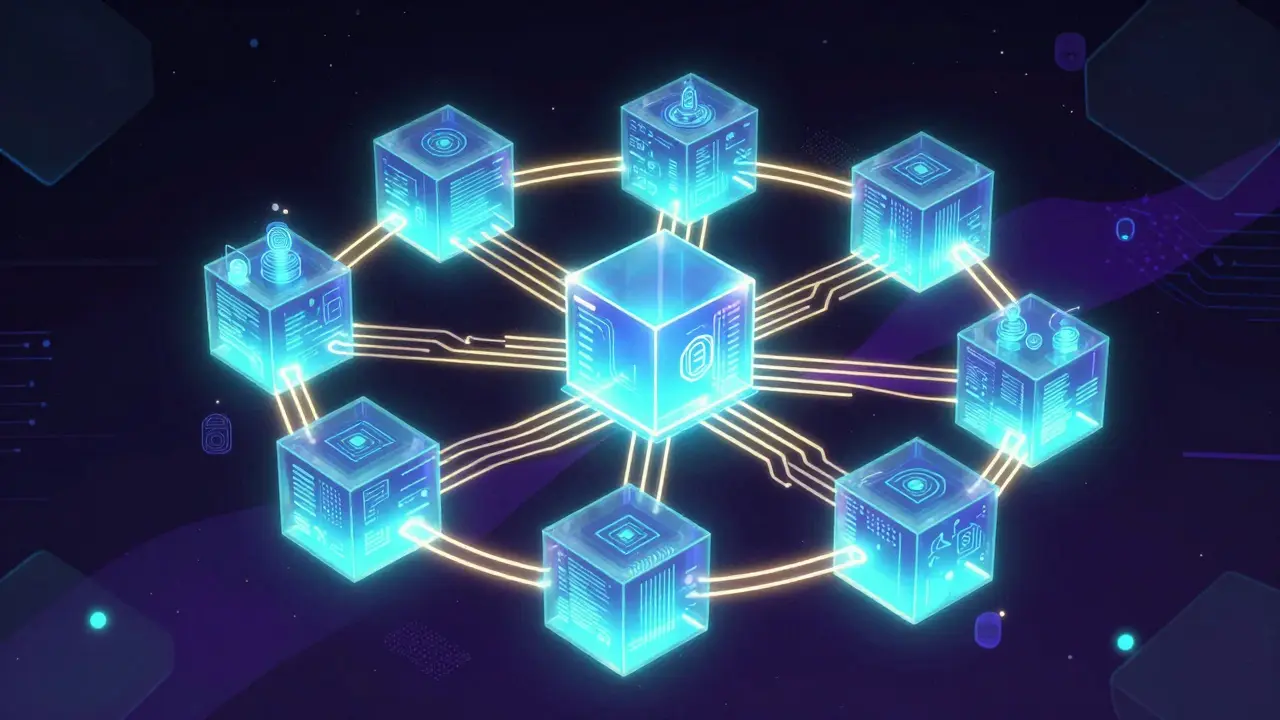
At its heart, Distributed Ledger Technology (DLT) is just a database that isn't owned by one person. Instead of one central server (which is a prime target for hackers), the data is mirrored across many computers simultaneously. Each new piece of information is bundled into a "block" and cryptographically chained to the one before it. If someone tries to change a record from three years ago, the chain breaks, and everyone knows immediately.
In the insurance world, not all blockchains are created equal. You won't find most insurers using a public network like Ethereum for their internal data because they need privacy. Instead, they use Consortium Blockchains. In this model, a group of trusted organizations-say, 65 different global insurers-jointly manage the network. It's the perfect middle ground: it's more secure than a private database but more controlled than a public one.
| Feature | Traditional Databases | Blockchain (DLT) | Cloud (SaaS) |
|---|---|---|---|
| Trust Model | Centralized Trust | Decentralized/Shared | Provider Trust |
| Data Immutability | Can be edited | Permanent record | Editable by admin |
| Reconciliation Time | Days to Weeks | Near Instant | Fast, but siloed |
| Breach Risk | Single point of failure | Distributed risk | High (Centralized) |
The Magic of Smart Contracts and Parametric Insurance
The real game-changer is the Smart Contract. Think of a smart contract as a digital "if/then" statement. If a specific condition is met, the contract automatically executes the payment. No human needs to review the file, no one needs to sign off on the check, and no one can argue about the facts if the data comes from a trusted source.
This has led to the rise of parametric insurance. Traditional insurance pays based on the *actual loss* suffered (which requires an adjuster to visit the site). Parametric insurance pays based on a *trigger event*. For example, AXA's "Fizzy" platform uses blockchain to monitor flight data. If a flight is delayed by more than two hours, the smart contract triggers a payout automatically. The user doesn't even have to file a claim-the money just appears.
This automation isn't just for travel. In the world of catastrophe bonds, blockchain is now being used to trigger real-time payouts after natural disasters, like Hurricane Helene, ensuring funds reach affected areas in hours rather than months.
Solving the Reinsurance Nightmare
If you aren't an insurance pro, you might not know about reinsurance (insurance for insurance companies). It's a massive global business, but it's historically been a mess of spreadsheets and emails. When a major disaster hits, a primary insurer might have to coordinate data with dozens of reinsurers across different time zones. This reconciliation process used to take 45 to 60 days.
By using consortiums like B3i (Blockchain Insurance Industry Initiative), the process has been slashed to under 72 hours. Because everyone is looking at the same ledger, there's no need to spend weeks arguing over which version of a CSV file is the correct one. This eliminates the 15-20% of operational time that insurers used to waste on manual data matching.
Fighting Fraud with Immutable Records
Insurance fraud is a trillion-dollar headache. One common trick is "double dipping," where a person claims the same accident or loss with three different insurance companies. In a traditional system, this is hard to catch because Company A doesn't talk to Company B.
Blockchain solves this by creating a transparent, unalterable history of every claim. While privacy laws like GDPR mean that personal details are still protected, the *fact* that a claim was made for a specific asset (like a VIN number for a car) can be recorded on the ledger. If someone tries to file a second claim for the same car at another company, the system flags it instantly. It's like having a global, digital notary that never sleeps.
The Hard Truth: Why Isn't Everyone Doing This?
If blockchain is so great, why is only 41% of the North American market fully on board? The problem isn't the technology; it's the "legacy debt." Most big insurers are running on software from the 1980s and 90s. Integrating a modern DLT network with a 30-year-old mainframe is like trying to plug a Tesla charger into a steam engine.
Beyond the tech, there's a massive cultural hurdle. Insurance is built on silos. Companies treat their data like gold, and the idea of sharing a ledger with competitors-even a secure, permissioned one-is terrifying to some executives. Many pilots fail not because the code didn't work, but because the organization couldn't handle the shift in how they collaborate.
Regulatory fragmentation also slows things down. In the US, insurance is regulated state-by-state. A blockchain solution that works in New York might hit a regulatory wall in Florida, forcing companies to build custom compliance modules for every single jurisdiction.

Implementing Blockchain in Your Organization
For those looking to move beyond the pilot phase, the path usually involves three distinct steps. First, you have to choose your architecture. About 85% of insurers go with the consortium model because it balances privacy with efficiency. Second, you need a governance framework. Who decides when the ledger is updated? Who is allowed to add new members? Third, you need the right talent.
This isn't a job for a general IT team. You need a cross-functional squad of 5-7 specialists who understand both insurance domain logic and Solidity (the programming language used for smart contracts). Expect a deployment cycle of 9 to 12 months, and be prepared to spend significantly on specialized training-often between $15,000 and $25,000 per employee to get them up to speed.
Does blockchain replace the need for insurance adjusters?
Not entirely. While smart contracts handle "parametric" claims (like flight delays or weather events) automatically, complex claims-like a house fire or a legal liability suit-still require human judgment and physical inspection. Blockchain simply removes the administrative friction and data disputes from the process.
Is data on a blockchain actually private?
In a consortium blockchain, yes. Unlike Bitcoin, where everyone can see every transaction, insurance blockchains use permissioned access. Only authorized parties can see specific data, and sensitive personal information is often stored "off-chain" with only a cryptographic hash (a digital fingerprint) stored on the ledger to prove the data is authentic.
How much does it cost to implement blockchain for an insurer?
Costs vary wildly. Joining an existing consortium might cost around $500,000 in setup and membership fees. Building a proprietary, custom solution from scratch can easily exceed $2.5 million, depending on the complexity of the legacy systems being integrated.
Which region is leading in blockchain insurance adoption?
Europe currently leads the pack with about 68% implementation. This is largely driven by the strict requirements of GDPR, which pushed European insurers to find more secure, transparent ways of managing and sharing personal data.
What is the typical ROI period for these systems?
According to joint assessments by the World Economic Forum and Accenture, the average payback period for a blockchain implementation in insurance is between 14 and 18 months, primarily driven by the massive reduction in manual reconciliation labor.
Next Steps and Troubleshooting
If you're a mid-sized insurer feeling overwhelmed by the tech gap, don't start by building your own chain. The smartest move is to look for an existing consortium that matches your niche. It's cheaper, the governance is already settled, and you get immediate network effects.
If you're seeing delays in your current pilot, check your integration layer. Most "blockchain failures" are actually just legacy API failures. Ensure your team is using a middleware solution like R3 Corda, which is designed specifically to bridge the gap between DLT and old-school policy administration systems.
Findlay Duncan Lyon
April 23, 2026 AT 21:58Spot on with the UK/EU leadership. We've always been a bit more agile with these frameworks.
Robert Mosolygo
April 25, 2026 AT 04:13The notion that a "consortium" blockchain provides privacy is laughably naive. In reality, these are just centralized databases with extra steps, designed to give the illusion of decentralization while the core power players maintain total control over the ledger. Furthermore, the claim regarding a 62% reduction in breach risk is an arbitrary statistic likely fabricated by a marketing department to soothe anxious stakeholders. If you believe the data is "immutable" when the governing body holds the keys, you are simply inviting a more sophisticated form of systemic surveillance.
Greg Reynolds
April 26, 2026 AT 15:48Actually, the ROI period is often much longer than 18 months when you factor in the hidden costs of employee attrition due to the steep learning curve of Solidity.
Tony Gurley-Ward
April 28, 2026 AT 03:33It's a wild dance of digital alchemy, isn't it? Turning a dusty ledger into a shimmering stream of instant payouts. I love the irony of using the most cutting-edge tech to fix a system that's essentially just high-stakes gambling for corporations. It's like putting a warp drive on a horse-drawn carriage. Quite a whimsical transition into the future!
Lisa Camp
April 28, 2026 AT 15:28STOP WAITING! If your company is still using 1980s mainframes, you're practically begging to go extinct! Get the team moving or get a new team!
Jennifer Taylor
April 29, 2026 AT 07:16This is just a way for them to track every single move we make. One global ledger means they know exactly who you are and what you own. Don't trust the "privacy" lie.
Gary Lingrel
April 30, 2026 AT 23:52everyone just wants a shortcut 🙄 why can't we just be honest and say this is about profit not people 🙄
praveen subbiah
May 2, 2026 AT 14:38Our tech hubs in India are absolutely dominating the implementation of these smart contracts! The sheer brilliance and scale of our engineers will push this globally beyond any western limit! A magnificent era for Indian IT!
Paige Raulerson
May 4, 2026 AT 00:12The mention of legacy debt is the only interesting part here. Most people don't even realize how primitive corporate infrastructure is. It's almost quaint.
Larry Yang
May 4, 2026 AT 17:14The math on the breach risk seems a bit optimistic, but hey, at least it's not another whitepaper about NFTs. Still a bit mid if you ask me.
Doc Coyle
May 5, 2026 AT 08:33It is simply a matter of logic. If the data is shared, the fraud is gone. It's not rocket science.
Sarah Fisher
May 6, 2026 AT 14:22It's interesting to think about the shift from human trust to algorithmic trust. We're basically outsourcing our faith in fairness to a piece of code.
Clair Geary
May 8, 2026 AT 02:11That parametric stuff is just magic lol
Imagine just waking up and seeing the money in your account because the plane was late... such a vibe
jill huyo-a
May 9, 2026 AT 08:26I wonder if there are ways to make the consortium model even more inclusive for smaller regional insurers who can't afford the $500k entry fee.
Alex Wan
May 10, 2026 AT 05:18I believe we must strive for a more collaobrative approach to these cost barriers! It is truly heartbreaking that smaller entities might be left behind in this digital revolution!! We must find a way to subsidize the entry fees for the greater good of the industry!
Benjamin Forg
May 11, 2026 AT 01:46the consortium is just a fancy word for a cartel theyll just collude to keep the premiums high while pretending to be efficient its all a game for the elites anyway
Sara Ellis
May 11, 2026 AT 06:31it just makes life easier
Ali Tate
May 12, 2026 AT 12:49Absolute drivel to suggest the US is lagging purely on tech. It's the bloated bureaucracy of state-level regulators that's the real cancer here. Our innovation is unmatched, but it's strangled by red tape that would make a Soviet clerk blush. Just sheer inefficiency at a systemic level