

Imagine if you could earn money just for sharing your spare Wi-Fi bandwidth or selling the extra electricity from your rooftop solar panels. It sounds like a scene from a sci-fi movie, but it is happening right now through a technology called DePIN, which stands for Decentralized Physical Infrastructure Networks. This concept flips the traditional business model on its head. Instead of one giant company building all the cell towers and power grids, everyday people contribute their own hardware and resources to build the network together.
If you have been hearing about crypto projects that involve real-world devices, you are likely encountering DePIN. But how does it actually work? Why would someone trust a decentralized group to manage critical infrastructure? And what keeps these networks running smoothly without a central boss? Let’s break down the mechanics behind this growing sector of the blockchain world.
The Core Idea: Replacing Corporations with Communities
Traditionally, when you need internet access or charge your electric vehicle, you rely on centralized providers. These companies spend billions to build infrastructure, and they recoup those costs by charging you monthly fees. The problem is that these systems can be slow to expand into rural areas, prone to single points of failure, and often expensive because there is little competition.
DePIN is a paradigm that uses blockchain technology to incentivize individuals to collectively create and maintain physical infrastructure. Instead of waiting for a corporation to lay fiber optic cables in your neighborhood, neighbors might set up their own mesh network nodes. They get rewarded with cryptocurrency tokens for providing that service. This creates a permissionless system where anyone with the right hardware can join, provide services, and earn rewards.
This approach democratizes infrastructure. It lowers the barrier to entry for new providers and gives users more control over their data and connections. By distributing ownership across thousands of participants, DePIN eliminates the risk of a single entity shutting down the entire service.
Two Main Types of DePIN Networks
Not all DePIN projects look the same. To understand how they work, you need to know the two primary categories they fall into: Physical Resource Networks (PRNs) and Digital Resource Networks (DRNs). The distinction comes down to whether the resource is tied to a specific location.
| Feature | Physical Resource Networks (PRNs) | Digital Resource Networks (DRNs) |
|---|---|---|
| Resource Type | Location-based hardware (e.g., sensors, chargers) | Fungible digital assets (e.g., storage, compute) |
| Geographic Constraint | Tied to specific physical locations | Location-independent |
| Examples | Helium (wireless), Energy Web (power) | Filecoin (storage), Render (GPU computing) |
| User Experience | Local connectivity or services | Global access to shared resources |
Physical Resource Networks (PRNs) deal with tangible assets that must be in a specific place to function. Think of a wireless hotspot in a coffee shop or an EV charging station in a parking lot. These resources are non-fungible; a charger in Hobart cannot serve a driver in Sydney. PRNs focus on sectors like connectivity, mobility, and energy.
Digital Resource Networks (DRNs), on the other hand, handle resources that can be sent anywhere instantly. If you share your unused hard drive space or your computer’s processing power, it doesn’t matter where you live. The data travels over the internet. DRNs are essentially marketplaces for computing power, storage, and bandwidth.
The Technical Engine: How It All Connects
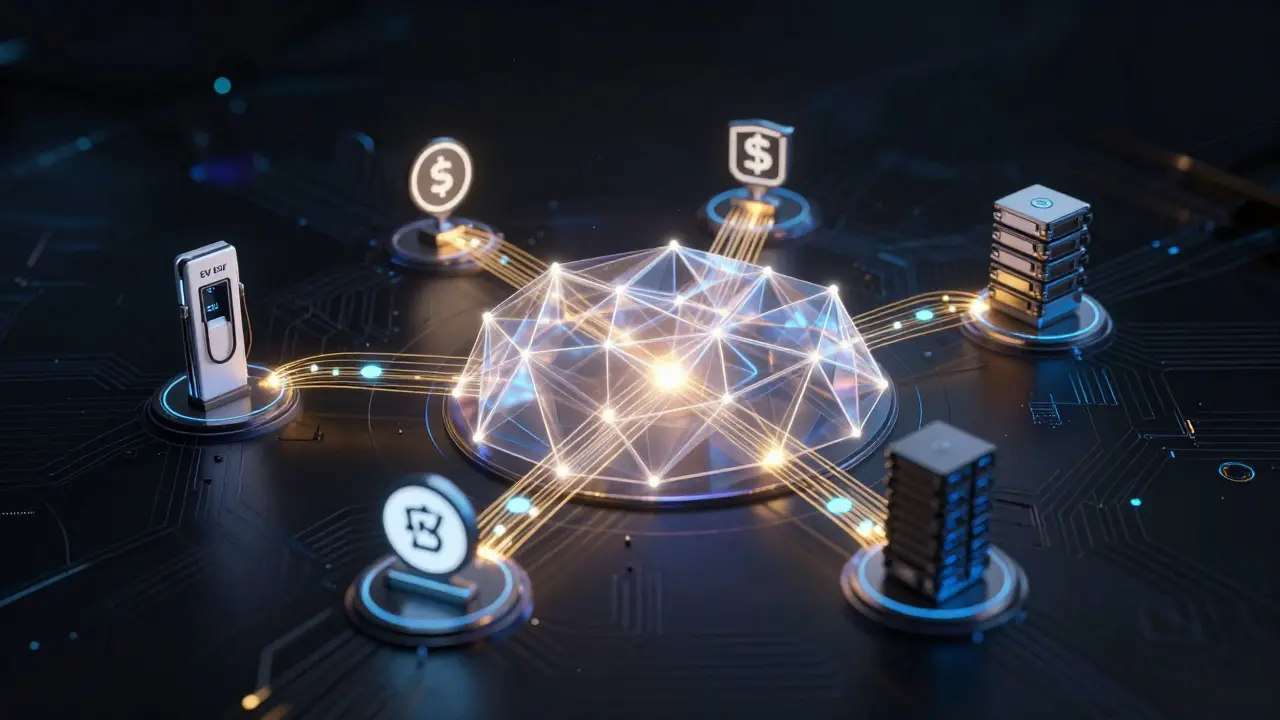
You might wonder how a random person’s Wi-Fi router connects to a global payment system securely. The answer lies in three core technical components working together: smart contracts, tokenization, and distributed architecture.
- Smart Contracts: These are self-executing agreements written in code. In a DePIN network, smart contracts automate the boring stuff. They verify that a provider is actually delivering service (like confirming a hotspot is online) and automatically send payments to the provider’s wallet. No middleman, no delayed invoices.
- Tokenization: Every contribution to the network is represented by a digital token. When you provide bandwidth, you earn tokens. When you use someone else’s bandwidth, you spend tokens. This creates a liquid economy where value flows directly between participants.
- Distributed Ledger: The blockchain acts as the record-keeper. It logs every transaction, every byte of data transferred, and every reward issued. Because the ledger is public and tamper-proof, everyone can audit the network’s health. This transparency builds trust among strangers who don’t know each other.
For example, in the Helium network, hotspots run software that proves they are providing coverage. The blockchain verifies this proof-of-coverage. Once verified, the smart contract mints new tokens and sends them to the hotspot owner. It’s a closed loop of action, verification, and reward.
Incentive Mechanisms: Why People Join
Nothing happens in DePIN without motivation. The entire ecosystem relies on carefully designed tokenomics to keep participants engaged. There are generally three ways people earn rewards:
- Sharing Excess Resources: Do you have a powerful GPU sitting idle at night? You can rent it out to researchers or artists who need rendering power. You get paid for what you already own.
- Building New Infrastructure: Some projects pay you upfront or offer high initial yields to deploy new hardware. For instance, setting up a sensor node in a remote area might earn significant tokens because it fills a coverage gap.
- Providing Active Services: Beyond just being online, some networks reward active tasks. This could mean querying data, validating transactions, or maintaining the health of the local network mesh.
The key here is sustainability. Early DePIN projects often suffered from inflationary token dumps, where early adopters sold their rewards, crashing the price. Modern projects are focusing on utility-driven models, where tokens are needed to access the service, creating natural demand that supports the price.
Real-World Applications: What Can DePIN Do?
DePIN isn’t just theory; it’s being deployed in several industries today. Here is how different sectors are using this technology:
Wireless Connectivity: Projects like Helium allow users to buy small hotspot devices and place them in homes or offices. These hotspots create a decentralized LoRaWAN or 5G network. IoT devices, like water meters or pet trackers, connect to the nearest hotspot. The owners of those hotspots earn tokens for carrying the data.
Energy Grids: Imagine a neighborhood where houses with solar panels sell excess energy to neighbors with electric cars. A DePIN protocol could facilitate these micro-transactions automatically. The smart contract ensures the buyer pays exactly for the kilowatt-hours received, and the seller gets paid instantly. This reduces reliance on large utility companies and stabilizes local grids.
Data Storage: Companies like Filecoin let users rent out unused hard drive space. Businesses needing secure storage can split their files across thousands of drives worldwide. If one drive fails, the data is still safe elsewhere. This is cheaper and more resilient than relying on a single cloud provider.
Compute Power: AI development requires massive computing resources. DePIN networks aggregate GPUs from gamers, developers, and data centers. Researchers can tap into this pooled power for training models, paying only for the time they use.

Benefits and Challenges
So, why bother with DePIN? The benefits are clear. First, cost reduction. By cutting out the corporate middlemen, services become cheaper for users and more profitable for providers. Second, resilience. A decentralized network has no single point of failure. If one node goes down, others take over. Third, accessibility. DePIN can bring infrastructure to underserved regions where big companies won’t invest because the ROI is too low.
However, it’s not all smooth sailing. Hardware maintenance is a real hurdle. Unlike software updates, fixing a broken sensor in a field requires physical labor. Quality control is also tricky. How do you ensure a home Wi-Fi hotspot provides consistent speeds? Finally, regulatory uncertainty looms large. Governments are still figuring out how to classify these token-incentivized utilities. Are they securities? Utilities? Commodities? The answers will shape the future of DePIN.
The Future of Decentralized Infrastructure
We are still in the early stages of DePIN adoption. As hardware becomes cheaper and blockchain interoperability improves, we will likely see more seamless integration into our daily lives. Your car might automatically choose the cheapest charging station based on real-time DePIN pricing. Your smart home might sell your anonymized usage data to advertisers via a secure decentralized network.
The shift is moving from centralized monopolies to community-owned ecosystems. While challenges remain, the potential to democratize access to essential infrastructure is undeniable. For those willing to participate, DePIN offers a unique opportunity to turn idle assets into income while contributing to a more robust, global network.
What is the main difference between DePIN and regular blockchain projects?
Regular blockchain projects often focus purely on financial transactions or digital assets. DePIN specifically bridges the gap between the digital blockchain world and physical reality. It incentivizes people to build and maintain real-world infrastructure like wireless networks, energy grids, and storage facilities using token rewards.
Is DePIN safe to participate in?
Safety varies by project. Since DePIN involves physical hardware, you need to consider device reliability and security. On the blockchain side, reputable projects use audited smart contracts. However, always research the tokenomics and team behind a project before investing money or hardware, as some early-stage projects may fail.
How do I start earning with DePIN?
To start, identify a DePIN project that aligns with your available resources. If you have extra storage, look into digital resource networks like Filecoin. If you want to provide wireless coverage, check out projects like Helium. Generally, you will need to purchase specific hardware, set it up according to instructions, and connect it to the network to begin earning tokens.
What happens if a DePIN node breaks?
If a physical node breaks, it stops providing service and thus stops earning rewards. The burden of maintenance falls on the node operator. This is a key challenge in DePIN compared to pure software projects. Operators must ensure their hardware is powered, connected, and functioning correctly to maintain income streams.
Are DePIN tokens valuable?
The value of DePIN tokens depends on supply and demand. Demand is driven by users needing to pay for services on the network. Supply is controlled by the project’s emission schedule. Successful DePIN projects with high user adoption tend to have more stable and valuable tokens because the tokens have real utility within the ecosystem.