
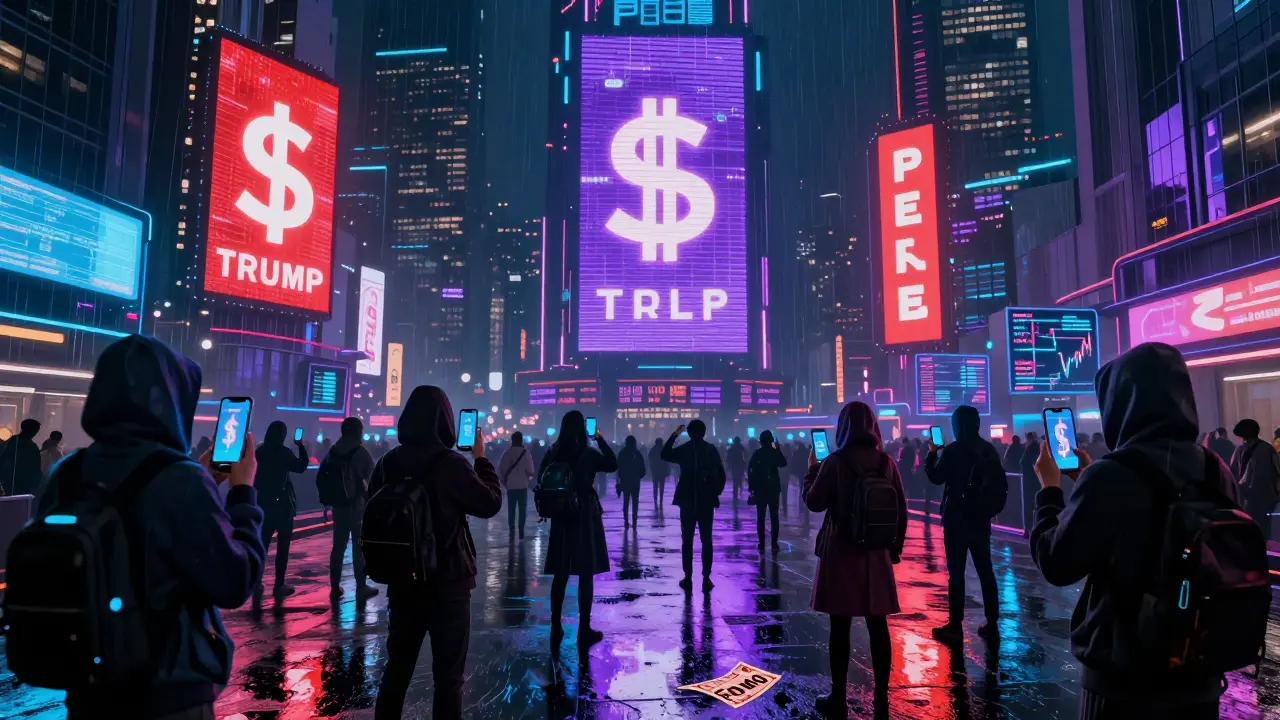
Memecoins aren’t investments. They’re internet jokes with price tags. And yet, people are putting real money into them - sometimes thousands, sometimes tens of thousands. In January 2025, a coin called $TRUMP jumped to a $27 billion market cap in less than a day. Three weeks later, it had lost $2 billion in value. That’s not a market correction. That’s a rollercoaster with no seatbelts.
What Exactly Is a Memecoin?
A memecoin is a cryptocurrency born from a meme, not a whitepaper. Dogecoin started as a joke in 2013 - a Shiba Inu dog with a caption like, "Why not?" - and somehow became worth over $12 billion by late 2024. Shiba Inu (SHIB) followed, launching with one quadrillion tokens so each one costs less than a penny. Pepe (PEPE), based on the internet frog meme, hit $3.7 billion in market value in 2024. These aren’t designed to fix blockchain problems or enable smart contracts. They’re made to be shared, laughed at, and traded like baseball cards.Unlike Bitcoin, which has a fixed supply of 21 million coins, most memecoins have endless supplies. Dogecoin creates 14.4 million new coins every day. Shiba Inu’s entire supply was dumped at launch. That’s not scarcity. That’s inflation on purpose. And yet, people buy them anyway, hoping the next person will pay more.
The Rewards: How People Make Money - Briefly
The only real reward memecoins offer is speed. If you catch the wave early, you can turn $500 into $3,000 in weeks. One Reddit user bought Pepe at $0.0000001 in April 2023 and sold at $0.0000037 just a month later - a 650% return. That’s not investing. That’s gambling with a Wi-Fi connection.These wins happen because of hype. When a celebrity tweets about a coin - like Donald Trump promoting $TRUMP on X and Truth Social - retail investors flood in. Fear of missing out (FOMO) kicks in. Prices spike. Then, the people who bought early sell. That’s when the crash begins. The $TRUMP coin’s peak lasted less than 48 hours. Most buyers lost money.
Some memecoins have built small real-world uses. Dogecoin is accepted by a few online stores. One user on Reddit said they processed over $12,000 in DOGE payments for merchandise in 2024. But that’s a drop in the ocean compared to its $12.5 billion market cap. Utility? Barely. Community? Strong. But community doesn’t pay your rent.
The Risks: Why You Lose More Than You Win
The biggest risk isn’t volatility. It’s that there’s no foundation. No revenue. No team. No roadmap. Just a Twitter account and a Discord group.Take the Central African Republic’s $CAR coin. It launched on February 10, 2025. One day later, it lost 95% of its value. Why? The project’s X account was suspended. Rumors spread it was a deepfake. No one knew who was behind it. The entire thing evaporated.
Scams are everywhere. In 2024, over 67% of all cryptocurrency scams were memecoins, according to CryptoScamDB. The "Squid Game" coin vanished in November 2024 with $6.2 million of investors’ money. The team disappeared. The website went dark. The Discord server vanished. That’s not a market crash. That’s theft.
And the exchanges? They don’t warn you. Trustpilot reviews show 78% of negative memecoin complaints are about "celebrity coins causing massive losses." Sixty-three percent say exchanges don’t give enough risk warnings. You can buy a memecoin on Binance or Coinbase in under five minutes. No education. No warnings. Just a buy button.
Who’s Really Buying These?
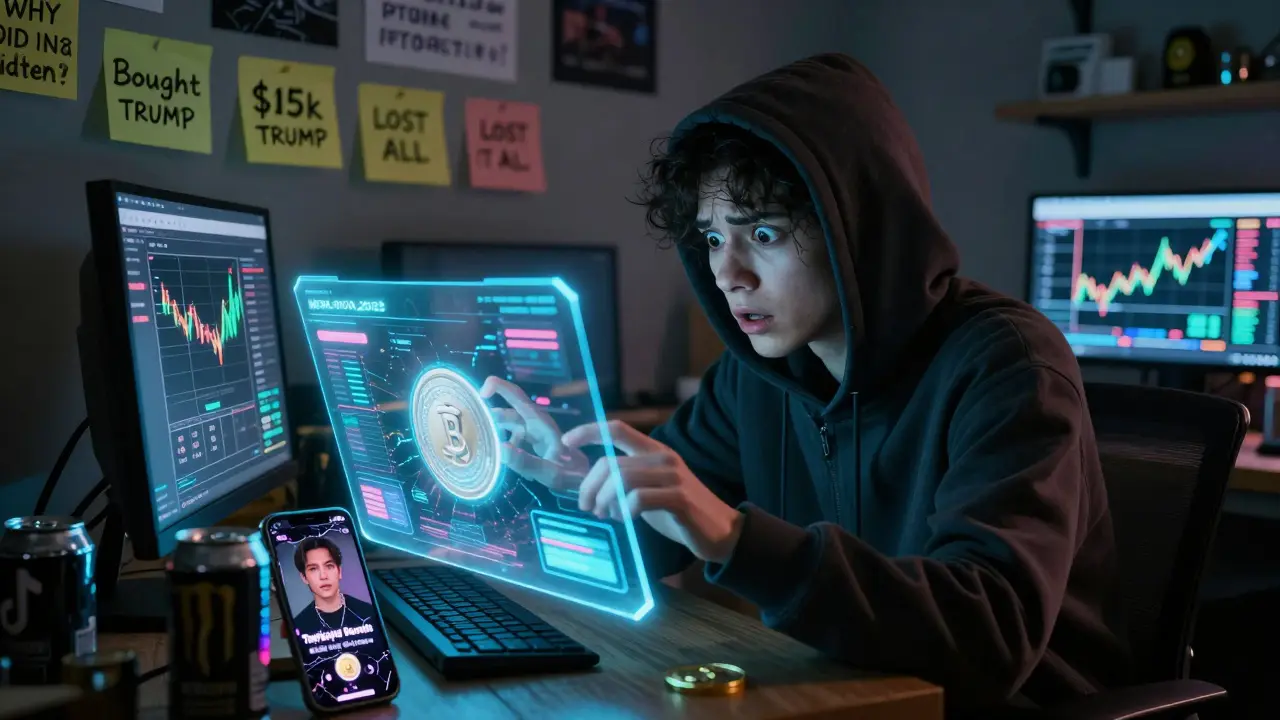
Not institutions. Not hedge funds. Not pension plans. Chainalysis found that in January 2025, institutions owned just 0.8% of all memecoins. Compare that to Bitcoin, where institutions hold 15.3%. Memecoins are a retail investor game. And retail investors are the ones who get crushed.They’re often young, new to crypto, and drawn in by viral videos or TikTok influencers. They see someone say, "I turned $100 into $10,000!" and think, "Why not me?" But those success stories are outliers. The rest? They’re the ones posting on Reddit about losing $8,500 on $CAR or $15,000 on $TRUMP.
The SEC says memecoins are "akin to collectibles." That’s not a compliment. It means they’re like Beanie Babies or Pokémon cards - fun to trade, but worthless if no one wants them anymore. And trends change fast. What’s hot today is a joke tomorrow.
How to Spot a Real Memecoin vs. a Scam
Not all memecoins are scams. But most are. Here’s how to tell the difference:- Check the team. Dogecoin and Shiba Inu have known creators. If the team is anonymous, walk away.
- Look for a whitepaper. 92% of new memecoins don’t have one. If it’s missing, that’s a red flag.
- Check community size. Dogecoin has 950,000 members on Reddit. Shiba Inu has 220,000 on Telegram. If a coin has fewer than 10,000 followers and no history, it’s likely a pump-and-dump.
- Watch for celebrity hype. If Elon Musk, Trump, or a TikTok influencer suddenly promotes a coin you’ve never heard of - it’s probably a trap.
- Don’t trust Telegram groups. They’re great for hype. Terrible for truth. Many pump-and-dump schemes are organized there.
Even the "legit" memecoins like Dogecoin are risky. They’re not stocks. They’re not bonds. They’re not even like Ethereum. They’re digital collectibles with no intrinsic value. Their price is 100% based on what someone else is willing to pay right now.
Should You Invest in Memecoins?
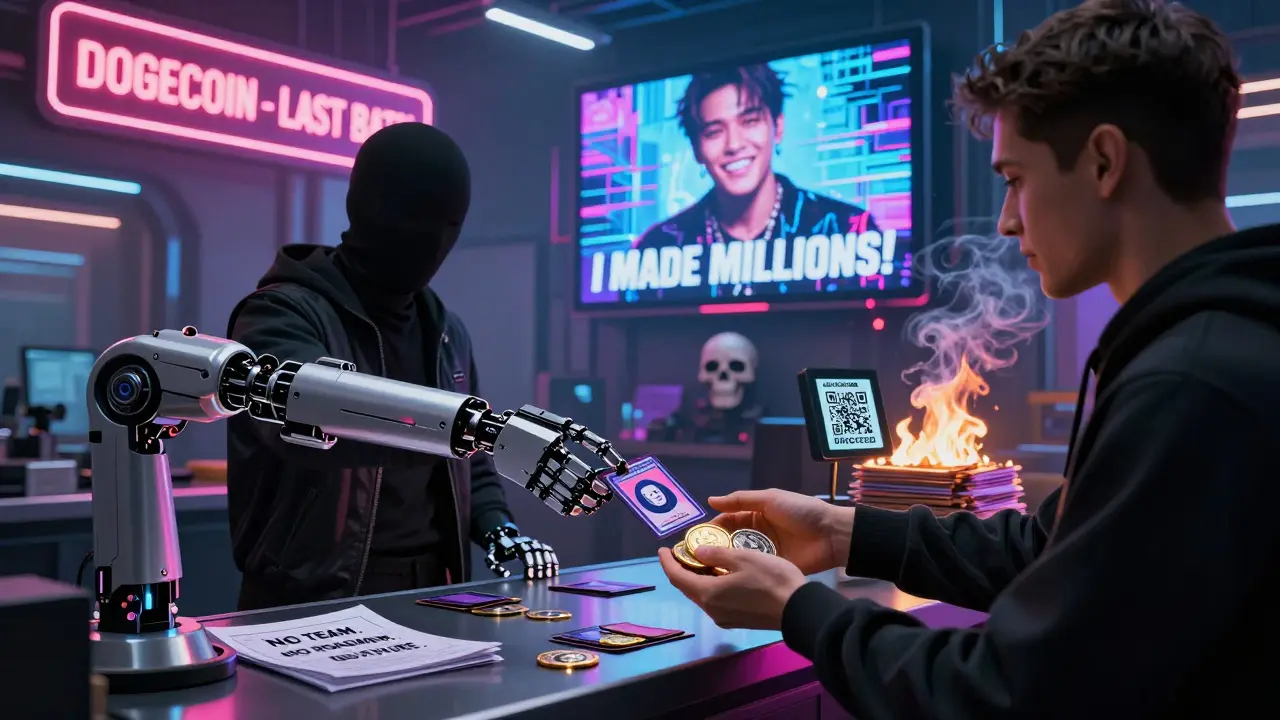
Only if you’re okay with losing it all. If you can afford to throw $100 into a coin and never think about it again - go ahead. Treat it like a lottery ticket. Not an investment.But if you’re thinking of putting in your savings, your rent money, or your emergency fund - don’t. The odds are stacked against you. The SEC, Charles Schwab, and every major financial analyst agree: memecoins are entertainment, not wealth-building.
There’s a difference between making a quick gain and building long-term value. Memecoins offer the first. They don’t offer the second. As one financial analyst put it: "It’s a casino, not a company."
What Comes Next?
Regulators are watching. The SEC has opened 47 investigations into celebrity-endorsed memecoins as of December 2025. More bans, more warnings, more crackdowns are coming. Countries like the Central African Republic are trying to use memecoins as national currency - and failing. The $CAR coin collapsed within days.Some analysts think memecoins might survive by adding real utility - like payment systems or NFT integrations. But so far, none have done it at scale. Dogecoin’s $12,000 in merchant payments? That’s less than $100 per day. It’s not a business. It’s a hobby.
The future of memecoins isn’t about technology. It’s about culture. As long as people keep sharing memes and chasing viral gains, these coins will exist. But they’ll never be stable. They’ll never be safe. And they’ll never be a reliable way to build wealth.
If you want to invest in crypto, stick to Bitcoin or Ethereum. They have networks, developers, and real use cases. If you want to have fun and risk losing money, go ahead and buy a memecoin. Just don’t call it investing. Call it entertainment.
Are memecoins legal?
Yes, memecoins are legal to buy and trade in most countries, including the U.S., Australia, and the EU. But they’re not regulated as securities. The SEC classifies them as collectibles - meaning you have no legal protection if the value crashes or the project turns out to be a scam.
Can you make a living trading memecoins?
A few people have made short-term profits, but it’s not sustainable. Memecoins move on hype, not fundamentals. One person might turn $500 into $5,000 in a week. The next week, they lose it all. Most who try to trade memecoins full-time end up broke. It’s gambling, not a career.
Why do people keep buying memecoins if they’re so risky?
Because of FOMO and social proof. When you see a friend post about making money, or a celebrity promotes a coin, your brain thinks, "I don’t want to miss out." The media amplifies the wins and ignores the losses. It’s the same psychology behind lottery tickets and sports betting.
Is Dogecoin still worth buying?
Dogecoin has the largest community and longest track record of any memecoin. But its market cap is still driven by speculation, not utility. If you buy it, treat it like a novelty. Don’t expect it to grow 10x. Don’t count on it for retirement. It’s a cultural artifact with a price tag - not an asset.
How do I avoid getting scammed?
Never invest based on a TikTok video or a random Telegram group. Only buy memecoins from major exchanges like Binance or Coinbase - never from random websites. Check if the project has a public team, a whitepaper, and a real community. If it doesn’t, it’s likely a scam. And if someone says, "This is the next Dogecoin," run.
What’s the difference between a memecoin and a utility coin?
A utility coin like Ethereum or Solana has a real purpose - it powers smart contracts, decentralized apps, or network fees. A memecoin has no technical function. Its only purpose is to be traded based on memes and hype. One builds infrastructure. The other builds memes.
Bradley Cassidy
December 18, 2025 AT 20:52man i threw $200 at $TRUMP last week and watched it go from 0.000004 to 0.000012 in 36 hours then crash back down like a balloon with a hole
still laughing though. it’s like buying a lottery ticket made of memes and regret
Emma Sherwood
December 20, 2025 AT 01:59remember when dogecoin was just a joke and people called it dumb? now it’s got its own merch line, a charity fund, and people using it to tip content creators
the community’s the real asset here-not the price chart. if you treat it like a digital friendship bracelet, you won’t get burned. if you treat it like a stock? you’re already halfway to bankruptcy
SeTSUnA Kevin
December 20, 2025 AT 11:11Memecoins are not investments. They are behavioral economics experiments with blockchain interfaces. The only rational actor is the whale who dumps on retail FOMO. Everything else is theater.
Tom Joyner
December 22, 2025 AT 06:44Of course you’re buying memecoins. You’re 22, live with your parents, and think ‘degen’ is a personality trait. Wake up. The only thing you’re building is a credit score-shaped hole in your future.
Craig Nikonov
December 23, 2025 AT 21:59they’re all controlled by the fed. you think trump’s promoting $TRUMP because he’s rich? nah. he’s being paid by the crypto cabal to distract you from the real inflation-your wages. the SEC? part of the cover-up. they don’t want you to know the truth.
Jonny Cena
December 25, 2025 AT 11:11i get it-you see someone turn $50 into $5k and think ‘that’s me’
but here’s the thing: every person who made that win had a backup plan. they didn’t bet their rent. they bet their pizza money.
if you’re thinking of going all in? stop. take a walk. breathe. come back tomorrow and ask yourself: ‘would i do this if no one was watching?’
Kelsey Stephens
December 27, 2025 AT 02:42my little brother lost $8k on $CAR. he cried for two days.
i didn’t yell at him. i didn’t say ‘i told you so.’ i just sat with him and said, ‘you’re not stupid-you got caught in the hype, and that happens to everyone.’
now he’s learning about index funds. slowly. gently. without shame.
if you’re reading this and you’re the one who lost money? you’re not alone. and you’re not a fool. you just trusted the wrong story.
Timothy Slazyk
December 29, 2025 AT 00:25the tragedy isn’t that people lose money on memecoins-it’s that they mistake the dopamine hit of a pump for meaning.
we’ve built a financial system that rewards impulsivity and punishes patience.
memecoins are the logical endpoint of a culture that values virality over virtue, clicks over craftsmanship, and noise over narrative.
we don’t need better coins-we need better minds.
and until we fix that, every new memecoin is just another mirror reflecting our collective hunger for easy meaning.
Elvis Lam
December 30, 2025 AT 05:19if you’re not checking the team, the whitepaper, and the community size before you buy-you’re not investing. you’re playing Russian roulette with your bank account.
and no, ‘everyone’s doing it’ is not a strategy. it’s a suicide note written in crypto jargon.
Dionne Wilkinson
December 31, 2025 AT 00:36i think about how we used to trade baseball cards as kids. you’d swap a rare card for a common one because you liked the picture.
now we do the same thing, but with numbers on a screen, and we call it ‘investing.’
maybe we didn’t grow up after all.
Rebecca Kotnik
January 1, 2026 AT 21:38It is imperative to recognize that the structural underpinnings of memecoin valuation are predicated entirely upon speculative consensus, devoid of any fundamental economic indicators such as revenue streams, operational expenditures, or technological innovation.
Consequently, the decision to allocate capital toward such instruments constitutes a non-rational behavioral deviation from classical financial theory, and is more accurately categorized as a form of digital collectible gambling, analogous to the speculative fervor surrounding Beanie Babies in the late 1990s.
Regulatory bodies, in their current capacity, are woefully under-equipped to mitigate the systemic risks posed by this phenomenon, given the absence of legal personhood, identifiable stakeholders, or enforceable contractual obligations inherent in most memecoin projects.
One must therefore exercise extreme caution, as the psychological architecture of retail participation in these markets is deliberately engineered to exploit cognitive biases such as loss aversion, anchoring, and social proof.
It is not merely risky-it is philosophically bankrupt.
Jesse Messiah
January 2, 2026 AT 15:01yo i just wanna say-i bought $pepe for $50 and it went to $300, then back to $10
but i’m chill. i didn’t borrow money. i didn’t cry. i just laughed and said ‘cool, i had a good time’
if you can treat it like a concert ticket or a new game-go for it
if you’re stressing over it? you’re already losing
Sue Bumgarner
January 3, 2026 AT 02:21why do americans keep falling for this? in my country, we don’t gamble our savings on a frog meme. we save. we invest. we plan.
you think this is freedom? it’s just dumb. and now the whole world laughs at us because of $TRUMP.
Abby Daguindal
January 4, 2026 AT 05:11you people are pathetic. you think you’re ‘degen’ or ‘crypto bros’? you’re just the herd. the dumb money. the ones who get drained so the whales can eat.
if you’re still buying memecoins after reading this post, you’re not just broke-you’re unteachable.