
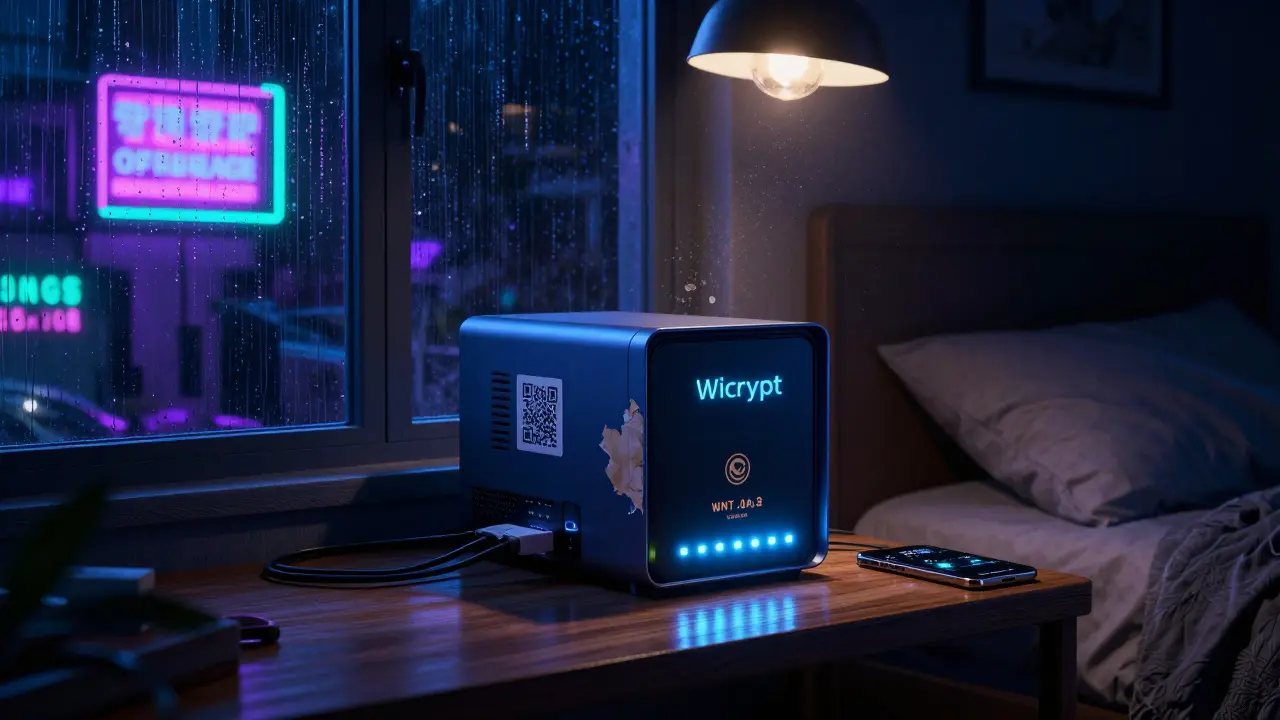
Back in 2021, Wicrypt promised something simple but powerful: plug in a device, share your internet, and earn cryptocurrency. No complex mining. No fancy staking. Just your home Wi-Fi turned into a money-making machine. The pitch? WNT tokens for sharing bandwidth. And yes, there was talk of an NFT and device drop - a way to get in early, get rewarded, and help build a decentralized internet. But here’s the truth most people didn’t hear: that airdrop never really took off, and today, the whole project is barely alive.
What Was the Wicrypt NFT & Device Drop?
The Wicrypt NFT & Device Drop wasn’t a traditional airdrop like those you see with new DeFi tokens. It wasn’t about claiming free tokens from a wallet. Instead, it was a hardware-based reward system. You had to buy a Wicrypt device - a small router-like gadget - for $99. In return, you got access to the WNT token ecosystem. The "NFT" part? It wasn’t a collectible image or a digital art piece. It was a digital certificate tied to your device, proving you owned a node on their network. Think of it like a license plate for your internet-sharing rig.
Here’s how it was supposed to work: you plug the device into your home modem, leave it running 24/7, and Wicrypt’s software routes unused bandwidth to people in areas with poor or expensive internet. For every gigabyte you shared, you earned WNT tokens. The more uptime you had, the more you earned. It sounded like a win-win: you helped someone get online, and you got paid. No middleman. No telecom company taking 80% of your bill.
But the catch? You had to buy the device first. There was no free entry. No claiming tokens without hardware. That’s not an airdrop in the usual sense - it’s a pre-sale with a twist. And that’s where things started to unravel.
The Promise vs. The Reality
Wicrypt’s team had solid credentials. CEO Olayinka Okereke came from Microsoft and Andela. CTO Adeyinka Adebayo had worked at Google. They raised $1.5 million in private funding. Their vision? Solve internet inequality in places like Nigeria, where the average person spends over 7% of their monthly income just to get online.
By late 2021, they had deployed around 1,200 devices - mostly in Nigeria. That’s not nothing. But compare that to Helium, which had over half a million hotspots by then. Wicrypt’s scale was tiny. And the earnings? They weren’t consistent. One Reddit user in Lagos reported making $3.50 a day. That sounds great - until you realize that’s $105 a month. After paying $99 for the device, you break even in one month. But only if the device never glitches.
And that’s the problem. Users reported frequent reboots. Devices overheated in tropical climates. Shipping delays hit 6-8 weeks. Some people waited months just to get their hardware. By the time it arrived, the hype was gone. And when they finally got it running, the earnings dropped. Why? Because not enough people were using the network. No demand = no bandwidth purchases = no rewards.
Why the NFT Didn’t Matter
The "NFT" part of the drop was mostly marketing. It wasn’t traded on OpenSea. It wasn’t used in games or metaverses. It was just a digital ID linked to your device. If your device stopped working, the NFT became useless. If you sold the device, the NFT didn’t transfer cleanly. There was no marketplace. No liquidity. No utility beyond proving ownership.
Compare that to Helium’s HNT tokens, which could be staked, traded, or used to pay for data on their network. Wicrypt’s NFT had none of that. It was a badge, not a tool. And when the token’s value started slipping, no one cared about the badge anymore.
What Happened to the WNT Token?
The WNT token launched on Cardano’s OccamRazer platform in October 2021. It had a clear release schedule: 2 months of linear unlocking, then 36 months for the rest. That’s a long vesting period - meant to prevent dumping. But here’s the irony: if no one is using the network, why should the token hold value?
By mid-2022, trading on decentralized exchanges had stopped. CoinGecko delisted it in 2025. The last GitHub commit was March 14, 2022. The official Telegram group shrank from 8,500 members to under 1,200. The knowledge base? Still there. But no new articles. No updates. No new devices.
Wicrypt didn’t fail because of bad code. It failed because of bad timing and bad scaling. They targeted a real problem - expensive internet in emerging markets - but didn’t solve the chicken-and-egg problem: you need users to share bandwidth, but users won’t join unless there’s demand. And demand needs users who can pay for the service. Who pays when you’re in a country where 70% of people live on less than $5 a day?
Why It Didn’t Work Where It Mattered
Wicrypt’s biggest strength was its focus on Africa. Its biggest weakness? That same focus.
Nigeria has high internet demand and low infrastructure. But it also has low purchasing power. A $99 device is a luxury. Even if you earn $3.50 a day, that’s not enough to justify the upfront cost unless you’re already online and have spare bandwidth to spare. Most people in those markets don’t have extra bandwidth. They’re on mobile data with limited plans. They can’t afford to share what they barely have.
Meanwhile, in places with cheap, reliable internet - like Australia, where I’m writing this from - no one cares. Why would you plug in a device to share bandwidth when your Telstra connection is $60 a month and unlimited? There’s no incentive. No reward big enough.
The Bigger Lesson
Wicrypt wasn’t a scam. It was a well-intentioned idea that ran into the hard reality of blockchain hardware projects. Projects that require physical devices almost always fail. Why? Because hardware is expensive. Shipping is slow. Maintenance is messy. And users don’t want to babysit a router just to earn a few cents.
Helium tried the same thing with LoRaWAN hotspots. It blew up, then crashed. Wicrypt never got close to that scale. It didn’t have the brand, the community, or the funding to keep going. And once development stopped, the network died quietly.
Today, if you search for "Wicrypt airdrop," you’ll find old forum posts, expired links, and a handful of people still holding onto devices they never used. The WNT token is worth almost nothing. The NFTs are digital ghosts. And the dream of decentralized Wi-Fi? Still unfulfilled.
What You Should Know Now
- The Wicrypt NFT & Device Drop was not a free airdrop - you had to buy hardware.
- WNT tokens were earned by sharing bandwidth, not by claiming them.
- The project is inactive as of 2026. No updates, no new devices, no trading.
- The NFT had no utility beyond proving ownership of a device.
- Wicrypt’s failure highlights why most blockchain hardware projects don’t survive beyond 18 months.
If you’re looking for a way to earn crypto by sharing internet today, look elsewhere. Projects like Helium have pivoted. Others have shut down. The space is still young. But Wicrypt? It’s a lesson in how good ideas can die quietly when they don’t solve the real problem: making it easy, cheap, and worth it for real people to join.
Was the Wicrypt NFT & Device Drop a free airdrop?
No, it wasn’t free. To participate, you had to purchase a Wicrypt device for $99. The "NFT" was a digital certificate tied to your device, not a claimable token. There was no way to earn WNT without buying hardware.
Can I still earn WNT tokens today?
No. The Wicrypt network stopped operating in 2022. The WNT token is no longer traded on any major exchange, and the official servers are offline. Even if you still have the device, it no longer connects to the network or earns rewards.
What happened to the Wicrypt devices?
Most devices are now inactive. They can still be plugged in, but they don’t communicate with any live network. The software was shut down, and there’s no way to update or reconfigure them. Some users repurposed them as regular Wi-Fi extenders, but they lost all blockchain functionality.
Was Wicrypt a scam?
No, it wasn’t a scam. The team had real experience, raised legitimate funding, and delivered hardware to users. But the business model didn’t scale. Without enough demand for shared bandwidth, the token lost value, and development stopped. It failed due to poor market fit, not fraud.
Are there any similar projects still active today?
Yes, but they’ve changed. Helium shifted from Wi-Fi to LoRaWAN for IoT devices and now focuses on enterprise clients. Other projects like Hivemapper and Hola are trying new models - some with mobile apps instead of hardware. But none have replicated Wicrypt’s original vision of a consumer-focused, decentralized Wi-Fi network.
karan narware
March 13, 2026 AT 14:28And don't get me started on the NFT. A digital license plate? For a device that stops working in 30°C heat? Please. We have solar-powered phones that last longer than this project.
Michael Suttle
March 14, 2026 AT 03:01Jenni James
March 15, 2026 AT 20:44Alex Thorn
March 17, 2026 AT 15:18Maybe next time, we start with the people. Not the whitepaper.
Howard Headlee
March 19, 2026 AT 13:43Julie Tomek
March 21, 2026 AT 02:25Brandon Kaufman
March 22, 2026 AT 03:37Craig Gregory
March 23, 2026 AT 23:00Anshita Koul
March 23, 2026 AT 23:38PIYUSH KOTANGALE
March 25, 2026 AT 08:16Jennifer Pilot
March 27, 2026 AT 02:12vishnu mr
March 27, 2026 AT 23:37Grace van Gent-Korver
March 29, 2026 AT 00:58Zephora Zonum
March 30, 2026 AT 22:50Anthony Marshall
April 1, 2026 AT 16:54Chelsea Boonstra
April 2, 2026 AT 19:08Lindsay Girvan
April 4, 2026 AT 18:07Alex Thorn
April 5, 2026 AT 23:18