
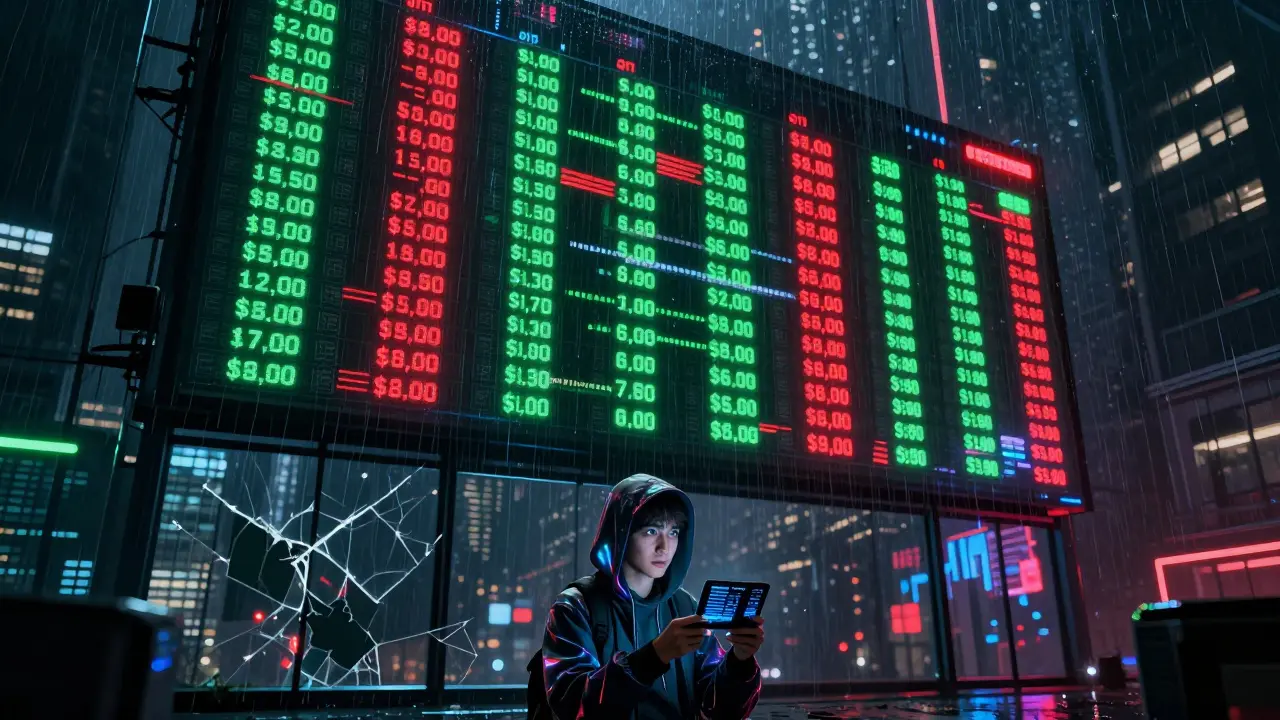
When you look at a cryptocurrency order book, what you see isn’t always what you get. Behind the numbers - the bids, the asks, the depth - there’s a hidden game being played. Traders with access to speed, capital, and sophisticated algorithms are manipulating the order book to trick others into making bad trades. This isn’t science fiction. It’s happening right now on every major exchange, and retail traders are getting burned every day.
What Is Order Book Manipulation?
The order book is supposed to show real supply and demand. But manipulators don’t care about fairness. They place fake orders - large ones - to create illusions. A massive buy wall at $68,000 on Bitcoin? That might be a trap. It’s not real buying pressure. It’s a lure. When you see it, you think the price will go up. You buy. Then, in under half a second, it vanishes. The price drops 3%. You’re left holding at a loss.
This is called spoofing. It’s the most common tactic. The U.S. Commodity Futures Trading Commission (CFTC) banned it in 2010, and since then, regulators have recovered over $1.27 billion in penalties. But in crypto, enforcement is patchy. Exchanges don’t always have the tools or the will to stop it. And with 24/7 markets, low liquidity in off-hours, and no central authority, spoofing thrives.
How Spoofing Works
Spoofing isn’t random. It’s calculated. A manipulator will place a huge order - say, 5,000 BTC - on the bid side, just below the current price. That’s 10 to 50 times the average trade size. It looks like institutional buyers are stepping in. Retail traders see it. They get excited. They start buying. The price creeps up. Then, milliseconds before the order can be filled, it’s canceled. The fake wall disappears. The price crashes. The manipulator, who already held Bitcoin, sells into the panic at a better price than they could’ve gotten otherwise.
According to CME Group’s 2022 report, spoofing accounted for 37% of all detected market manipulation cases across major exchanges. In crypto, the numbers are likely higher. Why? Because crypto exchanges have weaker surveillance. Many don’t even log timestamps with microsecond precision. That makes it impossible to prove a trade was canceled too fast to be legitimate.
Layering: The More Sophisticated Version
If spoofing is a one-shot trick, layering is a multi-layered trap. Instead of one fake order, the manipulator places dozens - 15 to 20 - at slightly different price levels. Imagine 20 sell orders stacked up, each one 0.5% higher than the last. It looks like massive resistance. Traders think the price won’t break through. They avoid buying. Or worse - they short. Then, the manipulator quietly executes their real sell order from below. The artificial resistance collapses. The price falls. And the manipulator walks away with 23% more profit than with basic spoofing, according to the FCA’s 2022 study.
Layering is harder to detect because it looks like natural order flow. But the giveaway is repetition: the same pattern of orders appearing and vanishing over and over. If you see the same 5-tick spread of sell orders reappearing every 10 seconds, that’s not luck. That’s manipulation.
Iceberg Orders: Hiding the Giant
Not all hidden orders are illegal. Market makers use iceberg orders to quietly place large trades without spooking the market. But when used to disguise a manipulator’s true intent, they become weapons. An iceberg order shows only 5-20% of the total size. When part of it gets filled, more appears. It looks like steady demand. But behind it? A 10,000 BTC position. Retail traders think, “This is strong support.” They buy. The manipulator dumps the rest when the price peaks.
The NYSE found only 12% of iceberg orders used for manipulation are detected. That’s because they’re legal on their face. The problem isn’t the order type - it’s the intent. And intent is nearly impossible to prove without deep surveillance.

Momentum Ignition and Quote Stuffing
Some manipulators don’t need to fake orders. They just need to nudge the market. Momentum ignition is exactly that: placing tiny trades - 1 or 2 BTC - to trigger algorithmic stop-losses or trend-following bots. If 65% of trading volume comes from algorithms, one small trade can set off a chain reaction. JPMorgan’s 2020 settlement revealed they used 15-25 microsecond timing to exploit delays between exchanges. They’d buy on one exchange, then sell on another 20 microseconds later - before the price adjusted. It’s like a glitch in the system, and they profit from it.
Quote stuffing is another tactic. It’s not about moving price. It’s about clogging the system. A manipulator floods the exchange with 50,000 orders per second - all canceled instantly. This overwhelms the matching engine. Legitimate traders get delayed. Their orders execute late. Or not at all. The SEC reported this tactic was 78% effective in 2015. But after exchanges added speed bumps - tiny delays of 300-350 microseconds - its success dropped to 41% by 2023. Still, it’s alive in crypto markets where latency isn’t regulated.
Why Retail Traders Lose
You’re not fighting other humans. You’re fighting machines. And those machines are faster, smarter, and funded by hedge funds with millions in infrastructure.
Reddit’s r/algotrading logged 1,247 spoofing incidents in 2022. 68% involved Nasdaq stocks, but crypto was close behind. One user, DayTraderMike, lost $14,500 on a single Tesla trade after a fake buy wall vanished. In crypto, it’s worse. On Binance or Bybit, you’re trading against bots from Shanghai, London, and New York - all operating on co-located servers, with direct fiber-optic feeds to the exchange. You’re on a home Wi-Fi connection. You don’t stand a chance.
And the worst part? You’re being targeted during low-liquidity hours. The Optimus Futures forum found 79% of E-mini S&P 500 spoofing happens during Asian trading hours. In crypto, that’s 2 AM to 6 AM UTC - when most retail traders are asleep. That’s when the big players strike.
How to Spot Manipulation
You don’t need a $3 million surveillance system to protect yourself. You just need to know what to look for.
- Large orders that vanish fast - If you see a 100 BTC bid at $67,500, and it disappears the moment price hits $67,490, that’s spoofing. Legitimate orders don’t vanish when price touches them.
- Repeating patterns - If the same 5-tick spread of asks reappears every 15 seconds for 10 minutes straight, that’s layering. Real market depth doesn’t repeat like clockwork.
- Asymmetric depth - If the bid side has 3x more volume than the ask side but the price isn’t moving up, something’s wrong. That imbalance is likely fake.
- Price spikes with no volume - A 5% jump in 2 seconds with only 50 BTC traded? That’s momentum ignition. Someone triggered bots, not real demand.
Tools like TradingView’s order book heatmap can help. If you see a “heat zone” of orders that keeps reappearing and vanishing, you’re looking at manipulation. Don’t trade into it.
What Exchanges Are Doing (and Not Doing)
Major exchanges like CME and Nasdaq spend billions on surveillance. CME’s Aurora system processes 1.2 million messages per second. It flags suspicious patterns using machine learning. Since 2024, it’s reduced false positives by 33%.
But most crypto exchanges? They don’t even track timestamps accurately. Binance, OKX, and Bybit don’t publish their surveillance methods. No transparency. No audits. No public reports. You’re trusting them to protect you - but they’re making money from your trades, not protecting you.
The SEC’s MIDAS system processes 1.2 trillion market events daily. It caught 8,000+ manipulation attempts per month in U.S. markets. Crypto exchanges don’t come close.
The Future: Blockchain Audit Trails
The World Federation of Exchanges predicts 78% of exchanges will adopt blockchain-based audit trails by 2026. That means every order placement, cancellation, and modification gets permanently recorded on an immutable ledger. No more hiding. No more fake orders. No more “I didn’t see it” excuses.
If this happens, order book manipulation could become obsolete. But until then, you’re on your own.
Final Advice: Don’t Trust the Book
The order book is not a map. It’s a mirror - and manipulators are holding up illusions. If you trade based on what you see, you’ll lose. Instead, trade based on what you know: volume, news, trend, and context. Ignore the big walls. Watch the price action. Wait for confirmation. If price breaks through a “resistance” level with real volume, then act. If it doesn’t? Walk away.
Market manipulation isn’t going away. But you can stop being its victim.
Is order book manipulation illegal in cryptocurrency markets?
Yes, but enforcement is inconsistent. Spoofing and layering are illegal under U.S. law (Dodd-Frank Act) and EU regulations (MiFID II). However, most cryptocurrency exchanges operate outside strict regulatory jurisdictions. While major centralized exchanges like Binance and Coinbase claim to prohibit manipulation, they often lack the surveillance tools to detect it reliably. Decentralized exchanges (DEXs) have virtually no oversight. So while the behavior is illegal in regulated markets, in crypto, it’s often unenforced.
Can retail traders detect manipulation on their own?
Yes, with practice. You don’t need expensive software. Look for three red flags: 1) Large orders that disappear when price approaches them, 2) Repeated patterns of orders appearing and vanishing at the same levels, and 3) Extreme bid/ask imbalances without price movement. Tools like TradingView’s order book heatmap can help visualize these patterns. It takes 80-120 hours of focused study to become reliable at spotting them - but even basic awareness can save you from major losses.
Why does manipulation happen more during low-liquidity hours?
Because it’s easier. With fewer real traders and less volume, a small fake order can have a huge impact. For example, a 1,000 BTC spoofed buy wall on Bitcoin during Asian hours (when global volume drops 63%) can look like institutional demand. That’s enough to trigger panic buying or FOMO. In U.S. daytime hours, with thousands of real orders flowing, that same 1,000 BTC order would be drowned out. Manipulators target windows of weakness.
Do exchanges profit from order book manipulation?
Not directly - but they benefit indirectly. Exchanges earn fees from every trade, whether it’s legitimate or triggered by manipulation. If spoofing causes more trades - because retail traders keep getting fooled - the exchange makes more money. Some exchanges have been caught turning a blind eye. In 2022, a survey by the Investors’ Exchange (IEX) found 87% of retail traders believed exchanges weren’t policing manipulation, despite paying over $1.2 billion annually in fees for market surveillance.
Are there tools to protect against manipulation?
For retail traders, yes - but limited. TradingView’s order book depth visualization, Coinigy’s real-time alerts, and KuCoin’s “Order Flow” dashboard offer basic detection. Institutional traders use systems like TRADING CENTRAL’s Manipulation Detection Score (MDS) or Nasdaq’s Market Analytics, which cost over $1 million per year. These tools analyze 147+ behavioral metrics and flag manipulation risk in real time. For most retail traders, the best tool is education: learn the patterns, don’t react to fake walls, and wait for price confirmation before entering trades.
Sriharsha Majety
February 26, 2026 AT 11:15bro this is so real i lost 2k last week on a fake buy wall on binance just vanished when i hit buy lmao
Kaitlyn Clark
February 28, 2026 AT 03:32OMG YES 😤 I’ve been saying this for months! Those big walls? Total traps. I started ignoring them and now I’m up 40% this quarter. Trust the price action, not the fake numbers! 🚀
christopher luke
February 28, 2026 AT 16:33This is such an important post. I used to fall for every fake wall too. Now I wait for volume confirmation before I enter. It’s boring, but it saved my account. You’re not behind-you’re just smarter now. 💪
Michelle Xu
March 1, 2026 AT 08:58While the technical analysis presented here is accurate, I would like to emphasize that behavioral discipline is equally critical. Retail traders often overlook the psychological component of market manipulation. The emotional response to a fake order wall-FOMO, panic, or overconfidence-is precisely what manipulators exploit. Developing a written trading plan with predefined entry and exit criteria significantly reduces susceptibility to these tactics. Consistency, not timing, is the true edge.
Tabitha Davis
March 2, 2026 AT 21:38lol this is just another ‘crypto is rigged’ post. You know what’s really rigged? The SEC. They’re the ones who let big banks manipulate the markets for decades. Now they want to ‘protect’ us? Please. Crypto is the only honest market left. Stop crying and learn to trade.
Cory Derby
March 4, 2026 AT 09:27Thank you for breaking this down with such clarity. Many people don’t realize that the order book isn’t a reflection of true demand-it’s a theater. The key insight is this: manipulation doesn’t require complex algorithms. It only requires timing, capital, and the knowledge that most traders act on impulse. If you pause for five seconds before clicking buy, you’ve already won half the battle. Slow down. Breathe. Watch.
Mary Scott
March 5, 2026 AT 11:05They’re using AI to fake the order book. I’m convinced the exchanges are in on it. I saw the same pattern on 3 different coins at 3am. CoinGecko’s API was lagging too. This isn’t coincidence. This is a coordinated attack. Who owns the exchanges? Who profits? I’ve got receipts.
Shannon Black
March 5, 2026 AT 11:54The structural asymmetry between institutional and retail participants in cryptocurrency markets remains profoundly unaddressed. While the technical descriptions of spoofing and layering are accurate, the broader institutional critique-that exchanges monetize liquidity provision without assuming fiduciary responsibility-remains under-discussed. Regulatory arbitrage is not merely a loophole; it is a systemic feature of the current market architecture. Until exchanges are held to the same transparency standards as regulated financial intermediaries, retail participants will continue to serve as de facto liquidity providers for algorithmic actors.
Vishakha Singh
March 7, 2026 AT 09:05Thank you for sharing this insightful breakdown. I’ve been teaching trading to beginners in India, and this exact issue comes up every week. I now use your four red flags as a checklist in our sessions. One student caught a layering pattern on Solana last week and avoided a 30% drop. Knowledge is power-and you’ve given us a powerful tool. Keep writing.
Shannon Holliday
March 8, 2026 AT 20:42THIS. 🙌 I used to be the guy who chased every big wall. Now I just look for the ‘ghost volume’-when the price moves but the order book doesn’t fill. That’s the real signal. Also, if you’re trading at 3am… you’re playing their game. Go to sleep. 🛌💤