
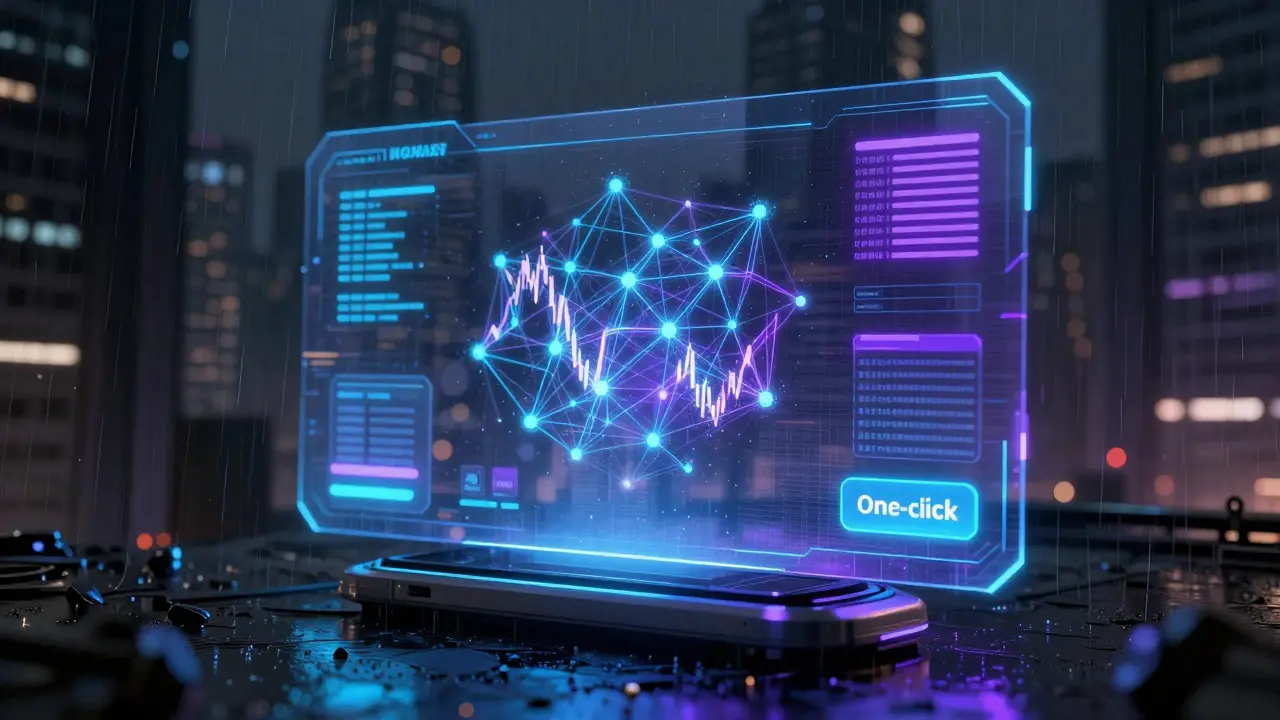
Have you heard about Uniart AI (UNIART)? It’s a cryptocurrency token that promises to bring artificial intelligence to your Web3 investments. The marketing sounds sleek: an "AI agent analyst" that gives you one-click financial insights. But before you throw money at it, let’s look at what this project actually is right now in May 2026.
Here is the hard truth: UNIART is a very small, high-risk asset. It operates on the BNB Smart Chain, has a market cap of only around $313,000, and shows almost zero trading volume on major trackers. If you are looking for a stable investment or a proven technology, this might not be it. If you are curious about how these micro-cap tokens work-and why they are dangerous-keep reading.
Key Takeaways
- Uniart AI (UNIART) is a BEP-20 token launched in 2025 on the BNB Smart Chain.
- The project claims to offer AI-driven investment insights, but there is no public proof of a working product or technical whitepaper.
- Market data is inconsistent, with prices ranging from $0.00002 to $0.0003 across different platforms, indicating low liquidity.
- There are no independent audits, security certifications, or institutional research reports available for this token.
- Buying UNIART requires using decentralized exchanges (DEXs) like PancakeSwap, which carries higher risk than buying on centralized exchanges.
What Exactly Is Uniart AI?
To understand Uniart AI, you first need to know where it lives. It is not its own blockchain. Instead, it is a token built on the BNB Smart Chain (also known as BSC). This means it follows the BEP-20 standard, which is the same rulebook used by thousands of other tokens on Binance’s network.
The team behind UNIART describes their mission as providing "AI-Driven Web3.0 Investment Insights." Their tagline promises a "state-of-the-art AI agent analyst" for market insight and a "one-click AI assistant" for financial analysis. In theory, this sounds useful. Imagine having a bot that scans the blockchain and tells you when to buy or sell.
However, there is a big gap between the promise and the proof. As of mid-2026, there is no accessible whitepaper, no GitHub repository showing code development, and no detailed explanation of the AI models they use. Are they using large language models? On-chain data feeds? We don’t know because the technical details are missing from public records.
The Numbers Don't Add Up: Market Cap and Price Chaos
If you try to find the price of UNIART today, you will likely get confused. This is a major red flag for any investor. Here is what the data looks like across different platforms:
| Platform | Reported Price | 24h Volume | Implied Market Cap |
|---|---|---|---|
| CoinMarketCap | $0.00 (Data Error) | $0 | ~$313,000 |
| Crypto.com | $0.0003015 | N/A | ~$301,500 |
| Coinbase Tracker | $0.00002153 | N/A | ~$21,530 |
| Binance Converter | NaN (No Value) | 0% | Unknown |
Look at that discrepancy. Coinbase lists the token at roughly $0.00002, while Crypto.com lists it at $0.0003. That is a tenfold difference! Why does this happen? Because UNIART has extremely low liquidity. There aren’t enough buyers and sellers to set a clear, fair price. When volume is near zero, even a small trade can swing the price wildly, or worse, leave you unable to sell at all.
The total supply is 1 billion UNIART tokens. According to CoinMarketCap, nearly 100% of these tokens are already circulating. This means there are no locked tokens or vesting schedules protecting investors from a sudden dump by the creators. With only about 6,070 wallet holders, the supply is concentrated in relatively few hands compared to major cryptocurrencies.
Security and Trust: Who Is Watching?
In the crypto world, trust is built through transparency. For a token claiming to use advanced AI, you would expect rigorous security checks. Unfortunately, UNIART lacks these basics.
- No Audits: There is no record of security firms like CertiK, PeckShield, or Trail of Bits auditing the smart contract. Without an audit, you don’t know if the code has backdoors that could allow the developers to steal funds.
- No Liquidity Lock: Legitimate projects often lock their liquidity pools so they can’t pull out the money and run (a "rug pull"). There is no public evidence that UNIART’s liquidity is locked via services like PinkSale or Unicrypt.
- No Institutional Research: Major research outlets like Messari, Binance Research, or CoinDesk have published nothing on UNIART. This isn’t surprising for a micro-cap, but it means you are flying blind without expert analysis.
The fact that the circulating supply is "self-reported" also raises eyebrows. CoinMarketCap accepts this number from the project team without independent verification. This is common for small tokens, but it adds another layer of uncertainty.
How Do You Actually Buy UNIART?
You won’t find UNIART on the main spot markets of top-tier exchanges like Binance or Coinbase Pro. Instead, you have to go through decentralized channels. Here is the typical path users take:
- Get a Wallet: You need a non-custodial wallet that supports BNB Smart Chain. The Binance Web3 Wallet or MetaMask are popular choices.
- Fund with BNB: Buy BNB (Binance Coin) on a centralized exchange and send it to your Web3 wallet. You need BNB to pay for gas fees on the network.
- Connect to a DEX: Go to a decentralized exchange like PancakeSwap. Connect your wallet.
- Import the Token: Paste the official UNIART contract address into the swap interface. Warning: Double-check this address carefully. Scammers create fake tokens with similar names.
- Swap: Exchange your BNB for UNIART. Be prepared for high slippage due to low liquidity.
This process is more complex than buying Bitcoin or Ethereum. It requires technical knowledge and carries higher risks of interacting with malicious contracts or losing money to failed transactions.
UNIART vs. Established AI Tokens
Let’s put UNIART in perspective. The "AI crypto" narrative is crowded. Compare UNIART to established players in the space:
- SingularityNET (AGIX): Has a multi-billion dollar market cap, active development, and listings on major exchanges.
- Fetch.ai (FET): Offers autonomous AI agents with real-world utility and strong institutional backing.
- The Graph (GRT): Provides essential indexing infrastructure for blockchains, widely used by developers.
These projects have years of history, transparent teams, and deep liquidity. UNIART, with its ~$300k market cap and zero volume, sits at the extreme micro-cap end of the spectrum. It is highly speculative. While small caps can sometimes explode in value, they are far more likely to fade away or collapse entirely.
Is Uniart AI a Good Investment?
I’m not here to tell you what to do with your money, but I can tell you what the data says. Based on the available information in May 2026, UNIART fails most of the basic criteria for a safe investment:
- Liquidity Risk: You might buy it, but can you sell it? With $0 daily volume reported on some platforms, exiting your position could be impossible without crashing the price.
- Utility Uncertainty: There is no working product to verify the "AI analyst" claim. You are betting on a promise, not a performance.
- Regulatory Gray Area: There are no regulatory filings or compliance statements. In many jurisdictions, unregistered securities tokens face legal risks.
If you decide to proceed, treat it as entertainment spending, not investing. Only use money you are fully prepared to lose completely. Never invest your life savings or rent money into a token with no audit and no liquidity.
When was Uniart AI (UNIART) launched?
According to Poloniex and other aggregators, Uniart AI was launched in 2025. This makes it a very recent project in the cryptocurrency landscape.
Which blockchain does UNIART operate on?
UNIART operates on the BNB Smart Chain (BSC) and follows the BEP-20 token standard. This means it is compatible with wallets and exchanges that support BSC networks.
Why is the price of UNIART different on different websites?
The price discrepancies are due to extremely low liquidity and thin trading volumes. Different exchanges may have stale data or isolated trades that do not reflect a unified market price. This volatility is a sign of high risk.
Has the UNIART smart contract been audited?
There is no public record of any third-party security audits for the UNIART smart contract. This lack of verification increases the risk of potential vulnerabilities or malicious code.
Can I buy UNIART on Binance or Coinbase directly?
No, UNIART is not listed on the central spot markets of major exchanges like Binance or Coinbase. You must purchase it through decentralized exchanges (DEXs) like PancakeSwap using a Web3 wallet.
What is the total supply of UNIART tokens?
The total supply is 1 billion (1,000,000,000) UNIART tokens. Reports indicate that nearly 100% of this supply is currently circulating, though this figure is self-reported by the project team.