
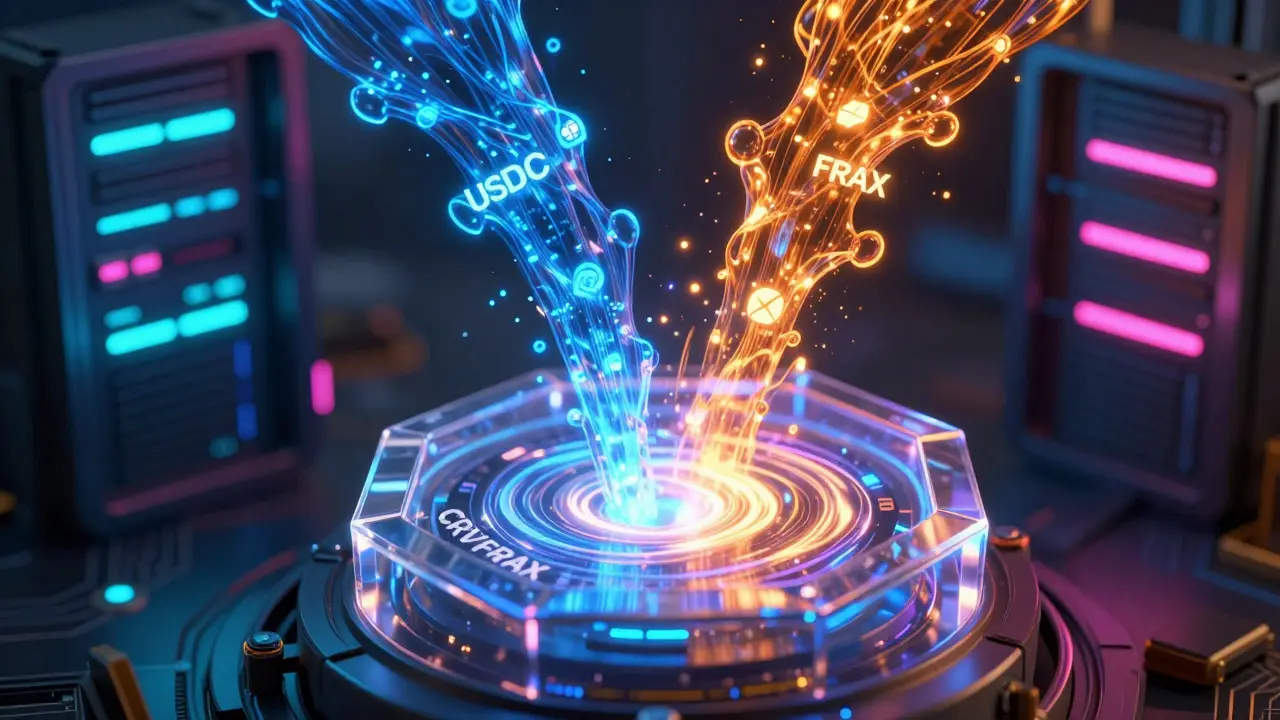
Imagine you have a pile of cash in your pocket and another pile in your bank account. Both are dollars, but moving them around costs time or fees. In the world of crypto, Curve.fi is a decentralized exchange built specifically for swapping stablecoins with minimal slippage. When you want to swap between two specific stablecoins-FRAX, which is partially backed by real assets and partially by code, and Frax Protocol and USDC, which is fully backed by fiat currency held in reserve banks-you don't just walk into a store. You use a digital vault called a liquidity pool.
The token that represents your share in this specific vault is called CRVFRAX. It is a liquidity provider token representing ownership in the FRAX/USDC trading pool on Curve Finance. If you've ever wondered why someone would hold a token that doesn't go up in value like Bitcoin or Ethereum, the answer lies in how decentralized finance (DeFi) pays its workers. This article breaks down exactly what CRVFRAX is, how it makes money for holders, and whether it fits your investment strategy in 2026.
Understanding the Mechanics of the FRAX/USDC Pool
To understand CRVFRAX, you first need to understand the pool it belongs to. Traditional exchanges match buyers and sellers order-by-order. Curve uses an Automated Market Maker (AMM) model. Think of it as a vending machine. You put one coin in (USDC), and the machine gives you out another (FRAX) based on a mathematical formula, not a human decision.
The FRAX/USDC pool is unique because both assets are pegged to the US dollar. This means the price difference between them should theoretically be zero. However, small discrepancies happen due to market demand. Traders exploit these tiny differences, paying small fees to do so. These fees accumulate in the pool.
When you deposit equal values of FRAX and USDC into this pool, you receive CRVFRAX tokens in return. Your CRVFRAX balance is essentially a receipt showing how much of the total pool you own. If the pool grows because traders pay fees, your slice of the pie gets slightly larger. If you withdraw your funds later, you get back your original FRAX and USDC plus your share of the accumulated fees.
| Asset | Type | Collateral Mechanism | Role in Pool |
|---|---|---|---|
| FRAX | Fractional-Algorithmic | Mix of Fiat & Algorithmic Stability | Trading Pair Component |
| USDC | Fiat-Collateralized | 1:1 Backed by Cash Reserves | Trading Pair Component |
| CRVFRAX | Liquidity Provider Token | Represents Pool Share | Proof of Ownership & Fee Claim |
How CRVFRAX Generates Yield for Holders
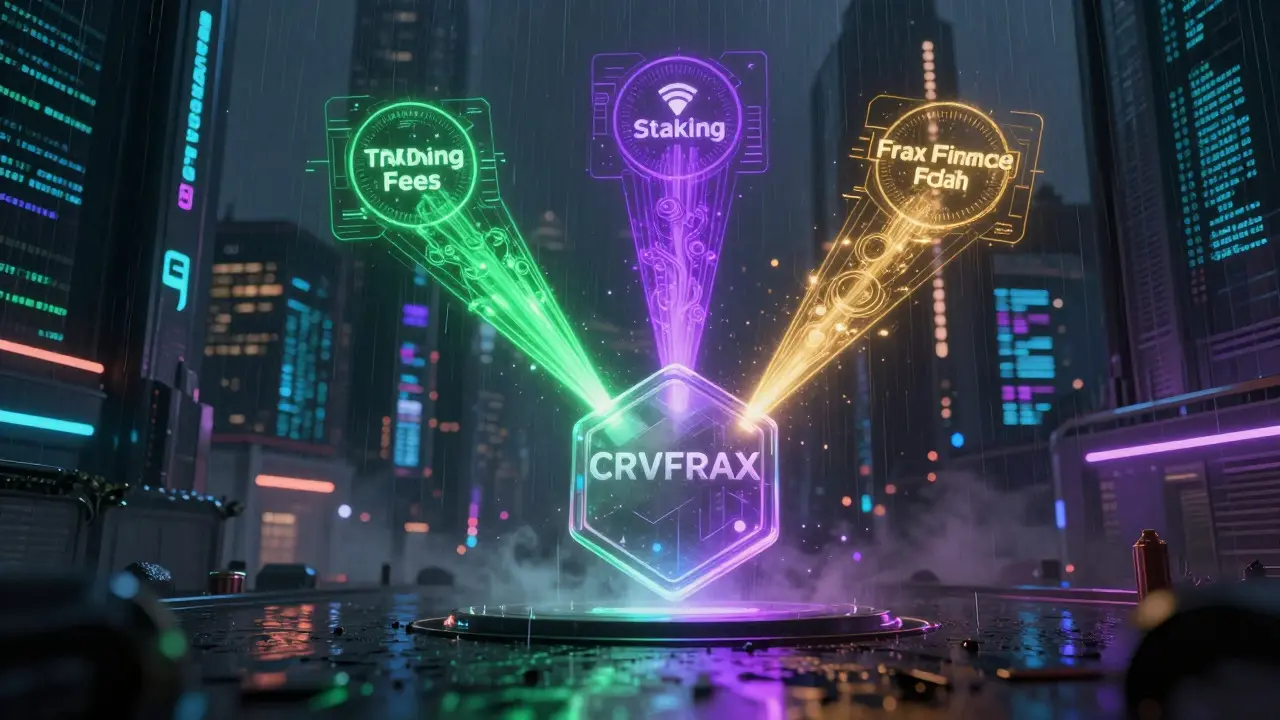
Holding CRVFRAX isn't just about parking your money; it's about earning passive income through three main channels. Understanding these streams is crucial for evaluating if this asset meets your financial goals.
- Trading Fees: Every time someone swaps FRAX for USDC or vice versa on Curve, they pay a small fee (usually around 0.04% for stablecoin pools). This fee goes directly into the pool. Since you own a piece of the pool via CRVFRAX, you earn a proportional share of these fees. In high-volume periods, this can generate significant annual percentage yields (APY).
- Staking Rewards: You can take your CRVFRAX tokens and stake them in the Curve Gauge system. By doing this, you vote on where Curve's governance token (CRV, the native governance token of Curve Finance) emissions go. In return, you receive CRV tokens as rewards. These CRV tokens can be sold for profit or restaked.
- Frax Finance Integration: Because FRAX is involved, there are often additional incentives from the Frax Finance ecosystem. They may offer extra rewards to users who provide liquidity to their stablecoin, boosting the overall APY of the CRVFRAX position.
This multi-layered reward structure is why CRVFRAX has attracted millions in liquidity. It combines the safety of stablecoins with the active yield generation of DeFi protocols.
Risks Associated with Holding CRVFRAX
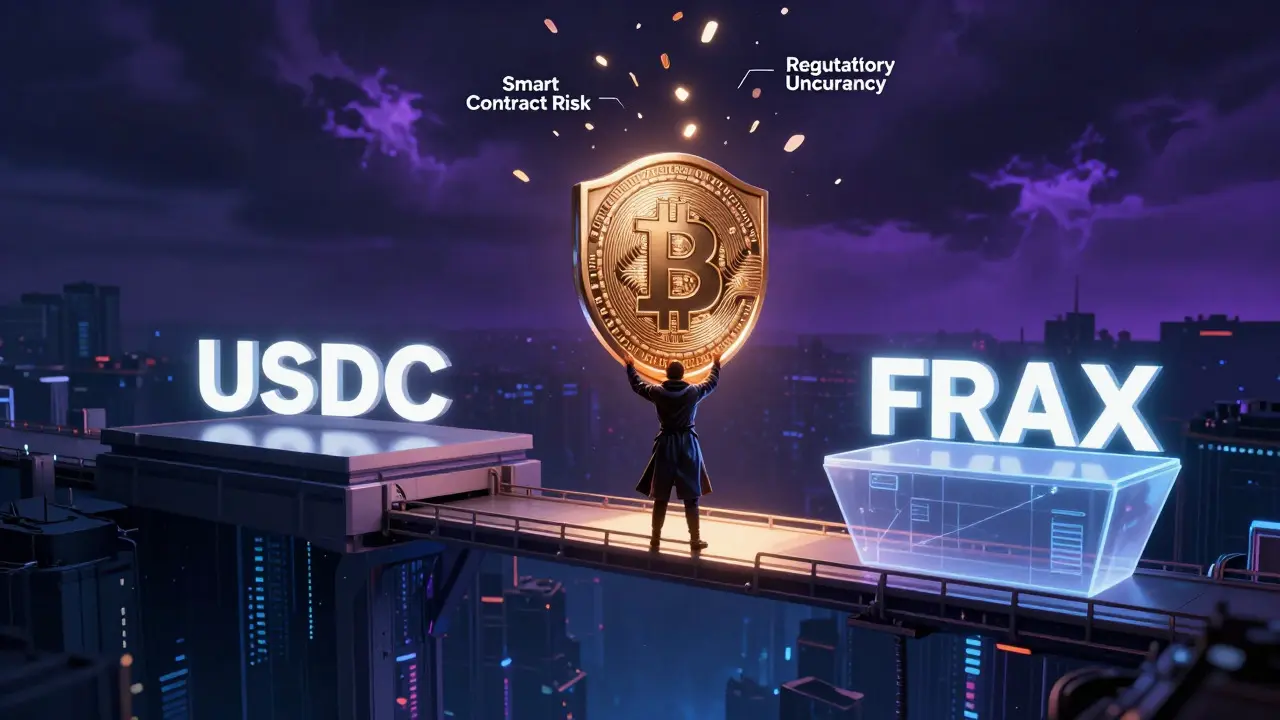
No investment is risk-free, even when dealing with stablecoins. While CRVFRAX is considered lower risk than holding volatile altcoins, several factors can impact your capital.
Impermanent Loss (IL): This sounds scary, but in stablecoin pools, it's usually minimal. IL happens when the price ratio of the two assets in the pool changes significantly. Since FRAX and USDC are both pegged to $1, major deviations are rare. However, if FRAX were to de-peg (lose its $1 value) temporarily while USDC stayed strong, you would end up with more FRAX and less USDC in your wallet upon withdrawal. If FRAX recovers, you're fine. If it doesn't, you lose value.
Smart Contract Risk: The entire pool runs on code deployed on the Ethereum Blockchain, the underlying infrastructure supporting most DeFi applications. If there is a bug in the Curve smart contracts or the FRAX contract, hackers could potentially drain the pool. Audits help mitigate this, but they don't eliminate risk entirely.
Regulatory Uncertainty: Stablecoins face increasing scrutiny from global regulators. Changes in regulations regarding USDC or algorithmic stablecoins like FRAX could affect their usability or liquidity, indirectly impacting the value of the CRVFRAX pool.
Market Performance and Liquidity Analysis (2026 Context)
As of mid-2026, the landscape for CRVFRAX reflects a maturing DeFi market. The token trades close to its peg, typically hovering around $1.01 USD per share. This slight premium often indicates healthy demand for the liquidity provided.
Historically, CRVFRAX reached an all-time high of $1.12 USD in August 2023 during a period of intense DeFi bull market activity. Since then, prices have normalized. Current data shows a market capitalization of approximately $56 million, indicating a moderately sized pool. While not as deep as the USDT/USDC pools, it offers sufficient liquidity for most retail and institutional traders without causing massive price slippage.
The number of holders remains relatively concentrated, with hundreds of addresses controlling the majority of the supply. This is typical for liquidity pools, as large institutions often dominate provision to maximize fee earnings. For the average user, this means entering and exiting positions is generally smooth, provided you aren't moving millions of dollars at once.
Who Should Invest in CRVFRAX?
Not every crypto investor needs CRVFRAX in their portfolio. Here is how to decide if it’s right for you:
- Conservative DeFi Users: If you want exposure to blockchain technology but fear the volatility of Bitcoin or Ethereum, stablecoin LP tokens are a middle ground. You keep your principal safe (mostly) while earning higher yields than traditional savings accounts.
- Yield Farmers: If you actively manage your portfolio and understand how to claim and compound rewards (like CRV tokens), this pool can be part of a diversified yield strategy.
- Long-Term Holders of FRAX or USDC: If you already plan to hold either of these stablecoins, putting them to work in the pool generates free income rather than letting them sit idle in a wallet.
Conversely, if you are looking for speculative gains where the token price itself doubles or triples, CRVFRAX is likely not the right choice. Its value is tied to the underlying stablecoins, so it won't experience exponential growth like a new meme coin.
How to Get Started with CRVFRAX
Entering the pool requires a few technical steps. First, you need a Web3 wallet like MetaMask or WalletConnect. Next, acquire either FRAX or USDC on a centralized exchange or bridge them to the Ethereum network. Finally, connect your wallet to the Curve.fi interface, select the FRAX/USDC pool, deposit your assets, and confirm the transaction. You will immediately receive CRVFRAX tokens in your wallet.
Remember to factor in gas fees. On Ethereum, transaction costs can vary wildly. During times of high network congestion, the cost to enter or exit the pool might outweigh the short-term fees earned. Many users opt to stake their CRVFRAX for longer periods to amortize these initial costs.
Is CRVFRAX a cryptocurrency or a receipt?
Technically, it is a token on the blockchain, but functionally, it acts more like a receipt or a bond. It proves you deposited assets into a pool and entitles you to a share of that pool's contents plus fees. Unlike Bitcoin, its value doesn't fluctuate wildly based on market sentiment; it stays near $1.
Can I lose my money holding CRVFRAX?
Yes. Risks include smart contract hacks, the de-pegging of FRAX or USDC, and impermanent loss if the stablecoins diverge significantly in value. While rare for major stablecoins, these events have happened in the past.
What is the difference between CRV and CRVFRAX?
CRV is the governance token of the Curve platform, used for voting and receiving rewards. Its price is volatile. CRVFRAX is a specific liquidity token for the FRAX/USDC pool. You might earn CRV tokens *by* staking your CRVFRAX, but they are distinct assets with different purposes.
Do I need to hold ETH to buy CRVFRAX?
You need ETH to pay for gas fees on the Ethereum network when interacting with the Curve smart contract. So yes, having some ETH in your wallet is necessary to execute transactions, even though you are depositing FRAX and USDC.
Is CRVFRAX available on other blockchains?
The specific CRVFRAX token discussed here operates on Ethereum. However, Curve Finance has expanded to other chains like Arbitrum, Optimism, and Polygon. There may be similar FRAX/USDC pools on those networks, but the tokens and contracts are separate.