
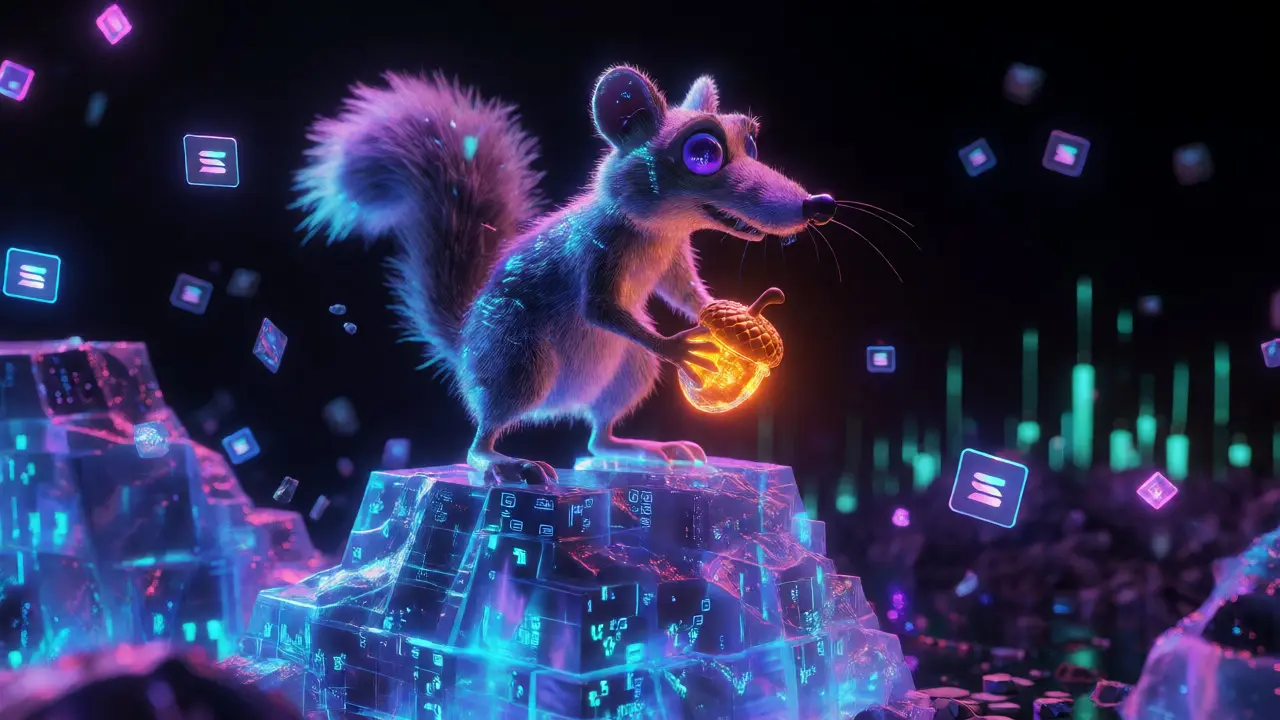
Imagine a half-squirrel, half-rat creature who lost his fortune to global warming and is now chasing opportunities in the chaotic world of decentralized finance. That’s Scrat, or SCRAT, a meme-based cryptocurrency token that launched on the Solana blockchain. If you’ve stumbled upon this ticker while scrolling through your exchange feed, you’re probably wondering if it’s the next big pump or just another digital ghost town. The reality sits somewhere in between, and understanding where it fits requires looking past the cartoonish branding.
This article breaks down exactly what Scrat is, how it functions technically, and whether its current market status offers any real value for investors. We’ll look at the hard data-supply, volume, and price action-so you can decide if lending a hand to this degen icon makes sense for your portfolio.
The Origin Story: From Iceberg to Blockchain
Every meme coin needs a narrative, and Scrat leans heavily into pop culture nostalgia mixed with crypto resilience. The project describes its mascot as "once the richest creature in existence" who suffered a "tragic accident involving an iceberg and global warming." This backstory isn’t just flavor text; it sets the tone for the community’s mindset. The character has been "dropped, smooshed, even set on fire," yet he refuses to give up. This mirrors the experience of many early adopters in the crypto space who have held through brutal drawdowns.
The call to action is simple: "He can't do it alone. Are you willing to lend a hand?" It positions token holders not just as speculators, but as partners in a comeback story. While this emotional hook drives community engagement, it doesn’t necessarily translate to technical utility. Unlike projects building new Layer-2 solutions or DeFi protocols, Scrat relies entirely on social momentum and the sheer absurdity of its branding to maintain relevance.
Technical Specifications and Tokenomics
Let’s strip away the memes and look at the numbers. Scrat operates on the Solana network, which means it benefits from high transaction speeds and low fees compared to Ethereum-based alternatives. You can verify every transaction using the contract address starting with 3geznp41v on Solscan.io.
Here are the core metrics you need to know:
- Total Supply: Fixed at 100 million SCRAT tokens.
- Circulating Supply: Approximately 99.99 million, meaning nearly 100% of all tokens are already in circulation.
- Fully Diluted Valuation (FDV): Matches the market cap because there are no locked tokens waiting to be unlocked.
- Holder Count: Around 3,610 unique wallets hold the token.
The fact that 100% of the supply is circulating is a double-edged sword. On one hand, there’s no risk of sudden inflation from team unlocks diluting your holdings. On the other hand, it means all selling pressure comes from existing holders. If a few whales decide to exit, there’s no buffer of locked liquidity to absorb the shock.
| Metric | Value / Status | Implication |
|---|---|---|
| Current Price | ~$0.001165 - $0.001301 USD | Micro-cap asset with low absolute cost per unit. |
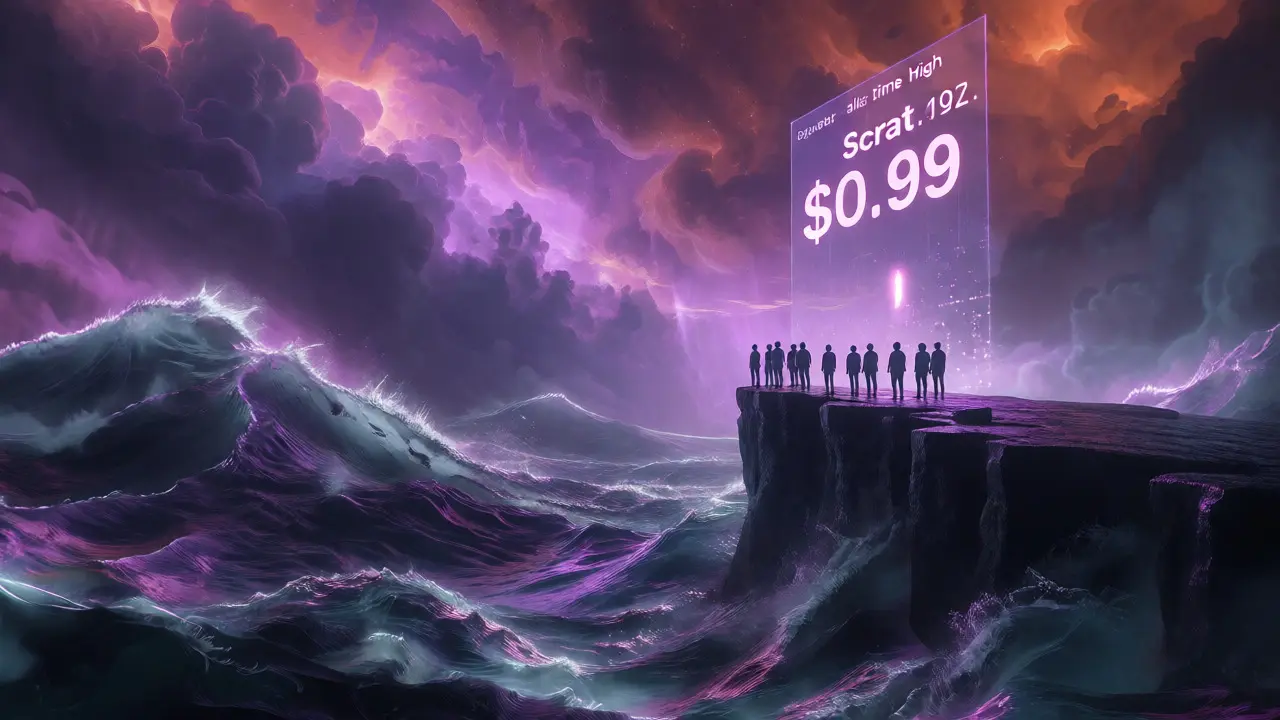
| All-Time High | $0.9907 USD | Represents a >99% decline from peak hype. |
| Market Cap | ~$137k - $145k USD | Extremely small; highly susceptible to manipulation. |
| 24h Volume | $0 USD (reported) | Indicates negligible trading activity or illiquidity. |
| Volatility (30d) | 8.02% | Relatively stable for a meme coin, likely due to lack of volume. |
The Liquidity Problem: Why Volume Matters
Here is the biggest red flag for anyone considering buying Scrat today: trading volume. Multiple tracking platforms, including Gate.io and CoinGecko, report a 24-hour trading volume of $0 USD. In the crypto world, volume is oxygen. Without it, the market suffocates.
When volume hits zero, it usually means one of two things. Either the token is so illiquid that trades happen so infrequently they don’t register within the standard reporting window, or the project has been effectively abandoned by active traders. For a micro-cap token like Scrat, this creates a severe risk known as slippage. Even if you wanted to sell $100 worth of SCRAT, you might find no buyers, or you’d have to accept a significantly lower price than the last recorded trade to get out.
This lack of liquidity also distorts technical analysis. Indicators like the Relative Strength Index (RSI) currently sit at 69.63, approaching overbought territory. But does an RSI reading mean anything when no one is actually trading? Probably not. These metrics become noise in a vacuum. The price might look "stable" simply because it hasn’t moved since the last tiny transaction weeks ago.
Risks Beyond the Chart
Beyond the cold hard numbers, there are structural risks you should understand before deploying capital.
Absence of Security Audits
There is no public record of a professional security audit for the Scrat smart contract. While Solana’s architecture is robust, unaudited contracts can contain vulnerabilities. More importantly, in the meme coin sector, "rug pulls" often involve malicious code rather than technical bugs. Without an audit, you are trusting the anonymous developer completely.
Identity Confusion
You must be careful about which "Scrat" you are buying. There is another project called "Scrat the Squirrel" with the same ticker but a different contract address and a 1 billion token supply. There is also "Scratch Meme Coin" (SCRATS). Because these names are similar, inexperienced investors often buy the wrong token by mistake. Always verify the contract address starting with 3geznp41v before confirming any transaction.
Development Transparency
Information about the development team, roadmap, or future utility is scarce. The website, scrat.meme, focuses primarily on the character lore and community links. There are no recent news updates, partnership announcements, or development milestones listed on major aggregators. This silence often signals a project that has run its course or is purely community-driven without formal leadership.
Is Scrat a Good Investment?
If you are looking for a safe haven or a tech-driven play, Scrat fails both tests. It offers no yield, no staking rewards mentioned in primary sources, and no clear utility beyond speculation.
However, crypto markets operate on cycles. Some investors specialize in "zombie coins"-tokens that have died but retain a small, loyal holder base. If the broader Solana ecosystem experiences a massive bull run, speculative money might trickle down to forgotten micro-caps like Scrat. The fixed supply means that if demand suddenly returns, the price could spike sharply because there are no new tokens being minted to dampen the rise.
But betting on this scenario is akin to buying a lottery ticket. The probability of a return to its all-time high of $0.99 is infinitesimal. A more realistic hope might be a modest recovery driven by a viral social media moment or a coordinated community push. Given the current $0 volume, any entry position should be treated as money you are willing to lose entirely.
How to Buy and Verify Scrat
If you still want to take the gamble, here is the safest way to proceed:
- Find the Right Exchange: Check listings on Gate.io, Raydium, or Jupiter Aggregator. Since volume is low, decentralized exchanges (DEXs) on Solana are often the only venues with actual order books.
- Verify the Contract: Copy the official contract address from Solscan or CoinMarketCap. Paste it into your wallet search bar. Do not rely solely on the name "Scrat."
- Check Liquidity Pools: Before swapping, look at the liquidity pool size. If the pool holds less than $5,000 in total value, your trade will suffer heavy slippage.
- Start Small: Given the volatility and liquidity risks, allocate only a tiny fraction of your portfolio to this experiment.
Final Thoughts
Scrat (SCRAT) is a classic example of the boom-and-bust cycle inherent in meme coins. It captured attention with a quirky narrative and rode the wave of Solana’s popularity, but it struggled to convert that attention into sustained economic activity. Today, it exists in a state of suspended animation-technically alive, but commercially dormant.
For the average investor, Scrat represents high risk with unclear reward potential. It lacks the fundamental pillars of value: utility, transparent governance, and active development. Its survival depends entirely on the whims of its 3,610 holders and the unpredictable tides of crypto sentiment. If you enjoy the thrill of hunting for hidden gems and don’t mind the possibility of holding a bag forever, Scrat might scratch that itch. Otherwise, keep your eyes open for projects with verifiable volume and clear roadmaps.
Where can I buy Scrat (SCRAT) crypto?
Scrat is primarily traded on decentralized exchanges (DEXs) within the Solana ecosystem, such as Raydium and Jupiter. It may also be listed on centralized exchanges like Gate.io, though trading volume is extremely low. Always verify the correct contract address before purchasing.
Why is Scrat's trading volume reported as $0?
A $0 trading volume indicates that no significant transactions occurred in the last 24 hours across tracked exchanges. This suggests extreme illiquidity, meaning it may be difficult to buy or sell large amounts without significantly affecting the price.
Is Scrat the same as the squirrel from Ice Age?
The branding draws inspiration from the character Scrat, but it is not officially affiliated with the movie franchise. There is also a separate token called "Scrat the Squirrel" which explicitly references the Ice Age character. Be sure to distinguish between these projects by checking their unique contract addresses.
What is the total supply of SCRAT tokens?
The total supply is fixed at 100 million SCRAT tokens. Currently, approximately 99.99 million are in circulation, meaning there are no plans for additional minting or token unlocks that would dilute existing holders.
Does Scrat have any real-world utility?
Currently, Scrat functions primarily as a speculative meme asset. There is no documented utility such as payment integration, staking rewards, or governance rights. Its value is derived from community sentiment and market speculation rather than functional application.
Mike Thomas
October 5, 2026 AT 10:45Bro this is exactly why I love digging into these micro-caps! The narrative of the squirrel coming back from the dead is actually kinda inspiring if you think about it. We are all just trying to survive the drawdowns and find that next big win right? I’m not saying buy everything but don’t sleep on the community spirit here. If Solana heats up again this thing could fly purely on vibes and nostalgia. Keep grinding fam we got this!
Glen Russell
October 6, 2026 AT 18:47The absence of a security audit is a critical oversight that cannot be ignored by any serious investor. One must consider the possibility that the developer remains anonymous for a reason which often correlates with malicious intent in the meme coin sector. Furthermore the confusion between SCRAT and Scrat the Squirrel suggests a lack of clear branding or perhaps an intentional strategy to confuse retail investors. It is imperative to verify contract addresses manually as automated searches frequently yield incorrect results. Trusting an unaudited smart contract with significant capital exposure is a gamble rather than an investment strategy. The market data indicating zero volume further supports the hypothesis that active interest has evaporated completely. Without liquidity the price discovery mechanism fails rendering technical analysis useless. Therefore one should approach this asset with extreme caution and skepticism regarding its long-term viability.
Sandra Speakerworth
October 7, 2026 AT 03:55I find myself pondering the nature of value itself when looking at tokens like Scrat. Is value derived solely from utility or can collective belief create something tangible out of thin air? The story of resilience mirrors our own struggles within the broader economic landscape. Perhaps the worth lies not in the financial return but in the shared experience of holding onto hope during uncertain times. We must ask ourselves what we truly seek when we engage with these digital artifacts. Is it profit or is it connection to a community that understands the absurdity of modern finance? These questions remain open and invite deeper reflection beyond mere price charts.
Dana T.
October 8, 2026 AT 03:02Zero vol means dead project. No audit = rug risk. Don't touch.
Richard Moore
October 9, 2026 AT 22:08Hey guys i think u might be too harsh on scrat lol. Sometimes these small coins pop off when nobody expects it. I remember buying some solana memes last year that were basically dead and then boom 10x in a week. Its all about timing and luck honestly. But yeah the zero volume part is scary so maybe just put in like 5 bucks and forget about it? Thats my strategy anyway haha
Kevin Van Deusen
October 11, 2026 AT 01:41People need to stop throwing money at garbage because they want to feel special. You are supporting lazy development and no utility. Just sell your bags and go buy something real. This isn't investing it's gambling for people who hate their savings account.
Aman Kumar Shah
October 11, 2026 AT 02:15Well, well, well... look who decided to crawl out of the digital woodwork to offer some 'analysis' on a token that essentially trades in the void. It is quite fascinating, really, how we can dissect the anatomy of a zombie with such clinical precision while ignoring the fact that the patient hasn't taken a breath in months. The mention of 'slippage' is particularly amusing given that slippage requires a counterparty, and currently, there appear to be none. One wonders if the author is writing this for investors or merely for the sake of filling space on the internet. Nevertheless, the breakdown of the supply metrics is accurate, even if the conclusion feels somewhat predetermined. We shall see if the 'comeback story' holds water or if it dissolves like sugar in hot tea.
Chris Larkins
October 12, 2026 AT 12:55I appreciate the detailed breakdown provided in the article. It is important to maintain a respectful perspective when discussing assets that may not perform as expected. While the risks are clearly outlined, we should also acknowledge the efforts of the community members who continue to support the project despite the challenges. A supportive approach encourages healthy discussion rather than dismissal. For those considering entry, verifying the contract address is indeed the most prudent first step. Let us keep the conversation constructive and focused on facts rather than emotional reactions.
Ana Caroline
October 13, 2026 AT 07:00The notion that 'community spirit' translates to financial value is a quaint illusion held by those who have never managed a real portfolio. Meme coins are ephemeral distractions for the intellectually lazy. To suggest that nostalgia for a cartoon character warrants capital allocation is to misunderstand the fundamental mechanics of market liquidity. One does not invest in ghosts; one speculates on them, and usually loses. The pretension of treating this token as a serious subject worthy of deep philosophical inquiry is misplaced. It is noise, nothing more.
Steve Parshall
October 13, 2026 AT 10:52Chill vibes only. I saw this on Twitter a few weeks ago. Looks pretty cool actually. Even if it goes to zero it was fun watching the chart move. No stress.
Queen Hijabi
October 14, 2026 AT 16:49Wait did you say Glen Russell commented? Because his take on the audit issue is spot on. Usually when there is no audit and the dev is anon things get sketchy fast. I dropped mine last month after seeing the volume drop to absolute zero. Not worth the headache anymore.
Glen Russell
October 15, 2026 AT 03:07Thank you for validating the concern regarding the lack of professional security audits. It is reassuring to know that other participants recognize the inherent dangers associated with unaudited smart contracts in the meme coin ecosystem. Your decision to exit the position prior to further decline demonstrates prudent risk management. Indeed the correlation between anonymity and potential malice is well-documented in blockchain history. We must remain vigilant against projects that prioritize marketing over technical transparency. The current state of illiquidity serves as a stark reminder that without active trading the theoretical value of an asset becomes meaningless. Continued skepticism is warranted until verifiable improvements are implemented.
Amit Sharma
October 15, 2026 AT 20:06eh whatever man. crypto is all fake anyway. just waiting for the bubble to burst completely so we can go back to normal life. sc rat sc rat. boring.
Shruti Mala
October 17, 2026 AT 18:23Omg wait!! 🤯 Are you sure about the zero volume?? I checked Raydium just now and saw a tiny swap?! 😱 Maybe the bots are waking up?? ✨ Also the lore is SO cute though 🐿️💔 I’d still hold just for the aesthetic even if it dumps. Who else is vibing with the comeback energy?? 🚀🔥
Dana T.
October 19, 2026 AT 17:29tiny swap != volume. bot wash trading. ignore.
Richard Holle
October 19, 2026 AT 18:11Good point on the bots. Wash trading distorts the view. Stay safe everyone.
Kerry Sims
October 20, 2026 AT 20:31it’s weird how we assign meaning to pixels moving around. maybe scrat represents the futility of chasing things that aren’t there. or maybe it’s just a squirrel. either way i’m tired.