
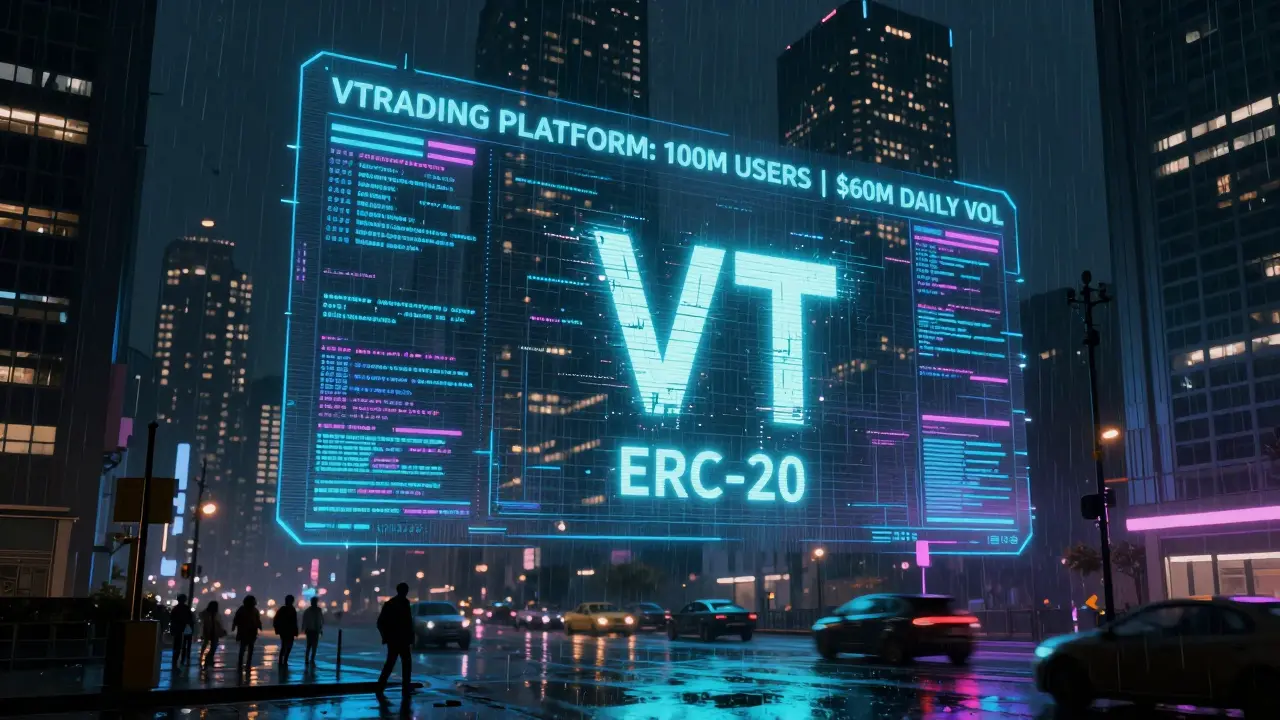
The VTRADING (VT) token is a cryptocurrency launched in 2024 that claims to power an AI-driven trading platform called Vtrading. At first glance, it sounds like a promising tool: artificial intelligence helping everyday traders make smarter moves in crypto markets. But the reality is more complicated. Behind the flashy claims, there’s a major disconnect between the platform’s user numbers and the token’s actual market value.
What is VTRADING (VT) really?
VTRADING (VT) is an ERC-20 token on the Ethereum blockchain. Its contract address is 0x69CadE383dF52ec02562869Da8Aa146Be08c5c3c. It was introduced in 2024 as the native utility token for the Vtrading ecosystem - a platform that’s been around since December 2017. The platform itself offers tools for algorithmic trading, bot creation, strategy backtesting, and asset management. It’s designed for traders who want to automate their crypto trades using visual interfaces and AI-powered logic.
But here’s the twist: while the Vtrading platform claims to have over 100 million users worldwide, 12 million trading bots, and $60 million in daily trading volume, the VT token doesn’t seem to be part of that equation. Most users likely interact with the platform without ever holding or using VT tokens. That’s not just odd - it’s a red flag for anyone wondering why the token exists at all.
Token supply and pricing: A tale of two numbers
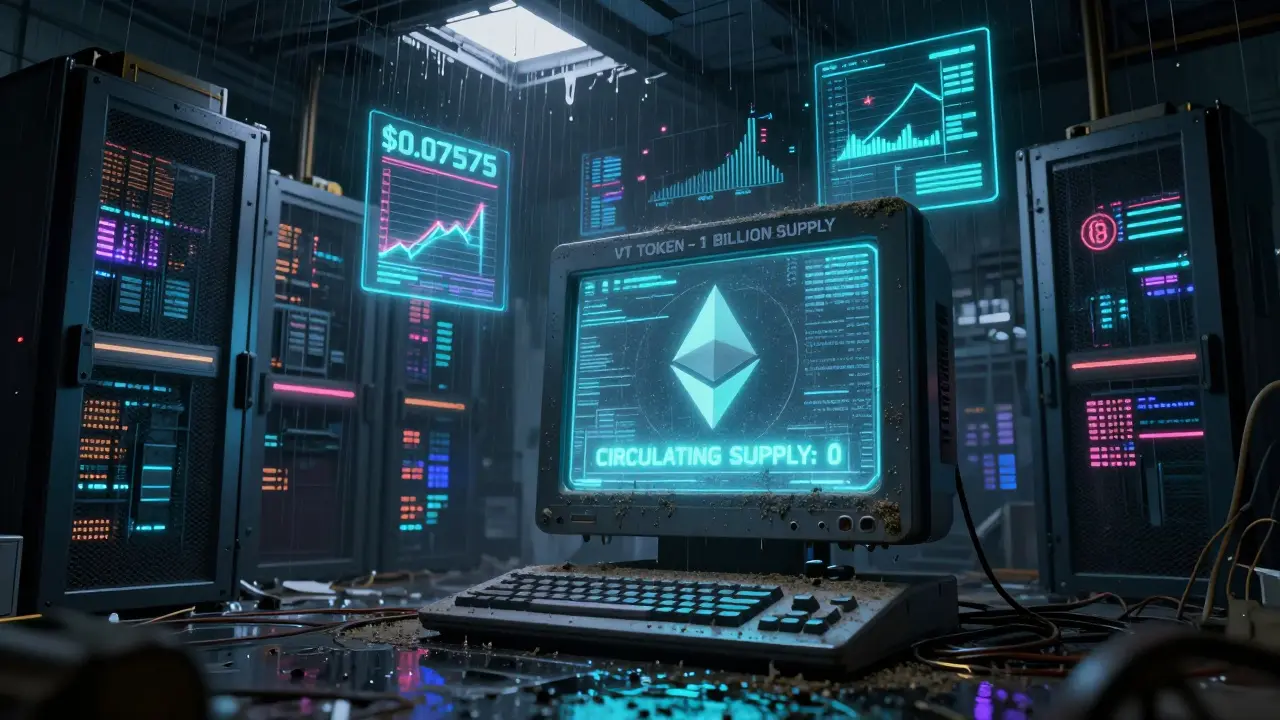
VTRADING has a fixed total supply of 1 billion tokens. That’s it. No more will ever be created. That sounds stable - until you look at the numbers.
Some sources say all 1 billion tokens are in circulation. Others say none are. That’s not a glitch - it’s a sign of poor data transparency. The fully diluted valuation (FDV) is listed around $1.56 million, but the market cap is reported as $0.00 on most platforms. How can a token with a billion supply have zero market cap? Either nobody is trading it, or the data is broken.
As of March 2026, the price of VT hovers between $0.0013 and $0.0017. That’s down over 97% from its all-time high of $0.07575 in May 2024. It hit a low of $0.001041 in July 2025, and since then, it’s only bounced back about 50%. The 7-day price range shows wild swings - from $0.001169 to $0.001840. That’s a 57% swing in just a week. That kind of volatility isn’t typical for a token tied to a large platform. It’s more like a speculative asset with no real demand.
Where can you trade VT?
VTRADING is listed on a few centralized exchanges, but trading is extremely limited. Gate.io is the main hub, accounting for nearly 70% of all volume. The VTRADING/USDT pair there has a 24-hour volume of around $79,700. MEXC Global shows about $4,500, and Uphold also lists it. But compared to even small-cap coins, this is tiny.
For context: a single popular meme coin might trade over $100 million in a day. VT’s highest daily volume is less than $80,000. That’s not a market - it’s a whisper.
On Gate.io, the price is around $0.00179. On MEXC, it’s $0.00157. The inconsistency between exchanges isn’t just confusing - it’s risky. If you buy VT on one platform, you might not be able to sell it at the same price on another. Liquidity is thin. Slippage is high. And if you need to cash out quickly, you might not find buyers.
The platform vs. the token: Why the gap?
This is the core mystery. Vtrading the platform is a serious operation. It has:
- 100 million+ registered traders
- 12 million+ automated trading bots
- $60 million+ in daily trading volume
- API security with multi-algorithm encryption
- Custom deployment options for large clients
It’s built for scale. It uses Hbase for fast backtesting. It has rebate systems and documentation tools. It’s not some fly-by-night project. So why doesn’t it use its own token?
The most likely answer: VT isn’t necessary to use the platform. Users pay for premium features with fiat currency or stablecoins. The token might have been launched as a speculative play - not a utility. Maybe the team hoped to create a token economy, but users never adopted it. Or worse: the token was meant to raise funds, and the platform kept running independently.
This disconnect makes VT hard to value. If you’re a trader using Vtrading’s tools, you don’t need VT. If you’re an investor, there’s no clear reason to hold it. No staking. No governance. No fee discounts. No burning mechanism. Just a token with no clear use case.
Is VTRADING a scam?
It’s not labeled a scam by regulators - but it’s not far off. There’s no audit of the smart contract. No public GitHub activity. No developer updates. No community forums or Discord servers linked to the token. The Vtrading website talks about the platform, but barely mentions VT beyond a token sale page.
Compare that to real AI crypto projects like Fetch.ai or SingularityNET. They have active developer teams, public roadmaps, and token utilities built into their core services. VT has none of that. It’s a token without a function.
Its ranking on CoinGecko is #3413. That’s below 99% of all cryptocurrencies. Even obscure tokens with tiny teams and no product rank higher because they have active trading or community support.
Should you buy VTRADING (VT)?
If you’re looking to invest in AI-driven crypto trading tools, VT isn’t the way.
Here’s why:
- No utility: You can’t use it to pay for services, earn rewards, or vote on upgrades.
- Zero market confidence: Market cap of $0.00 isn’t a typo - it’s a statement.
- Extreme volatility: Price swings of 50% in a week mean you’re gambling, not investing.
- No transparency: No audits, no team info, no roadmap.
The only reason to buy VT right now is if you believe the price will go up because someone else buys it. That’s classic pump-and-dump behavior. And with a token that dropped 97% from its peak, that’s a dangerous bet.
What’s next for VTRADING?
There’s no public roadmap. No announcements. No updates since late 2024. The platform continues to operate, but the token appears frozen in time.
If the Vtrading team wanted to fix this, they could:
- Integrate VT as a payment method for premium features
- Launch staking with rewards
- Use the token for bot creation fees or API access
- Conduct a smart contract audit and publish it
But so far, they haven’t. And that’s telling.
The Vtrading platform might be legitimate. But the VT token? It’s a ghost. A relic of a failed tokenomics experiment. And unless something changes soon, it’s unlikely to ever become anything more.
Is VTRADING (VT) a good investment?
No, VTRADING (VT) is not a good investment. The token has no clear utility within the Vtrading platform, its market cap is effectively zero, and its price has dropped over 97% from its peak. There’s no staking, no governance, no fee discounts, and no developer activity. The token appears to be disconnected from the platform’s real users and operations. Buying VT is speculation, not investment.
Can I use VT to pay for Vtrading platform services?
Based on available information, no. Users of the Vtrading platform appear to pay for premium features using fiat currency or stablecoins like USDT. There’s no evidence that VT is accepted as payment for bot creation, strategy editing, or API access. The token’s role within the ecosystem remains unclear and likely non-functional.
Why is the market cap of VT listed as $0.00?
The market cap is calculated by multiplying the circulating supply by the current price. If exchanges report zero circulating supply - or if trading volume is too low to establish a reliable price - the market cap becomes zero. In VT’s case, this likely means there’s no active buying pressure. Even with 1 billion tokens in existence, if no one is trading them, the value drops to zero.
Is VTRADING built on Ethereum?
Yes, VTRADING (VT) is an ERC-20 token on the Ethereum blockchain. Its contract address is 0x69CadE383dF52ec02562869Da8Aa146Be08c5c3c. This means it can be stored in any Ethereum-compatible wallet like MetaMask or Trust Wallet, and traded on decentralized exchanges that support ERC-20 tokens. However, it’s primarily traded on centralized exchanges like Gate.io and MEXC.
What’s the difference between Vtrading the platform and VTRADING the token?
Vtrading is a trading platform launched in 2017 that helps users automate crypto trades using AI and visual strategy builders. It has over 100 million users and processes $60 million in daily volume. VTRADING (VT) is a cryptocurrency token launched in 2024 that was meant to be part of that ecosystem. But there’s no evidence users need VT to access the platform. The platform functions independently - making the token’s purpose unclear.
Where is VTRADING traded the most?
Gate.io is the primary exchange for VTRADING (VT), accounting for nearly 70% of all trading volume. The VTRADING/USDT pair there has a 24-hour volume of around $79,700. MEXC Global and Uphold also list the token, but with far less activity. This limited liquidity makes it risky to buy or sell large amounts.
Has VTRADING been audited?
There is no public record of a smart contract audit for the VTRADING (VT) token. No security firm like CertiK, SlowMist, or Hacken has published an audit report. The contract address exists on Etherscan, but without an audit, users have no assurance that the code is secure or free from vulnerabilities. This is a major red flag for any crypto asset.
What happened to VTRADING’s price after its all-time high?
VTRADING reached its all-time high of $0.07575 on May 30, 2024. Since then, it has lost over 97% of its value. By July 17, 2025, it hit an all-time low of $0.001041. As of March 2026, it trades around $0.0015 - still 98% below its peak. This dramatic decline suggests a loss of investor confidence and lack of sustained demand.
Final thoughts
VTRADING (VT) is a token with a story - but not a future. The Vtrading platform is real. It’s been around for years. It has users. It has tools. But the token? It’s an afterthought. A marketing add-on with no function. If you’re interested in AI trading bots, use the platform. But leave VT alone. There’s nothing here to invest in - only noise.
Anshita Koul
March 11, 2026 AT 06:06They didn’t fail because of tech. They failed because they forgot: utility isn’t a marketing slide. It’s a promise.
PIYUSH KOTANGALE
March 11, 2026 AT 19:22vishnu mr
March 12, 2026 AT 05:26Grace van Gent-Korver
March 12, 2026 AT 12:26Zephora Zonum
March 13, 2026 AT 07:35Anthony Marshall
March 13, 2026 AT 21:20vasantharaj Rajagopal
March 15, 2026 AT 05:37ann neumann
March 15, 2026 AT 06:49William Montgomery
March 16, 2026 AT 06:11Mara Alves Mariano
March 17, 2026 AT 07:37Adam Ashworth
March 18, 2026 AT 20:02Allison Davis
March 19, 2026 AT 04:42Tom Jewell
March 19, 2026 AT 21:31karan narware
March 21, 2026 AT 14:19Michael Suttle
March 23, 2026 AT 09:30Jenni James
March 24, 2026 AT 18:45Chelsea Boonstra
March 26, 2026 AT 05:25Alex Thorn
March 28, 2026 AT 01:12