
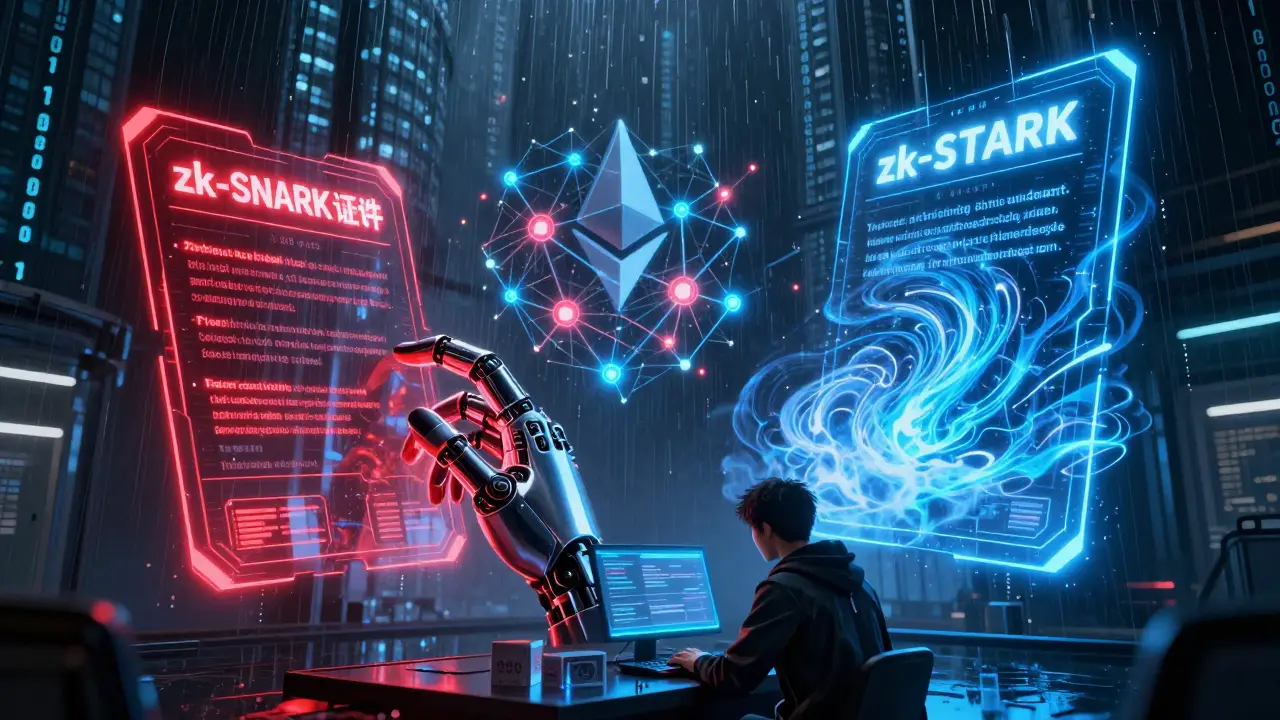
Imagine you want to prove you know a secret-like the password to a vault-without actually saying the password. That’s the magic of zero-knowledge proofs. In blockchain, this isn’t just clever math; it’s what lets networks like Ethereum scale without sacrificing security or privacy. Two technologies dominate this space: zk-SNARKs and zk-STARKs. They do similar jobs, but their differences matter a lot when you’re building or using a blockchain app.
What Exactly Are zk-SNARKs?
zk-SNARK stands for Zero-Knowledge Succinct Non-Interactive Argument of Knowledge. That’s a mouthful, but here’s what it means in plain terms: it’s a way to prove you did something-like a transaction-without showing the details. The proof is tiny, and it’s verified quickly, even on weak devices.
First developed in 2012 by researchers including Alessandro Chiesa, zk-SNARKs became practical in 2016 when Zcash used them to let users send anonymous coins. Since then, they’ve powered Tornado Cash, Ethereum Layer 2s like zkSync 1.0, and many privacy-focused dApps.
Their secret sauce? Elliptic curve cryptography. This lets them generate very small proofs-usually between 188 bytes and 1.5KB. On Ethereum, verifying one of these proofs costs around 300,000 to 500,000 gas. That’s cheap enough for high-volume applications like NFT marketplaces or DeFi swaps.
But here’s the catch: zk-SNARKs need a trusted setup. Before you can use them, a group of people must generate some initial cryptographic parameters. If even one person keeps a copy of those parameters after the ceremony, they could forge proofs and break the whole system. Zcash’s original setup involved six people across five countries. Newer versions like Powers of Tau reduced this to a single day, but the risk remains. You’re trusting people you may never meet-not ideal for a decentralized world.
What Are zk-STARKs?
zk-STARKs, or Zero-Knowledge Scalable Transparent Arguments of Knowledge, came along in 2018, created by Eli Ben-Sasson and his team. They were built to fix the biggest weaknesses of zk-SNARKs.
First, no trusted setup. Ever. Everything is generated using publicly verifiable randomness-like rolling dice in front of a camera. Anyone can check the process was fair. That’s huge for compliance, audits, and long-term security.
Second, they’re quantum-resistant. zk-SNARKs rely on elliptic curves, which a future quantum computer could crack. zk-STARKs use hash functions like SHA-256 or Keccak, which are believed to be safe even against quantum attacks. That’s why companies building for the next decade are watching them closely.
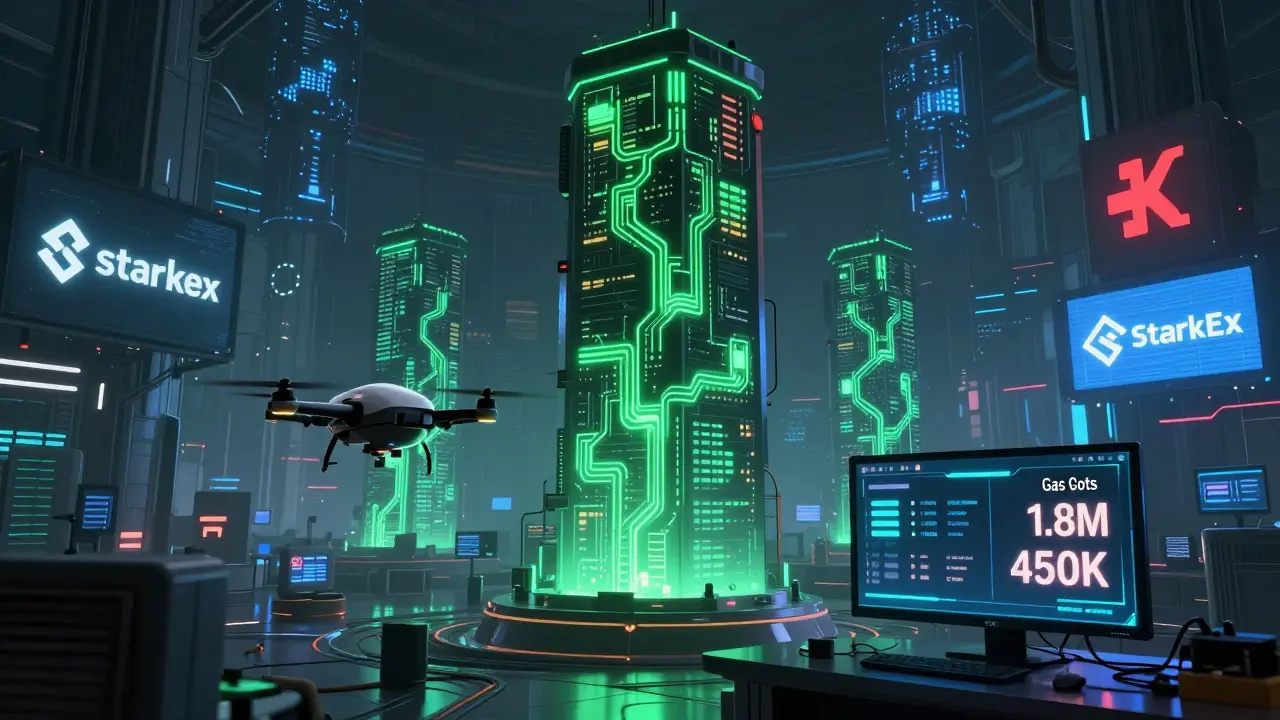
But there’s a trade-off: size. A zk-STARK proof is 45KB to 200KB-up to 100 times bigger than a zk-SNARK proof. On Ethereum, verifying one costs 1 to 2 million gas. That’s expensive. So for simple transactions, zk-STARKs aren’t always practical.
But here’s the twist: zk-STARKs get better as the computation grows. If you’re proving a complex calculation-like verifying 10,000 trades in a single batch-zk-STARKs scale more efficiently. Their verification time grows slower than zk-SNARKs’. That’s why platforms like StarkEx and Starknet use them for high-throughput applications like gaming and derivatives trading.
Performance: Speed, Size, and Cost
Let’s cut through the noise. Here’s how they stack up in real-world terms:
| Feature | zk-SNARKs | zk-STARKs |
|---|---|---|
| Proof Size | 188 bytes - 1.5 KB | 45 KB - 200 KB |
| Verification Time | 1-10 milliseconds | 10-200 milliseconds |
| Ethereum Gas Cost | 300K-500K | 1M-2M |
| Trusted Setup | Required | Not required |
| Quantum Resistance | No | Yes |
| Scalability for Large Computations | O(N) complexity | O(log² N) complexity |
For simple, frequent transactions-like sending ETH or swapping tokens-zk-SNARKs win. Their small size keeps costs low. Polygon’s zkEVM and zkSync used them to slash gas fees by 78% in early tests.
For complex, batched operations-like verifying thousands of NFT minting requests or order book matches-zk-STARKs win. Immutable X saw a 45% boost in throughput using them. The bigger the job, the more zk-STARKs shine.
Developer Experience: Learning Curve and Tools
Building with either system isn’t easy. But one is easier to start with.
zk-SNARKs have the edge in tooling. Circom, SnarkJS, and ZoKrates are mature. There are over 150 community tutorials. Developers with blockchain experience can get productive in 4-6 weeks. GitHub has 4,200+ stars for SnarkJS. The documentation is deep.
zk-STARKs? They’re newer. Cairo, the language used to write STARK proofs, is powerful but unfamiliar. It’s not like Solidity. Developers report spending 8-12 weeks to become comfortable. StarkWare’s docs are good-250 pages-but there are only 75 community guides. The community is smaller: 7,500 members on Discord vs. 12,000 for zk-SNARKs.
One developer on Reddit said: “I spent 3 weeks on a SNARK project. The STARK version took 8 weeks-even with better tooling.” That’s the reality. zk-SNARKs are the safe bet for teams under pressure. zk-STARKs are the future, but they demand patience.
Adoption and Market Trends
Right now, zk-SNARKs lead. About 72% of live ZK applications use them, according to Electric Capital’s 2023 report. Zcash, Tornado Cash, and early ZK-Rollups built their reputation on SNARKs.
But zk-STARKs are growing faster. They’re up 3.2x year-over-year, compared to zk-SNARKs’ 1.8x. Why? Gaming and NFT platforms love them. DappRadar found 82% of Web3 gaming apps use STARKs because they handle high-volume, complex logic better.
Enterprise adoption splits too. Financial institutions-banks, insurers-prefer zk-SNARKs. Why? They’re used to working with auditable, controlled systems. The trusted setup isn’t a dealbreaker if they can verify the ceremony was done right. Deloitte found 68% of enterprise ZK projects use SNARKs.
But regulators are starting to care. The SEC warned in 2022 that trusted setups could be a compliance risk. PwC’s 2023 guide said transparent systems like zk-STARKs align better with audit trails. That’s pushing more regulated projects toward STARKs.
The Future: Hybrid Systems and Quantum Threats
Neither side is winning outright. The future isn’t SNARKs vs. STARKs-it’s SNARKs + STARKs.
Halo 2, a zk-SNARK variant released in 2021, removes the trusted setup by using recursive proofs. But the proofs are bigger. It’s a compromise.
StarkWare’s DEEP-ALG update in June 2023 cut STARK proof sizes by 40%. That’s a big deal. It means they’re getting closer to SNARKs in efficiency.
Projects like Polygon Miden are already blending both. They use SNARKs for simple transfers and STARKs for complex logic. That’s the smart path.
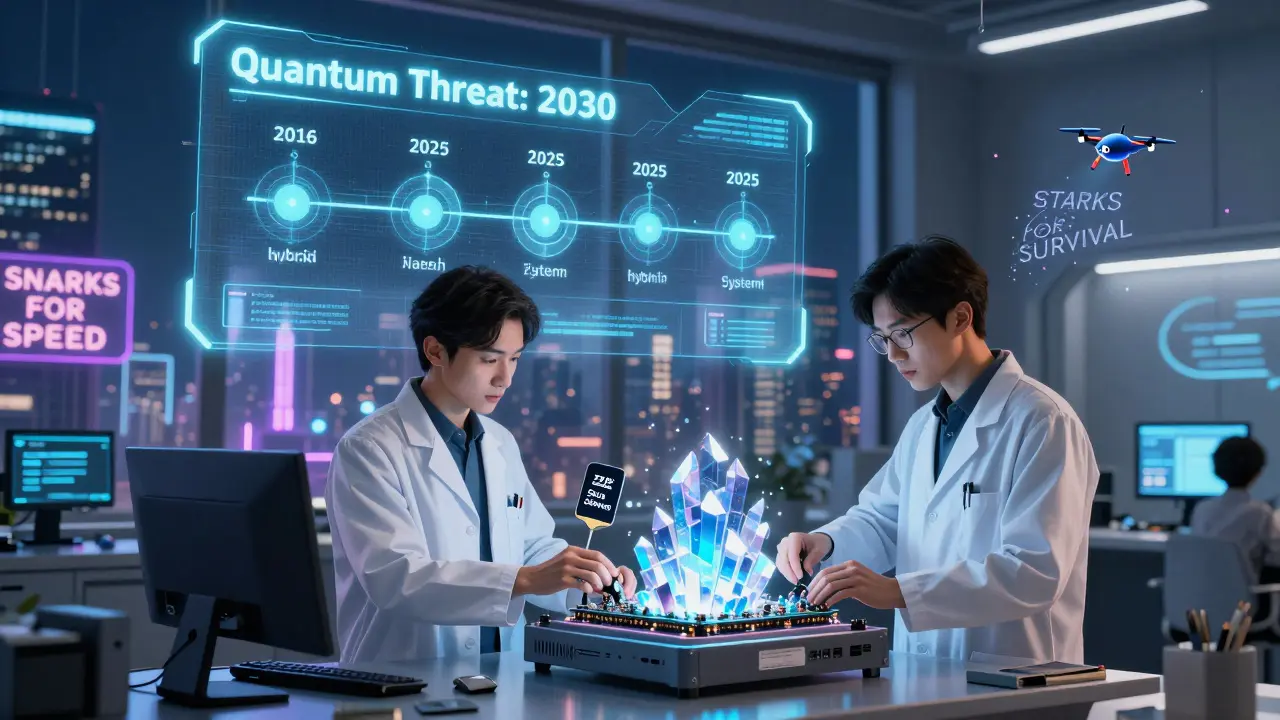
And then there’s quantum computing. IBM’s roadmap suggests a machine capable of breaking elliptic curve crypto could exist by 2030. If that happens, zk-SNARKs become obsolete overnight. zk-STARKs? They’ll still work. That’s why Vitalik Buterin says: “SNARKs are practical now. STARKs are the future.”
Which One Should You Choose?
Ask yourself these questions:
- Are you building a high-frequency, low-complexity app-like a DEX or payments layer? → Go with zk-SNARKs.
- Are you handling complex batched operations-like an NFT marketplace or gaming state updates? → Go with zk-STARKs.
- Do you need to comply with financial regulators? → zk-STARKs are safer.
- Are you on a tight timeline with a small team? → zk-SNARKs have better tools.
- Are you building for the next 10 years? → zk-STARKs are future-proof.
There’s no single right answer. But if you’re just starting out, zk-SNARKs are the path of least resistance. If you’re thinking long-term, bet on zk-STARKs. And if you can afford the complexity? Build with both.
Can zk-SNARKs be made secure without a trusted setup?
Yes, but with trade-offs. Projects like Halo 2 use recursive proving to eliminate trusted setups, but they create larger proofs and higher verification costs. It’s not a perfect fix-it’s a compromise between security and efficiency.
Why are zk-STARKs slower to verify than zk-SNARKs?
Because they’re bigger. A zk-STARK proof can be 100 times larger than a zk-SNARK proof. More data means more computation to verify. But this cost doesn’t grow as fast when the underlying computation gets larger, making STARKs more efficient for complex tasks.
Are zk-STARKs used in production today?
Absolutely. StarkEx, the scaling engine behind Starknet and Immutable X, has processed over 1 billion transactions since 2020 using zk-STARKs. They’re not just theoretical-they’re handling real-world volume.
Which is better for mobile wallets: zk-SNARKs or zk-STARKs?
zk-SNARKs. Their tiny proof size means they can be verified quickly on low-power devices like smartphones. zk-STARKs’ larger proofs require more memory and processing, which can drain battery life and slow down apps on older phones.
Will zk-STARKs replace zk-SNARKs completely?
Unlikely. They serve different needs. zk-SNARKs will stay dominant for simple, cost-sensitive apps. zk-STARKs will lead in high-complexity, long-term secure systems. The future is hybrid: using each where they fit best.
How does quantum computing affect these systems?
Quantum computers could break the elliptic curve cryptography used in zk-SNARKs, making forged proofs possible. zk-STARKs rely on hash functions, which are believed to be quantum-resistant. If quantum computers arrive before 2030, zk-SNARKs may become obsolete, accelerating the shift to STARKs.
Rob Duber
January 31, 2026 AT 05:24Brozk-SNARKs are like using a Swiss Army knife in a sword fight-works fine until you need to cut through a tank. STARKs? That’s the goddamn lightsaber. No setup, quantum-proof, and scales like a mother. Why are we still clinging to 2016 tech like it’s gospel?
Joshua Clark
February 1, 2026 AT 06:24I think it's important to recognize that the choice between zk-SNARKs and zk-STARKs isn't just a technical one-it's a philosophical one, too. On one hand, you have efficiency, familiarity, and established tooling that allows teams to move quickly and deliver value in the short term; on the other, you have transparency, long-term resilience, and alignment with decentralized ideals that prioritize trustlessness above all else. The trade-offs are real, and they're not just about gas fees or proof sizes-they're about what kind of blockchain ecosystem we want to build. Do we optimize for speed now, or durability forever? I don't think it's an either/or, but I do think we're being too quick to dismiss the latter.
Dahlia Nurcahya
February 3, 2026 AT 00:08Great breakdown! I’ve been watching this space for years, and honestly, I think the hybrid approach is where it’s at. Use SNARKs for payments, STARKs for complex logic-it’s like using a bicycle for commuting and a truck for moving furniture. Different tools for different jobs. No need to pick a side.
Akhil Mathew
February 3, 2026 AT 17:38SNARKs are fine for now, but if you're building anything that needs to last 5+ years, you're playing with fire. Quantum computers aren't sci-fi anymore-IBM just hit 1000+ qubits. STARKs are the only sane choice for future-proofing. Stop pretending this is a debate.
Pamela Mainama
February 4, 2026 AT 15:51STARKs for the win. No setup, no trust, no drama.
Christopher Michael
February 5, 2026 AT 16:56Actually, let’s not oversimplify. The gas cost difference is misleading-verification isn’t the bottleneck, proof generation is. STARKs take 10x longer to generate, and that’s the real bottleneck for rollups. SNARKs still win on throughput for most L2s. Also, Cairo is a nightmare-no decent IDE, no debugging tools. Don’t let the hype fool you.
Elle M
February 6, 2026 AT 16:05Of course SNARKs dominate-because Americans and Europeans still think ‘trustless’ means ‘trust your whitepaper.’ STARKs are the future, but only if you’re not scared of real decentralization. If your project needs a ceremony, you’re already compromised. Wake up.
Rico Romano
February 8, 2026 AT 09:08Let’s be honest: zk-SNARKs are for hobbyists and startups. zk-STARKs are what actual engineers use when they’re building for institutions, sovereigns, and central banks. The fact that you’re even asking this question proves you’ve never shipped a production system under regulatory scrutiny. The ‘trusted setup’ is a feature, not a bug-it’s called compliance.
Crystal Underwood
February 10, 2026 AT 07:16Y’all are still arguing about SNARKs like they’re not a backdoor waiting to be exploited? 🤦♀️ The ‘trusted setup’ is literally a single point of failure that could be weaponized by ANY nation-state. And you’re telling me we’re okay with this? If you’re not using STARKs, you’re not building blockchain-you’re building a casino with math.
Raymond Pute
February 10, 2026 AT 08:10Look, I get it-everyone wants to be the ‘future-proof’ guy. But let’s not pretend Starknet is some revolutionary utopia. The dev tooling is still in beta, Cairo is a cult language, and the community feels like a cult meetup with extra steps. Meanwhile, zkSync’s SNARK-based system is already processing 100K+ TPS with 99.9% uptime. You want ‘the future’? Fine. But don’t mistake ‘experimental’ for ‘better.’ Also, quantum computing? That’s 2040. We’re still fixing Ethereum’s MEV problem.
Jack Petty
February 10, 2026 AT 10:27Trusted setup? More like ‘trusted cartel.’ Zcash’s ceremony? Six guys in a room with laptops. Who were they? Who verified them? We’re all just trusting strangers on the internet… again. STARKs aren’t just better-they’re the only way out of this crypto cult of personality.
Meenal Sharma
February 11, 2026 AT 13:56While the technical merits of zk-STARKs are compelling, one must consider the sociopolitical implications of deploying opaque cryptographic primitives within regulated financial ecosystems. The absence of a trusted setup, while theoretically superior, introduces ambiguity in auditability, which may conflict with KYC/AML frameworks. A balanced, phased adoption strategy is therefore warranted.
Wayne mutunga
February 13, 2026 AT 05:18I read this whole thing and just thought… why not both? SNARKs for simple transfers, STARKs for heavy lifting. It’s not a war-it’s a toolkit. The real question is whether we’re building for today’s users or tomorrow’s problems. I think we need to do both, quietly, without the drama.
Dylan Morrison
February 15, 2026 AT 03:18It’s like choosing between a candle and a flashlight. One’s warm, familiar, easy to find. The other’s brighter, lasts longer, but needs batteries. We don’t need to pick one. We need to learn when to use each. 🌟