

Imagine plugging in your computer to mine Bitcoin, only to have authorities knock on your door not because of a crime, but because you used too much electricity. That is the reality facing residents of Algeria following the implementation of one of the strictest digital asset laws in the world. On July 24, 2025, the government published Law No. 25-10, which effectively criminalizes every aspect of the cryptocurrency ecosystem. This isn't just a warning; it is a comprehensive ban that targets mining, trading, holding, and even talking about crypto online.
The core driver behind this aggressive move? The national power grid. While many countries ban crypto due to financial instability or money laundering fears, Algeria explicitly cites energy concerns. With summer temperatures soaring and air conditioning demand spiking, the country’s electricity infrastructure is buckling under pressure. The government argues that energy-intensive activities like cryptocurrency mining are stealing power from households and essential services. If you live there, or if you are an investor watching the MENA region, understanding the specifics of this ban is crucial for navigating the new legal landscape.
The Legal Hammer: Understanding Law No. 25-10
To grasp the severity of the situation, we need to look at the text of the law itself. Previous regulations, such as the 2018 Financial Law, were restrictive but lacked clear teeth. Law No. 25-10 changes that entirely. It defines crypto-assets broadly as "property, income, funds or financial assets," regardless of their intended use. This broad definition means there are no loopholes for "utility tokens" or specific niche coins.
The penalties are severe and immediate. Individuals caught engaging in any prohibited activity face prison sentences ranging from two months to one year. The fines are equally steep, starting at 200,000 Algerian dinars (approximately $1,540 USD) and reaching up to 1,000,000 dinars ($7,700 USD). For repeat offenders, these penalties double. Perhaps most shockingly, the law criminalizes passive possession. You do not need to be actively trading to break the law; simply having Bitcoin in a wallet on your phone can lead to prosecution.
| Offense Type | Prison Sentence | Fine Range (DZD) | Fine Range (USD Approx.) |
|---|---|---|---|
| First-time Offender | 2 months - 1 year | 200,000 - 1,000,000 | $1,540 - $7,700 |
| Repeat Offender | 2 months - 1 year | 500,000 - 2,000,000 | $3,700 - $14,700 |
| Equipment Seizure | N/A | Confiscated | Value lost |
The law also grants authorities the power to seize equipment used for mining. Whether you are running a single GPU at home or operating a small industrial facility, your hardware is considered contraband. This creates a chilling effect where citizens are afraid to own high-performance computers, fearing they might be mistaken for mining rigs during inspections.
The Energy Crisis: Why Mining Is the Target
The heart of the controversy lies in the relationship between cryptocurrency mining and SONELGAZ, Algeria’s state-owned electricity provider. During normal periods, the national grid operates at about 70% capacity. However, during peak summer months, when air conditioning usage skyrockets, utilization hits 95-100%. At these critical times, every kilowatt-hour matters.
Cryptocurrency mining, particularly Proof-of-Work (PoW) algorithms like those used by Bitcoin, consumes massive amounts of electricity. According to statements from Salah Eddine Taleb, Governor of the Central Bank of Algeria, mining one Bitcoin requires approximately 1,500 kWh. To put that in perspective, that is equivalent to the monthly electricity consumption of 30 average Algerian households. When millions of people are trying to stay cool in August, dedicating that much power to generating digital currency is viewed by the government as unsustainable and socially irresponsible.
Data from 2024 revealed the scale of the issue. SONELGAZ detected unauthorized mining operations consuming between 15 MW and 20 MW of power during the summer peak. While this represents only about 1.5% of the national grid's total capacity, it is concentrated in specific zones and occurs precisely when the system is most vulnerable. The government argues that subsidized electricity rates-often as low as $0.035 per kWh compared to the global average of $0.14-create an unfair economic incentive for miners to operate domestically, draining resources meant for residential use.
Enforcement Realities: Inspections and Seizures
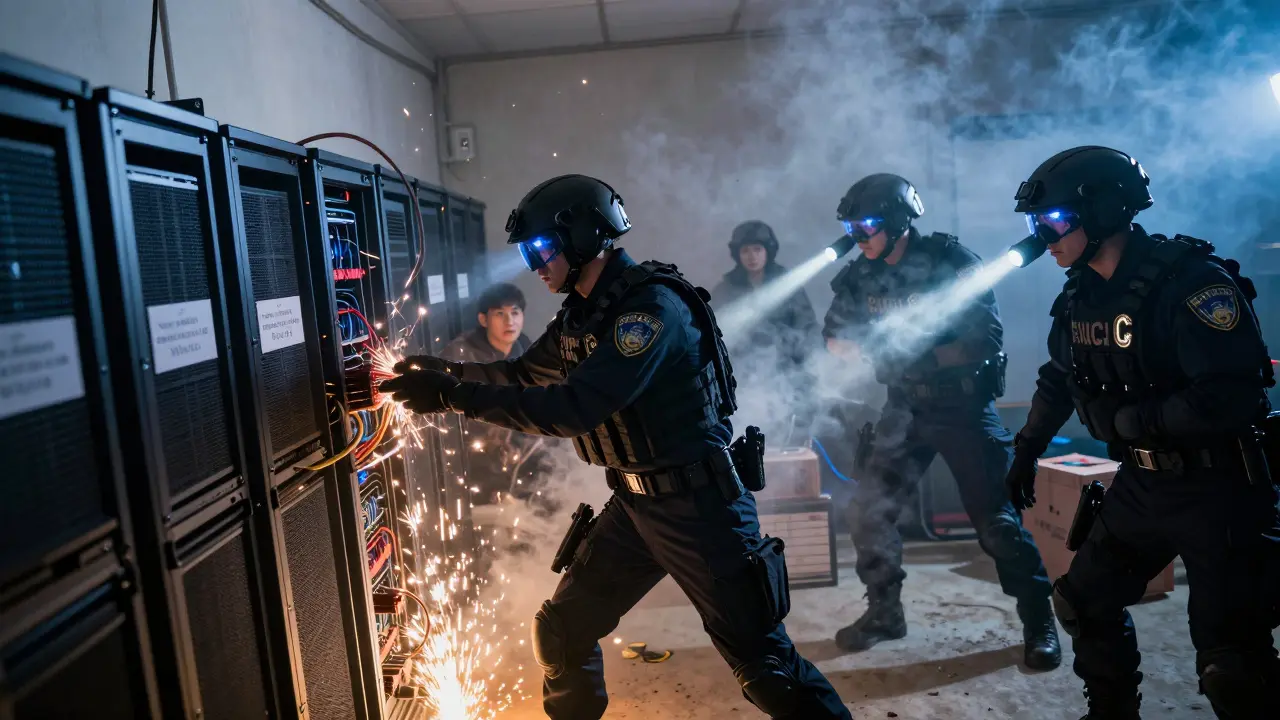
Laws on paper mean little without enforcement, and Algeria has moved quickly to implement its new rules. The government allocated 1.2 billion DZD ($9.2 million) in the 2025 budget specifically for regulatory enforcement. This funding supports specialized cyber units within the National Gendarmerie, trained to detect cryptocurrency transactions and identify mining operations through data analysis.
How do they find the miners? They watch the meters. Authorities monitor industrial zones and residential areas for abnormal power usage patterns. If a facility or home shows a 30-50% increase in electricity consumption compared to similar-sized neighbors, it triggers an inspection. These checks are often surprise raids. Reports from August 2025 detail numerous instances of equipment seizures. In one notable case, authorities confiscated seven mining rigs from a university student in Oran. Another user on Reddit reported shutting down a 12-rig Ethereum operation after hearing rumors of increased surveillance, citing that the risk of jail time was no longer worth the $350 monthly income.
The ban also extends to Virtual Private Networks (VPNs). By banning VPNs, the government aims to close the loophole that allowed citizens to access international cryptocurrency exchanges. This makes it significantly harder for individuals to participate in the global crypto market, even if they are not mining.
A Regional Outlier in the MENA Landscape
If you look at the broader Middle East and North Africa (MENA) region, Algeria stands out as an extreme outlier. Most neighboring countries are moving toward regulation rather than prohibition. The United Arab Emirates, for example, has established the Virtual Assets Regulatory Authority (VARA), which processed 157 license applications by the second quarter of 2025. Saudi Arabia and Bahrain have also created frameworks to foster innovation while managing risks.
Even Morocco, which has historically been strict, does not criminalize passive holding to the same extent. Egypt permits holding but prohibits trading. Tunisia allows mining under specific licensing conditions. Algeria’s approach is comparable only to China’s 2021 ban on transactions, but with a key difference: Algeria explicitly criminalizes mining due to energy constraints, a rationale not emphasized in other regional bans. This isolation has led to what experts call a "crypto brain drain." Data from LinkedIn analyzed by Startup Researcher shows that 37% of Algerian blockchain developers relocated to more friendly jurisdictions like Tunisia and Morocco between 2023 and 2025.

Expert Criticism and Missed Opportunities
While the government defends the ban as necessary for stability, experts argue it may be counterproductive. Dr. Leila Bencharif, a Professor of Financial Technology at Algiers University, points out that Algeria has significant renewable energy potential, including 22GW of solar capacity identified in the 2024 National Renewable Energy Strategy. She argues that instead of banning mining, the government could have channeled these operations toward excess solar power, creating a green mining industry that utilizes otherwise wasted energy.
The International Monetary Fund (IMF) echoed this sentiment in its July 2025 assessment. They noted that while energy concerns are valid, a targeted regulatory approach would better balance conservation with technological innovation. The Global Crypto Alliance reports that countries with clear legal frameworks see a 30% increase in crypto-related investments and a 40% rise in startups. By banning the sector entirely, Algeria risks forfeiting billions in potential investment and job creation.
User sentiment reflects this frustration. A study of 1,200 social media posts found that 67% of negative comments focused on the lack of distinction between energy-intensive Proof-of-Work mining and less intensive Proof-of-Stake systems. Many users feel punished for supporting technology that could be environmentally neutral if regulated correctly.
What Comes Next?
For now, the ban remains firm. There are no indications of an immediate reversal. The simultaneous passage of Law No. 25-12, governing traditional mining activities, suggests the government wants to redirect technological focus toward physical resource extraction rather than digital assets. However, policy landscapes shift. Dr. Bencharif’s team is preparing a white paper proposing a regulated framework for mining using excess solar capacity. Given that 68% of crypto bans implemented between 2020 and 2025 were partially reversed within three years due to economic pressures, Algeria’s stance may eventually soften.
Until then, citizens must comply. The message from Algiers is clear: protect the grid, avoid the crypto, and keep your electricity usage normal. For the rest of the world, Algeria serves as a stark example of how energy security can override financial innovation, setting a precedent that other resource-constrained nations might follow.
Is holding cryptocurrency illegal in Algeria?
Yes. Under Law No. 25-10, passive possession of cryptocurrencies is strictly prohibited. You do not need to be trading or mining to break the law; simply having digital assets in a wallet can result in fines and imprisonment.
Why did Algeria ban cryptocurrency mining specifically?
The primary reason is energy consumption. Cryptocurrency mining strains the national electricity grid, especially during summer peaks when air conditioning demand is high. The government views mining as an inefficient use of subsidized electricity that should be reserved for households and essential services.
What are the penalties for crypto mining in Algeria?
Penalties include prison sentences of two months to one year and fines ranging from 200,000 to 1,000,000 Algerian dinars ($1,540-$7,700 USD). Repeat offenders face doubled penalties. Additionally, all mining equipment is subject to seizure by authorities.
Are VPNs banned in Algeria?
Yes. Law No. 25-10 includes provisions that ban the use of Virtual Private Networks (VPNs). This measure is designed to prevent citizens from bypassing internet restrictions to access foreign cryptocurrency exchanges or services.
How does Algeria's ban compare to other MENA countries?
Algeria has one of the most restrictive approaches in the region. While countries like the UAE, Saudi Arabia, and Bahrain have established regulatory frameworks to encourage crypto innovation, Algeria prohibits all activities. Even neighboring Morocco and Egypt have slightly more nuanced rules regarding holding versus trading.
Will the crypto ban in Algeria be lifted soon?
There are no current plans to lift the ban. However, experts note that many global crypto bans are reversed within three years due to economic pressure. Researchers in Algeria are proposing alternative models that use solar energy for mining, which could influence future policy revisions.