
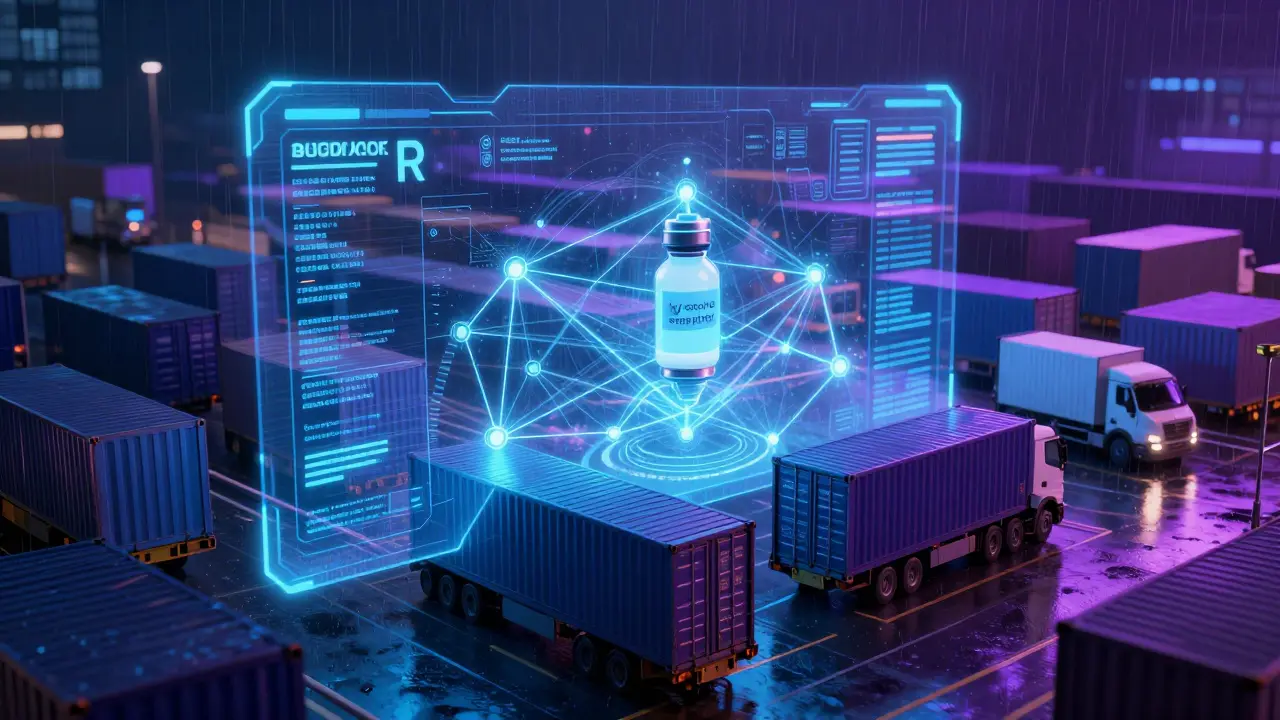
Imagine tracking a shipment of vaccines from the factory floor to a rural clinic, knowing exactly where it has been and ensuring it never exceeded safe temperatures. Now imagine doing that without trusting a single central database that could be hacked or corrupted. This is the promise of blockchain in logistics, which is a decentralized digital ledger system that records transactions across multiple computers to ensure data integrity and transparency. It’s not just about Bitcoin anymore; it’s about solving real-world problems like lost cargo, counterfeit goods, and endless paperwork.
The logistics industry moves roughly $10 trillion worth of goods annually, yet it remains plagued by inefficiencies. Traditional systems rely on siloed databases that don’t talk to each other well. When a truck crosses a border, when a warehouse receives stock, or when a retailer checks inventory, information often gets delayed or entered incorrectly. Blockchain fixes this by creating a shared, unchangeable record that everyone involved can see but no one can secretly alter.
Why Transparency Matters More Than Ever
Lack of visibility is the biggest headache for supply chain managers. According to Deloitte’s 2023 analysis, 68% of supply chain professionals cite lack of transparency as their top operational concern. In traditional setups, you might have your own data, your supplier has theirs, and the carrier has another version. Reconciling these differences takes days, if not weeks.
With blockchain, every participant-from the raw material supplier to the final delivery driver-writes to the same ledger. If a sensor detects a temperature spike in a refrigerated container, that event is recorded instantly and immutably. You don’t need to call the carrier to ask if the cold chain was broken; the data is already there, verified by cryptographic hashing (typically using SHA-256). This shared truth eliminates disputes over who is responsible for spoiled goods.
| Feature | Traditional EDI/Paper | Blockchain Network |
|---|---|---|
| Data Entry Errors | 15-20% error rate (Gartner, 2023) | 98% reduction via automated verification |
| Bill of Lading Processing | 5-10 days with 14+ document copies | ~4 hours with single digital document |
| Traceability Speed | Up to 7 days for food products | Seconds (e.g., Walmart’s 2.2-second trace) |
| Trust Model | Centralized authority required | Distributed consensus among peers |
Fighting Counterfeits and Ensuring Provenance
Counterfeit goods cost the global economy approximately $509 billion annually, according to OECD data from 2022. This isn’t just about fake luxury handbags; it’s about dangerous counterfeit medicines and unsafe auto parts. The World Health Organization reports that 1 in 10 medicines in developing countries is fake. Blockchain provides a digital passport for every item, proving its origin and journey.
When a product is manufactured, its unique identifier is hashed onto the blockchain. As it moves through the supply chain, each handoff is recorded. For high-value items like pharmaceuticals or electronics, this creates an immutable chain of custody. Consumers can scan a QR code to verify authenticity instantly. Companies like OriginTrail power traceability initiatives with 99.9% data accuracy, ensuring that what you buy is exactly what the manufacturer intended.
Smart Contracts: Automating Payments and Compliance
Paperwork slows down logistics more than trucks do. A traditional paper-based bill of lading process requires multiple signatures and physical copies circulating among stakeholders. Platforms like Wave’s electronic bill of lading reduced processing time from days to just 4 hours by digitizing this workflow on a blockchain.
This efficiency is driven by smart contracts, which are self-executing contracts with the terms of the agreement directly written into code. These run on platforms like Ethereum or Hyperledger Fabric. For example, a smart contract can be programmed to release payment automatically once IoT sensors confirm that a shipment has arrived at the destination and the temperature logs are within acceptable ranges. No invoices, no chasing accounts payable, and no delays. Dr. Jane Smith from MIT’s Supply Chain Laboratory notes that early adopters reported a 37% reduction in reconciliation costs thanks to this automation.
The Reality Check: Challenges and Costs
It’s important to keep expectations grounded. Blockchain is not a magic bullet. Dr. Robert Johnson from Stanford warns that "garbage in, garbage out" principles still apply. If the initial data entry at the factory is wrong, the blockchain will permanently record that error. Integration with Internet of Things (IoT) devices is crucial for reliable data capture.
Implementation is also expensive and complex. Setting up a basic consortium can cost around $50,000, while enterprise-scale deployments with custom smart contracts can exceed $500,000. The average deployment timeline is 14.7 months, with nearly half of that time spent just forming the consortium and agreeing on standards. Gartner reports that only 17% of implementations achieve full ROI within 24 months due to change management complexities.
Furthermore, blockchain struggles with high-volume transaction speeds compared to centralized databases. Visa processes 65,000 transactions per second, whereas most blockchain networks cap out between 10 and 1,500 TPS. This makes blockchain less suitable for low-value, high-volume commodity shipments where simple routing is all that’s needed.

How to Implement Blockchain in Your Supply Chain
If you’re considering adoption, follow a structured approach to avoid common pitfalls. Deloitte recommends a five-phase framework:
- Pain Point Identification (2-4 weeks): Don’t boil the ocean. Focus on specific issues like provenance verification or automated payments.
- Consortium Formation (3-9 months): Identify partners who benefit from shared data. Success depends on industry-wide collaboration; only 22% of initiatives succeed without broad alignment.
- Minimum Viable Product Development (4-6 months): Build a small-scale pilot using platforms like Hyperledger Fabric or private Ethereum chains.
- Incremental Scaling (6-12 months): Expand to more suppliers and routes based on pilot feedback.
- Continuous Optimization: Refine smart contracts and integrate AI for predictive analytics.
You’ll need technical skills in blockchain architecture and API integration. Expect to hire consultants charging around $185/hour. Ensure your system meets ISO/IEC 27001:2022 security protocols and integrates smoothly with existing Warehouse Management Systems (WMS) and Transportation Management Systems (TMS).
Future Outlook: AI Integration and Regulatory Drivers
The landscape is evolving rapidly. By 2028, the blockchain in logistics market is projected to reach $11.84 billion, growing at a 44.5% CAGR. Two major trends are shaping this growth:
- AI Integration: Combining blockchain’s trusted data with AI’s predictive power. DHL’s 2023 pilot used blockchain-verified data for machine learning, reducing inventory errors by 33%.
- Regulatory Pressure: Governments are mandating transparency. The EU’s Digital Product Passport and Corporate Sustainability Reporting Directive require detailed supply chain visibility starting in 2024. Similarly, the FDA’s Drug Supply Chain Security Act demands full electronic traceability.
Mike Kreider, CIO at DHL Supply Chain, predicts that by 2025, blockchain won’t be discussed as a standalone technology but as an integrated layer within broader digital supply networks. The goal is seamless interoperability, where cross-chain protocols reduce integration costs by 60%.
Is blockchain secure enough for logistics?
Yes, blockchain is highly secure due to cryptographic hashing and distributed consensus mechanisms. Unlike centralized databases, there is no single point of failure. However, security also depends on proper implementation of access controls and integration with IoT devices to ensure accurate data entry.
What is the cost of implementing blockchain in logistics?
Costs vary widely. Basic consortium setups start around $50,000, while enterprise-scale deployments with custom smart contracts and API integrations can exceed $500,000. Additional costs include consultant fees (approx. $185/hour) and staff retraining.
Which industries benefit most from blockchain logistics?
High-value, regulated industries benefit the most. Pharmaceuticals (due to counterfeit risks), luxury goods, and food & beverage (for safety traceability) see the highest ROI. Industrial manufacturing sees lower adoption rates because the value proposition is weaker for low-margin commodities.
Can blockchain replace ERP systems?
No, blockchain does not replace Enterprise Resource Planning (ERP) systems. Instead, it acts as an add-on layer that connects disparate ERPs across different organizations. It ensures that data exchanged between these systems is trustworthy and immutable.
How long does it take to implement a blockchain solution?
The average deployment timeline is 14.7 months from initial assessment to full operation. A significant portion of this time (42%) is spent on consortium formation and agreeing on data standards with partners, rather than just technical development.
Anuj Kashyap
July 14, 2026 AT 14:55It is fascinating how we trade the chaos of human error for the rigid immutability of code. One might argue that in doing so, we lose the beautiful ambiguity that allows for negotiation and mercy in business dealings. The blockchain does not care if your truck broke down due to a heart attack; it only cares about the timestamp. 😐
Jackie D
July 15, 2026 AT 13:09i mean like... who actually has time to set this up?? my boss keeps talkin about 'digital twins' and i just wanna go home. seems like a lot of hoopla for something that still needs humans to type stuff in correctly at the start 🙄
Ruth Williams
July 16, 2026 AT 11:53The notion that small enterprises can afford such an implementation is laughable. This technology is exclusively for those with the capital to absorb the initial $500,000+ expenditure without blinking. It is a tool for consolidation, not democratization.
Sophie Nakasako
July 18, 2026 AT 09:07I think there is real potential here if we focus on the collaboration aspect! It’s not just about the tech stack but about building trust between partners who have historically been adversarial. Imagine a world where suppliers aren’t afraid to share inventory data because they know it won’t be weaponized against them. That feels like the true win. ✨
Kristy Morrow
July 20, 2026 AT 06:33everyone is ignoring the elephant in the room which is energy consumption and the sheer bloat of storing every single transaction forever. its digital hoarding. why do we need to remember what happened to a banana three years ago? let it rot in the database like nature intended 🤷♀️
John Harman
July 21, 2026 AT 13:06Look, I've worked in supply chain for 15 years. The problem isn't the ledger. The problem is the guy loading the truck who doesn't give a damn about scanning the QR code. You put blockchain on top of bad processes and you get expensive bad processes. Fix the people first.
Antony Lopez
July 22, 2026 AT 01:55This is another example of foreign tech trying to solve American problems. Our logistics network is already the envy of the world. We don't need these crypto-bro solutions slowing us down with their 'consensus mechanisms'. Just use our existing systems which work fine for everyone else.
Kat Barr
July 23, 2026 AT 12:11Oh my gosh!! I love the idea of scanning a code to see where my food came from!!! 🥦👀 It makes me feel so much safer knowing exactly when that avocado was picked. Is it really that hard to implement?? Please tell me yes!! 🙏💖
Logan Edmison
July 24, 2026 AT 03:37so basically its just excel but harder to hack and more expensive to run? i dont get the hype. sounds like a solution looking for a problem unless u r shipping diamonds or insulin then maybe cool idk lol
Michelle Walker
July 24, 2026 AT 08:39Stop buying into the marketing fluff. ROI is a myth in this sector. Most pilots fail because the consortium collapses under political infighting, not technical debt. You are burning cash for a PowerPoint presentation.
Ella Collinson
July 25, 2026 AT 19:24The paradigm shift towards distributed ledger technology necessitates a re-evaluation of legacy ERP architectures. Without seamless API integration and middleware abstraction layers, the latency issues inherent in current consensus algorithms will bottleneck throughput significantly. It's not just about storage; it's about computational verifiability in real-time.
Ray Arney
July 27, 2026 AT 04:51I agree with John Harman on the human element. We tried a pilot last year and the warehouse staff hated the extra steps. If the tech doesn't make their lives easier, they'll find ways to bypass it. Maybe simpler interfaces would help?
Andrew Schneider
July 27, 2026 AT 22:23Ugh, here we go again with the 'trustless' narrative. Trust is a social construct, you can't code it away! 😡 Every time I read about blockchain in logistics, I feel like I'm being sold a bridge to nowhere by guys named Chad who wear hoodies. It's all smoke and mirrors! 💨🌉
Eric Braddock
July 29, 2026 AT 18:55You think this is secure? They want to track EVERYTHING. Your location, your purchases, your movements. It's a global surveillance grid disguised as 'efficiency'. Once they have the hash, they have you. Wake up sheeple. The central bank digital currency is next. 🚩👁️
Nick G
July 30, 2026 AT 11:14It is quite intriguing to consider the cultural implications of such transparency. In many Asian markets, relationship-based commerce often relies on a degree of flexibility that rigid digital ledgers might stifle. However, one must also acknowledge the universal desire for fairness and accuracy, which perhaps transcends cultural boundaries, suggesting a harmonious middle ground where technology serves tradition rather than supplanting it entirely.
Nick Wengel
August 1, 2026 AT 00:10I think it helps if we look at it simply. It's just a shared notebook. Everyone writes in it, no one can erase what's written. That's it. Not magic, just careful bookkeeping.