
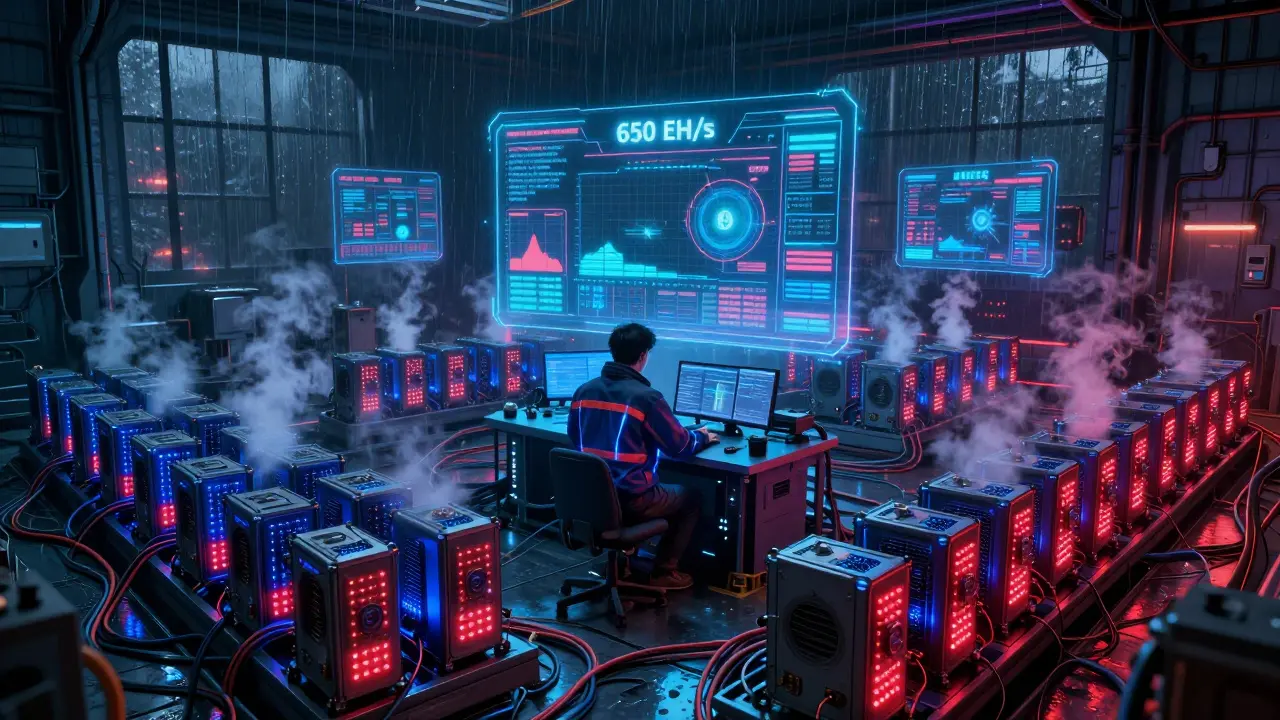
When you start mining cryptocurrency, the first thing you need to understand isn’t the price of Bitcoin or the latest ASIC miner-it’s hash rate. This number tells you how much computational power your rig is contributing to the network, and more importantly, whether you’re going to make money or lose it. Hash rate isn’t just a technical term; it’s the heartbeat of Proof-of-Work blockchains like Bitcoin. Without accurate hash rate calculation, you’re mining blind.
What Hash Rate Actually Means
Hash rate measures how many cryptographic guesses your mining hardware can make per second. Each guess is a hash-a random string of numbers and letters generated by your miner trying to solve a complex math puzzle. The first miner to solve it gets the block reward. Bitcoin’s network processes around 650 exahashes per second (EH/s) as of October 2025. That’s 650 quintillion guesses every second. To put that in perspective, your home computer might do 50 million hashes per second (50 MH/s). Bitcoin’s entire network does over 13 billion times that.
This isn’t just about speed. Higher hash rate means greater security. The more computing power dedicated to the network, the harder it is for a single entity to take control-a scenario called a 51% attack. In 2024, Bitcoin Gold suffered one because a single mining pool controlled over 58% of its hash rate. Bitcoin, with its massive global hash rate spread across 117 countries, has never been successfully attacked this way.
The Math Behind Hash Rate
The formula is simple: Hash Rate = Total Hashes / Time. If your miner completes 1 trillion hashes in one second, it’s running at 1 TH/s. But here’s the catch: you don’t directly measure the entire network’s hash rate. You estimate it.
Bitcoin calculates its network hash rate by looking at how many blocks were found in the last 24 hours and comparing that to how many should have been found based on the current difficulty. If more blocks were found than expected, the network assumes more miners joined, so it increases the difficulty. If fewer blocks were found, it lowers the difficulty. This adjustment happens every 2,016 blocks-roughly every two weeks.
For individual miners, the formula to estimate potential earnings is:
Hash Value = Block Reward × 86,400 / (Network Difficulty × 2³²)
As of January 2026, Bitcoin’s block reward is 3.125 BTC after the April 2024 halving. Network difficulty is around 85 trillion. Plug those numbers in, and you get a rough idea of how much BTC you’d earn per hash per second. But this is just theory. Real-world results depend on hardware efficiency, electricity cost, and pool fees.
Measuring Your Own Hash Rate
Manufacturers list hash rate numbers on their ASICs-like the Antminer S21 at 200 TH/s. But in practice, you rarely hit that number. Why? Heat. Power fluctuations. Poor ventilation. A 5°C rise in room temperature can drop your hash rate by 2.3%, according to Bitmain’s 2024 thermal report.
Use tools like CGMiner, BOSMiner, or your miner’s built-in dashboard to monitor real-time performance. Compare what you’re seeing with the advertised spec. If you bought 50 Antminer S19j Pro units expecting 100 TH/s each and you’re only getting 89.7 TH/s on average, you’re losing 10.3% of your potential income. One Reddit miner lost $18,500 because he didn’t test his units before full deployment.
Always run a 72-hour stress test before committing to a mining setup. Watch for thermal throttling, voltage drops, and fan failures. A miner running at 90% of its rated hash rate isn’t broken-it’s normal.

Comparing Hash Rates Across Cryptocurrencies
Not all blockchains are created equal. Bitcoin leads with 650 EH/s. Ethereum Classic runs at 300 TH/s. Litecoin sits at 600 TH/s. Monero? Just 3.5 GH/s. That’s a 185,000x difference between Bitcoin and Monero.
Why does this matter? Because profitability isn’t just about which coin has the highest price. It’s about which coin you can mine efficiently given your hardware. A GPU miner might make more mining Monero than Bitcoin, even though Bitcoin’s price is 100x higher. Why? Because Bitcoin requires ASICs-specialized hardware that’s useless for other coins.
Use tools like WhatToMine.com or MinerStat to compare real-time profitability. These sites pull live data from network hash rates, difficulty, and electricity prices to show you which coin gives you the best return per watt. One NiceHash user increased his earnings by 37% over six months by switching between coins based on hash rate trends instead of sticking to Bitcoin.
Profitability Isn’t Just About Hash Rate
Hash rate tells you how hard you’re working. But profitability tells you if it’s worth it. You need three things:
- Electricity cost: The global average is $0.058 per kWh. If you’re paying $0.15/kWh, you’re already at a disadvantage.
- Hardware efficiency: The Antminer S21 uses 3,025 watts for 200 TH/s. That’s 15.1 J/TH. Newer models like the upcoming S23 aim for 25 J/TH-better, but not revolutionary.
- Pool fees: Most miners join pools. Fees range from 1% to 4%. Higher fees mean less payout.
Also factor in depreciation. ASICs lose 30-40% of their value each year. If you buy a $5,000 miner and it lasts 18 months, you’re effectively paying $2,777 in depreciation alone. Add electricity and fees, and your break-even point might be longer than expected.
Why Hash Rate Calculators Lie (And How to Spot It)
Not all mining calculators are equal. Hashrate.no has a 4.7/5 rating on Trustpilot with over 1,200 reviews. Users praise its accuracy in predicting difficulty adjustments. MinerStat, on the other hand, gets 3.9/5. Why? It overestimates earnings by 12-18% during difficulty spikes.
Here’s why: most calculators assume the network difficulty stays flat. But difficulty changes every two weeks. If you calculate your earnings on a day right after a difficulty jump, you’ll get a misleadingly low number. If you calculate right before a jump, you’ll get an inflated one.
Use calculators that show real-time difficulty and update hourly. Look for ones that let you input your exact power cost and hardware model. Don’t trust generic “Bitcoin miner profitability” tools that use default settings.
The Hidden Risks of Hash Rate Centralization
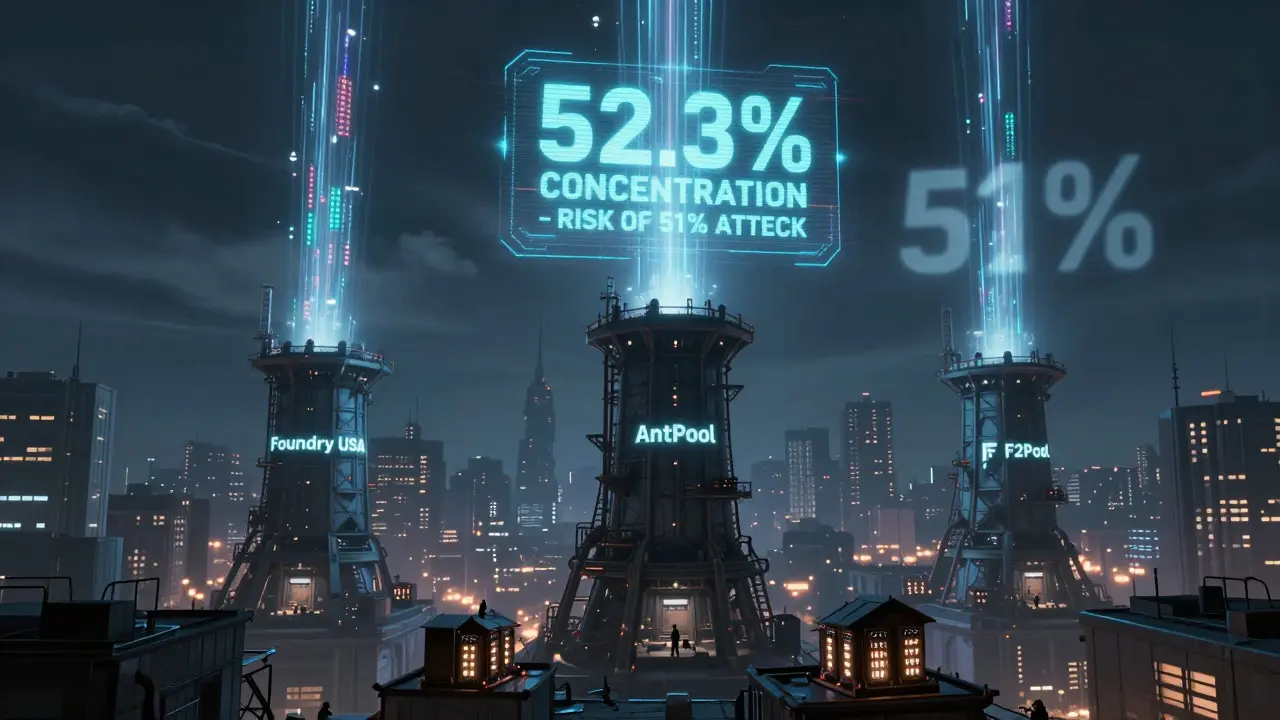
Bitcoin’s hash rate is huge-but it’s becoming concentrated. As of September 2025, the top three mining pools-Foundry USA, AntPool, and F2Pool-control 52.3% of the total hash rate. That’s above the 50% threshold that experts say could enable censorship or double-spending attacks.
NIST’s 2022 blockchain security framework warns that hash rate concentration is the biggest threat to Proof-of-Work networks. Even if no one has attacked Bitcoin yet, the risk is growing. Smaller coins like Bitcoin Gold are already vulnerable. In January 2024, a single pool briefly controlled over half the network and could have reversed transactions.
This isn’t just a technical problem. It’s an economic one. As ASICs get more expensive, only big operators with access to cheap power and bulk discounts can compete. Individual miners are being pushed out. In 2010, you could mine Bitcoin on a laptop. Today, you need a warehouse, a power contract, and a cooling system.
What’s Next for Hash Rate?
Bitcoin’s hash rate is projected to hit 1 zettahash per second (1,000 EH/s) by mid-2026. New ASICs like the Antminer S23 (expected 300 TH/s at 25 J/TH) will drive that growth. AI-powered forecasting tools like NiceHash’s HashAI are now predicting 72-hour hash rate trends with 89.7% accuracy, helping miners decide when to turn their rigs on or off.
But long-term, there’s a question: is hash rate still the best measure of security? Some experts argue it’s not. As mining becomes more centralized, the number of hashes doesn’t reflect decentralization. Others say it’s still the most reliable metric we have-especially since quantum computers capable of breaking SHA-256 are still 8-10 years away, according to IBM’s 2025 roadmap.
For now, hash rate remains the most trusted indicator of a blockchain’s health. But it’s no longer just a number. It’s a story-of energy, economics, and power.
How to Start Calculating Hash Rate Today
Here’s a simple 5-step plan:
- Choose your coin. Stick to Bitcoin if you’re using ASICs. Try Monero or Ravencoin if you’re using a GPU.
- Check your hardware’s real-world hash rate using CGMiner or your miner’s dashboard. Don’t trust the box label.
- Input your exact electricity cost into a trusted calculator like Hashrate.no.
- Factor in pool fees (1-4%) and hardware depreciation (30-40% per year).
- Monitor difficulty changes every two weeks. Adjust your expectations accordingly.
If your ROI is longer than 18 months, reconsider. Mining isn’t gambling-it’s engineering. Treat it like one.
What is a good hash rate for Bitcoin mining?
There’s no single "good" hash rate-it depends on your hardware and electricity cost. For individual miners, anything above 90 TH/s with an efficiency under 20 J/TH is competitive. But profitability matters more than raw speed. A 100 TH/s miner using $0.12/kWh power may lose money, while a 70 TH/s miner on $0.04/kWh can profit.
How is Bitcoin’s network hash rate calculated?
Bitcoin estimates its total hash rate by measuring how many blocks are mined in a 24-hour window and comparing it to the expected number based on current difficulty. If more blocks are found than predicted, the network infers more miners have joined and raises difficulty. This method is an estimate, not a direct measurement, with a margin of error of 1.5-3.2%.
Can I mine Bitcoin with a GPU?
Technically, yes-but you won’t make money. Bitcoin’s difficulty is so high that even the most powerful GPU today would generate less than $0.02 per day in revenue, while consuming $0.50 in electricity. ASIC miners are 100,000x more efficient for Bitcoin. GPUs are better suited for coins like Monero or Ravencoin.
Why does my miner’s hash rate drop over time?
Heat is the main culprit. ASICs generate intense heat. If your cooling system can’t keep up, the chip throttles down to avoid damage. Dust buildup, poor airflow, and high ambient temperatures (above 30°C) can reduce hash rate by 5-10%. Regular cleaning and proper ventilation are essential.
Is a higher hash rate always better for security?
Higher total hash rate improves security-but only if it’s widely distributed. If 90% of the hash rate comes from three mining pools, the network is vulnerable to collusion or censorship. Bitcoin’s strength comes from its global distribution across 117 countries. A high hash rate concentrated in one region or company is a red flag.
How often does Bitcoin’s difficulty change?
Bitcoin adjusts its mining difficulty every 2,016 blocks, which takes about 14 days on average. The algorithm recalculates based on how quickly blocks were found in the previous period. If blocks came in faster than 10 minutes each, difficulty increases. If slower, it decreases. This keeps the block time stable regardless of how many miners are active.
Anna Gringhuis
January 15, 2026 AT 18:10CHISOM UCHE
January 17, 2026 AT 12:23Pramod Sharma
January 17, 2026 AT 21:56Liza Tait-Bailey
January 19, 2026 AT 13:41Tony Loneman
January 20, 2026 AT 20:16Patricia Chakeres
January 22, 2026 AT 13:01nathan yeung
January 24, 2026 AT 10:14Bharat Kunduri
January 25, 2026 AT 18:54Christina Shrader
January 26, 2026 AT 23:41Josh V
January 27, 2026 AT 19:32Chris O'Carroll
January 28, 2026 AT 06:11