
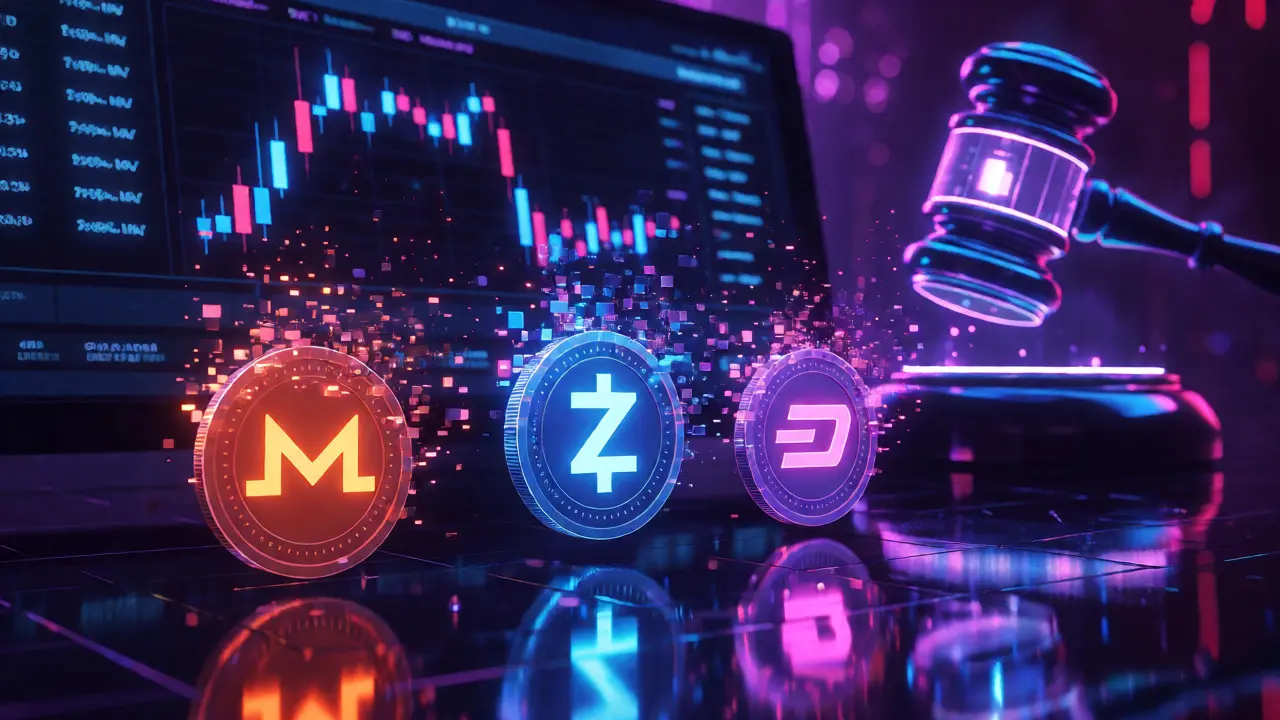
Imagine waking up to find your favorite Monero privacy coin gone from the exchange you use every day. No warning, no easy exit, just a notice that trading has stopped. This isn't a hypothetical scenario; it’s the reality for thousands of traders in 2025 and 2026. The privacy coin delisting wave has swept through major cryptocurrency exchanges, driven by an unyielding push for regulatory compliance.
Why are exchanges pulling these assets? It comes down to one word: transparency. Regulators worldwide are cracking down on anonymous transactions, fearing they facilitate money laundering. For exchanges like Binance or Kraken, keeping privacy coins means risking their licenses. So, they choose safety over variety. But what does this mean for you as an investor? And where do privacy coins go when centralized platforms shut the door?
The Scale of the Delisting Phenomenon
This isn’t just a few isolated incidents. It’s a coordinated global shift. According to data from CoinLaw, 73 exchanges worldwide delisted privacy coins in 2025 alone. That’s a 43% jump from the previous year. The targets are clear: Zcash (ZEC), Dash (DASH), and Monero (XMR). These three dominate the market, accounting for a significant chunk of the $250 billion in annual privacy coin transaction volume.
When Binance announced the removal of XMR, ZEC, and DASH from its European and US platforms in February 2025, it impacted roughly $600 million in trading volume overnight. That’s not small change. It signals that even the biggest players won’t fight regulators on this issue. If Binance drops them, smaller exchanges follow suit to avoid scrutiny.
Regulatory Drivers: The FATF and AML Rules
What’s behind this aggressive cleanup? Primarily, the Financial Action Task Force (FATF). In June 2024, the FATF issued updated guidance that tightened the screws on Anti-Money Laundering (AML) and Counter-Terrorism Financing (CTF) rules. The core problem is simple: privacy coins hide who sent money, how much was sent, and who received it. Bitcoin leaves a trail; Monero erases it.
The FATF’s "Travel Rule" extension specifically hit 57% of privacy coin transactions. This rule requires exchanges to collect and share customer info for transfers above certain thresholds. How can you share details about a transaction if the technology itself hides those details? You can’t. That technical mismatch makes compliance nearly impossible for traditional exchanges. Consequently, 97 countries have implemented stricter frameworks, leading to a 34% surge in regulatory actions against privacy-focused assets since 2024.
Global Jurisdictions: Who Banned What?
Not all regions act at the same speed. Asia tends to be the strictest. Japan banned privacy coins outright back in 2018, and South Korea followed with heavy restrictions. In early 2025, South Korea’s top five exchanges, including Upbit and Bithumb, removed privacy coins entirely. Upbit delisted six specific tokens in September 2025, citing FATF guidelines directly.
| Region | Status | Key Driver |
|---|---|---|
| Japan | Complete Ban | JFSA Guidance (since 2018) |
| South Korea | Exchange Prohibition | FATF Compliance |
| European Union | Ban Effective July 2027 | MiCA & AML Regulation |
| Switzerland | Restricted Trading | Strict KYC/AML Sandbox |
| USA | Pressure via Treasury | Poloniex Global Delisting |
The European Union is preparing for a comprehensive ban starting July 2027 under new Anti-Money Laundering Regulations. This will affect all 27 member states, effectively removing privacy coins from the largest regulated crypto market in the world. Meanwhile, Switzerland maintains a nuanced approach, allowing limited trading under strict Know Your Customer (KYC) protocols. This geographic fragmentation creates arbitrage opportunities but also confusion for users trying to move assets across borders.

Market Paradox: Prices Rise While Access Falls
You’d think delistings would crash prices. Instead, privacy cryptocurrencies gained 71.6% in 2025. This counterintuitive movement suggests strong underlying demand. When supply shrinks due to delistings but demand remains steady-or grows-prices tend to rise. Investors view these assets as scarce commodities now, protected from dilution by regulatory hurdles.
However, adoption metrics tell a different story. Zcash saw an 8% decline in shielded addresses because strict KYC measures made using private features cumbersome. People are buying for speculation, not necessarily for daily private transactions. Institutional investors, however, are showing increased interest as regulatory frameworks stabilize, viewing privacy as a premium feature rather than a liability.
Where Do Users Go Next? Decentralized Alternatives
If you can’t buy Monero on Coinbase or Binance, where do you go? The answer lies in decentralization. LocalMonero, a peer-to-peer platform, saw a 19% uptick in activity following recent delistings. Users are migrating to decentralized exchanges (DEXs) and atomic swap technologies that don’t require holding funds on a central ledger.
This shift aligns with the original ethos of cryptocurrency: self-custody and permissionless access. Community sentiment on Reddit and Twitter reflects frustration with centralized gatekeepers but excitement about regaining control. Non-custodial solutions allow users to trade without handing over personal data to an exchange, bypassing the very requirements that caused the delistings.

The Future: Hybrid Privacy Solutions
Will privacy coins disappear completely? Unlikely. Developers are working on hybrid models that balance anonymity with compliance. Zero-knowledge proofs (ZKPs) offer a path forward, allowing verification of transactions without revealing sensitive data. Some projects are exploring selective transparency, where users can prove compliance to auditors without exposing every detail to the public.
74% of privacy coin developers cite FATF rules as their biggest challenge. The next generation of privacy tech must satisfy two masters: user demand for secrecy and regulator demand for oversight. If they succeed, we might see a resurgence of compliant privacy coins. If they fail, these assets may remain niche tools for specialists rather than mainstream financial instruments.
Frequently Asked Questions
Why are exchanges delisting privacy coins?
Exchanges delist privacy coins primarily to comply with Anti-Money Laundering (AML) and Counter-Terrorism Financing (CTF) regulations. Guidelines from the Financial Action Task Force (FATF) require exchanges to track transaction origins and destinations, which is technically difficult with privacy-focused assets like Monero and Zcash.
Which privacy coins are most affected by delistings?
The most affected coins are Monero (XMR), Zcash (ZEC), and Dash (DASH). Other assets like Haven (XHV), BitTube (TUBE), and Pivx (PIVX) have also faced removals, but the big three account for the majority of trading volume and regulatory attention.
Can I still buy privacy coins after delistings?
Yes, but options are more limited. You can use decentralized exchanges (DEXs), peer-to-peer platforms like LocalMonero, or exchanges in jurisdictions with less strict regulations. However, accessing these assets often requires self-custody wallets and technical know-how.
Did privacy coin prices drop after delistings?
Surprisingly, no. Despite reduced accessibility, privacy cryptocurrencies gained 71.6% in 2025. This paradoxical rise is attributed to reduced supply on major exchanges and sustained speculative demand, outperforming many major cryptocurrencies during the same period.
What is the EU's stance on privacy coins?
The European Union plans a comprehensive ban on privacy coins and anonymous cryptocurrency accounts starting in July 2027. This decision stems from new Anti-Money Laundering Regulations aimed at increasing transparency across all 27 member states.