

The Speed Advantage: Order Books vs. AMMs
Most people are used to Uniswap is an automated market maker (AMM) where trades happen against a liquidity pool rather than another person . While AMMs are great for niche tokens, they often suffer from slippage-where the price shifts while your trade is processing. Serum takes a different path. By leveraging the Solana is a high-performance blockchain designed for scalability and speed network, Serum can handle between 50,000 and 65,000 transactions per second. To put that in perspective, typical Ethereum-based DEXes might struggle to hit 15 transactions per second during peak times. This isn't just a marginal gain; it's a massive performance jump that allows for near-instant execution and professional-grade charting.Cost and Tokenomics: The SRM Ecosystem
One of the biggest draws here is the cost. You won't find platform-mandated trading fees. Instead, you only pay the standard network cost for the blockchain. In early 2025, these fees averaged around $0.00025 per transaction. Compared to the volatile gas fees on Ethereum, this is essentially pocket change. The platform is powered by the SRM is the native governance token of the Serum ecosystem used to influence protocol changes and secure the network token. There is also MSRM, a rare token capped at 1,000 units, required for those wanting to run validator nodes. A key part of the value proposition is the buy-and-burn mechanism: roughly 68% of the fees collected on the exchange are used to buy back and burn SRM, which theoretically reduces supply and supports the token's price over time.| Feature | Serum DEX | Standard AMM (e.g., Uniswap) |
|---|---|---|
| Trading Model | Central Limit Order Book | Liquidity Pools (AMM) |
| Speed (TPS) | 50,000 - 65,000 | 1 - 15 (Layer 1) |
| Fees | Network only (~$0.00025) | Trading fee (e.g., 0.3%) + Gas |
| Slippage | Very Low (Direct Matching) | Variable (Depends on Pool Depth) |
The FTX Shadow and the Governance Problem
We can't talk about Serum without talking about the elephant in the room: the November 2022 collapse of FTX. It turned out that FTX held the "upgrade authority" for the Serum protocol. This meant that while the exchange was technically decentralized, a single entity had the keys to change the rules. When FTX went down, Serum's functionality was severely compromised. This was a wake-up call for the DeFi community. It proved that having your funds on a blockchain isn't the same as having decentralized governance. The project didn't die, though. The community stepped up and created a fork to keep the platform alive. While a January 2025 update finally removed the need for FTX intermediation for bridging assets from Ethereum, the "trust scar" remains. If you are risk-averse, the lingering questions about who actually controls the protocol's future are a valid concern.Real-World Integration: The Raydium Connection
Serum doesn't exist in a vacuum. It acts as a foundational layer for other projects. A prime example is its relationship with Raydium is a decentralized exchange and liquidity provider on Solana that integrates with Serum's order book . Raydium uses a hybrid approach. It has its own liquidity pools (AMM), but it feeds that liquidity into Serum's central order book. This is a brilliant piece of DeFi engineering because it gives traders the best of both worlds: the deep liquidity of a pool and the precision of an order book. If you use Raydium, you're often interacting with Serum's backend without even realizing it.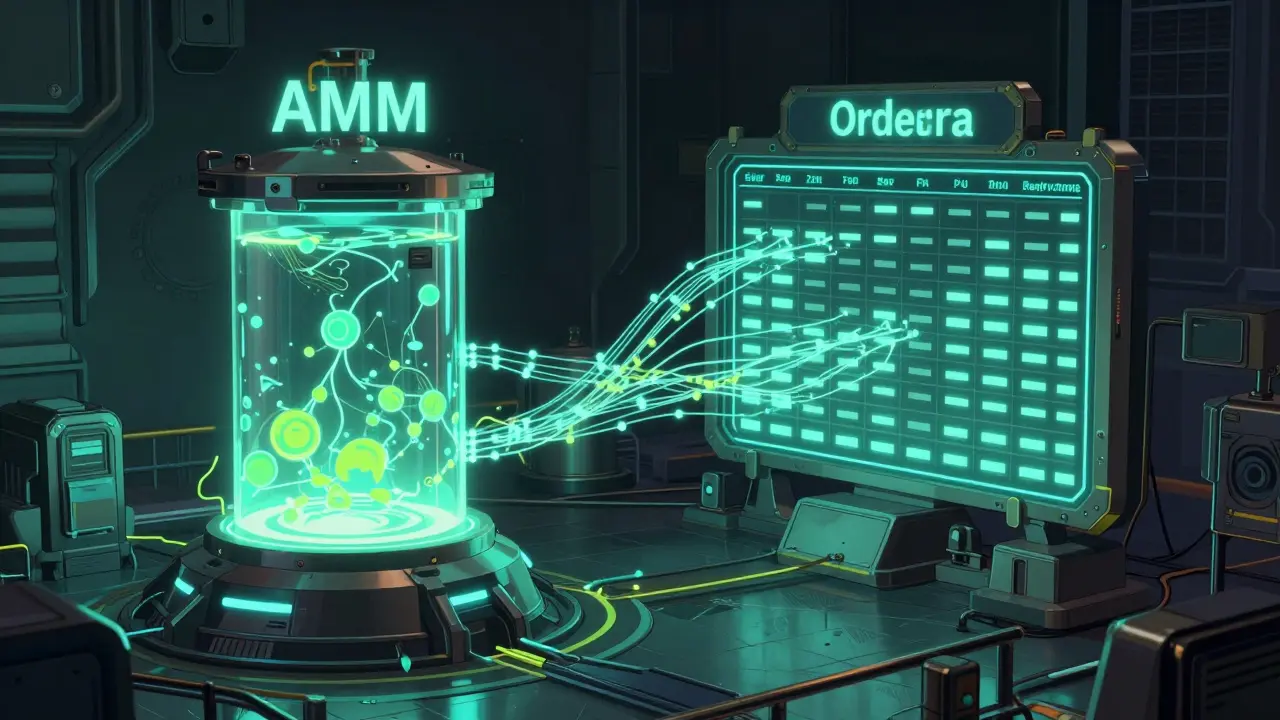
Getting Started: The User Experience
If you've only used centralized apps like Coinbase or Binance, the transition to Serum might feel a bit steep. You can't just sign up with an email. You need a Solana-compatible wallet. Most users opt for Phantom is a popular non-custodial wallet for the Solana ecosystem , though the Serum interface allows for basic wallet creation. Expect a learning curve of about 2 to 4 hours to get comfortable. The most common sticking points are setting up the wallet correctly and understanding how Solana confirms transactions. Be warned: when the network gets incredibly congested, about 8% of transactions can fail. It's a known quirk of the Solana architecture. If a trade doesn't go through, don't panic-just check the network status and try again.Is Serum Still the Right Choice in 2026?
Whether Serum fits your strategy depends on what you value. If you are a day trader or a bot operator who needs millisecond execution and almost zero fees, Serum is still a powerhouse. The Serum DEX provides a level of efficiency that is hard to find anywhere else in the decentralized world. However, if you are a beginner or someone who prioritizes absolute governance decentralization, you might look toward newer competitors like Hyperliquid or Drift Protocol. These newer platforms are trying to solve the same speed problems but with more transparent governance models from day one.Is Serum DEX safe to use after the FTX collapse?
Since the collapse, the community created a fork to remove the centralized control held by FTX. While the technical foundation is solid and your keys are your own, the risk now lies in the community governance stability. It is safer than a centralized exchange but carries the typical risks of DeFi protocols.
How are the fees on Serum calculated?
Serum does not charge a platform trading fee. You only pay the Solana network fee, which is typically a fraction of a cent (around $0.00025). This makes it significantly cheaper than Ethereum-based DEXes.
What is the difference between SRM and MSRM tokens?
SRM is the primary governance token used by the broader community. MSRM is a limited-supply token (max 1,000) specifically required for those who want to operate validator nodes to secure the network.
Can I trade Bitcoin and Ethereum on Serum?
Yes, but not directly. You trade "wrapped" versions of these assets. These are tokens on the Solana network that represent the value of the original asset, allowing them to be traded with Solana's speed.
What should I do if my transaction fails on Serum?
Transaction failures are usually due to Solana network congestion. Wait a few minutes, ensure you have enough SOL in your wallet to cover the network fee, and attempt the trade again. If the issue persists, check the community GitHub wiki for troubleshooting guides.
Artavius Edmond
April 12, 2026 AT 18:24Actually using Serum for a few months now and the speed is honestly insane compared to anything on Eth. It's just a different world when you aren't waiting for a block to confirm for ten minutes lol
Amanda Faust
April 13, 2026 AT 05:04CLOBs are objectively superior to AMMs for high volume because they eliminate the constant product formula inefficiency and just match orders directly
Jessie Tayaban
April 13, 2026 AT 13:53Omg the FTX stuff was literally the most terrifying thing ever!! I actually thought my whole portfolio was gone for a second there... absolutely heart stopping!!
The fork is a lifesaver though, just hope they dont mess up the govenance again!
Jason Davis
April 13, 2026 AT 20:32If you're new to this, just make sure you've got a bit of extra SOL for the network fees or the transaction will fail instantly. I've seen so many peple get confused why their trade didnt go through when they only had the exact amount of the asset they wanted to swap
Tyler Webb
April 15, 2026 AT 18:46It's really important to remember that wrapped assets are a trust mechanism too. While the speed is great, you're trusting the bridge. Just stay safe everyone! :)
Rebecca Violette
April 16, 2026 AT 04:51i just feel like no matter how fast the txs are we are all just gambling anyway and the anxiaty is too much lol
ssjuul z
April 17, 2026 AT 04:03Let's goooo! Solana is eating the world right now! 🚀 The efficiency is just too good to ignore if you're actually trying to make money!
Scott Fenton
April 17, 2026 AT 07:06One must exercise extreme caution when interacting with any protocol that has had a centralized upgrade authority in its past. While the community fork is a commendable effort, the systemic risk associated with governance instability cannot be entirely discounted.
aletheia wittman
April 17, 2026 AT 23:39the way this whole ecosystem just collapses and comes back is literally a soap opera i cant even deal with the stress of it all
Rima Dinar
April 18, 2026 AT 20:02For those of you who are just starting your journey in the world of decentralized finance, I would strongly encourage you to take your time with the wallet setup process because rushing through it often leads to avoidable mistakes that can be very stressful for a beginner to resolve, so please just breathe and follow the guides step by step until you feel confident.
Prasanna Shembekar
April 20, 2026 AT 17:16too much drama with the fork lol just trade and leave
Hope Johnson
April 22, 2026 AT 01:53It is interesting to consider how the shift from AMMs to CLOBs mirrors the evolution of traditional financial markets, moving away from simple liquidity pools towards a more complex but efficient system of direct matching, which ultimately democratizes the high-frequency trading experience for the average user who previously had no access to such tools.
Agnessa Dale
April 23, 2026 AT 06:29The recovery of the community after the crash is actually really inspiring to see!
Emily H
April 24, 2026 AT 12:32The integration with Raydium effectively optimizes capital efficiency by allowing liquidity providers to benefit from both market-making and direct order matching. This architectural synergy is a primary reason for the platform's continued relevance in the current market cycle.
logan bates
April 26, 2026 AT 04:43America leads the way in tech regardless of where the chain is hosted.
Akshay Gorad
April 26, 2026 AT 10:04I agree with the point about the learning curve. It is not as intuitive as a CEX but the control over one's assets is worth the effort.