
You’ve probably seen the ticker ASTRA pop up in your feed or on a tracker app. The name sounds futuristic-mixing "Astra" for space with "AI" for artificial intelligence. It promises to combine blockchain technology with machine learning to revolutionize how we invest. But before you click "buy," you need to know exactly what you are getting into. Is this a groundbreaking tech project, or just another speculative coin riding the AI hype train?
AstraAI is not a standalone blockchain like Bitcoin or Ethereum. Instead, it operates as an ecosystem built on top of existing infrastructure. Understanding its structure, its actual utility, and the significant risks involved is crucial if you are considering allocating any funds to it. Let’s break down the reality behind the marketing.
What Exactly is AstraAI?
AstraAI is a cryptocurrency platform launched in November 2023 by founder Dino N. and operated by AstraLabs Inc., a company based in the United Arab Emirates. The project aims to merge blockchain transparency with artificial intelligence capabilities. Their stated goal is to create a unified system for financial services, decentralized applications, and AI-driven investment tools.
The native currency of this ecosystem is the ASTRA token. This token acts as fuel for the platform’s various services. You use it to pay for subscriptions, access premium features, and facilitate transactions within their network. However, unlike major cryptocurrencies that have massive global adoption, AstraAI remains a niche player. As of recent data, it ranks around #1,243 on market trackers like CoinMarketCap, with a market capitalization hovering near $8 million. For context, that is tiny compared to giants like Bitcoin or even established AI-crypto projects like Fetch.ai.
How Does the ASTRA Token Work?
To understand where your money goes, you need to look at the technical foundation. The ASTRA token is an ERC-20 token. This means it lives on the Ethereum blockchain. It does not have its own independent chain; instead, it relies on Ethereum’s security and infrastructure.
This classification has practical implications for you:
- Wallet Compatibility: You can store ASTRA in any standard Ethereum-compatible wallet, such as MetaMask or Trust Wallet.
- Transaction Fees: Sending ASTRA requires paying gas fees in ETH, which can be expensive during network congestion.
- Liquidity: Trading happens primarily on decentralized exchanges (DEXs) or smaller centralized platforms, which may result in lower liquidity and higher slippage compared to top-tier coins.
The total circulating supply is capped at exactly 10 million ASTRA tokens. This fixed supply is often cited by proponents as a deflationary feature, but without strong demand drivers, scarcity alone does not guarantee price appreciation.
The Ecosystem: More Than Just a Token
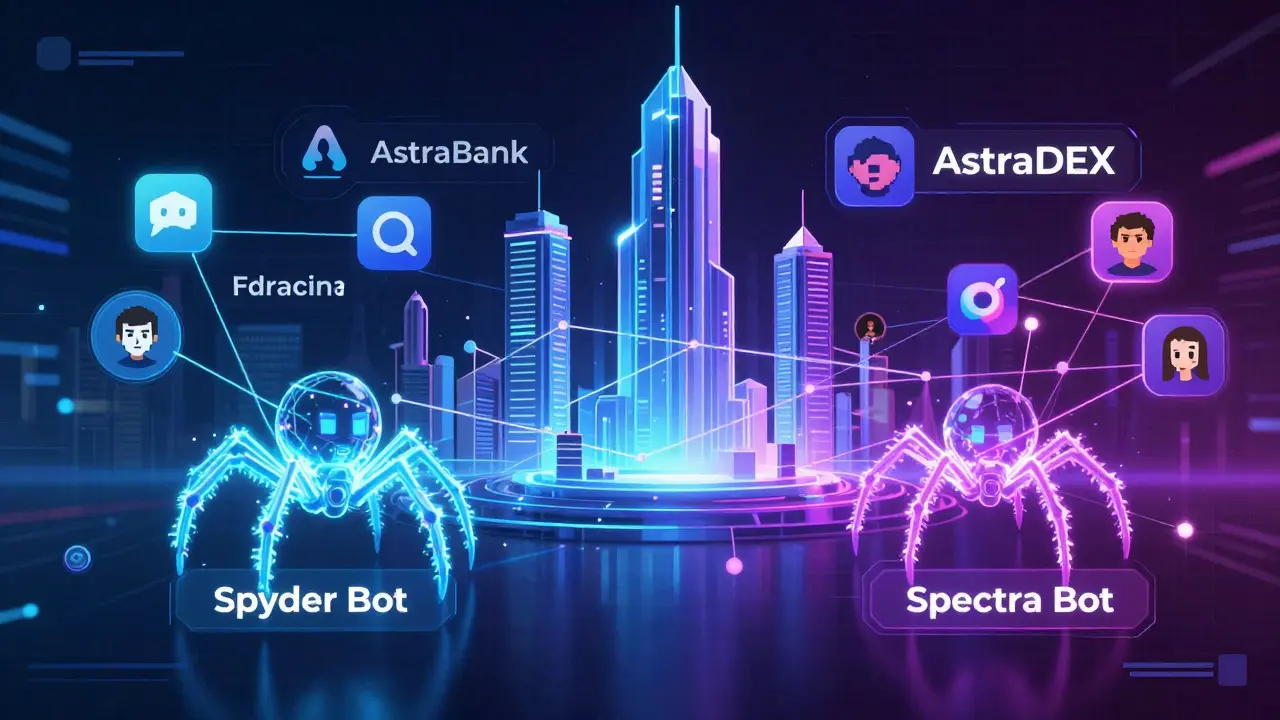
AstraAI claims to offer more than just a tradable asset. They have built an ecosystem consisting of several integrated components designed to serve both businesses (B2B) and consumers (B2C). Here is what they offer:
| Component | Function | User Benefit |
|---|---|---|
| AstraBank | Financial services layer | Provides banking-like utilities within the crypto space |
| AstraChain | Transactional infrastructure | Handles backend processing for ecosystem activities |
| AstraDEX | Decentralized exchange | Allows users to trade assets directly |
| Spyder Bot | Social tracking tool | Monitors key influencers and sends real-time Telegram alerts |
| Spectra Bot | Retail trader alert system | Uses a "Matching System" to notify when multiple influencers follow a project |
The most unique aspect of AstraAI seems to be its social bots, Spyder and Spectra. These tools attempt to gamify social sentiment analysis. By tracking who follows which crypto projects on social media, they aim to give traders an edge. Premium subscribers get faster alerts and access to an "Elite Channel." While innovative in concept, these tools rely heavily on the accuracy of their data sources and the genuine influence of the accounts they track.
Market Position and Competition
Let’s be realistic about where AstraAI sits in the broader market. The intersection of AI and blockchain is crowded. Established players like Fetch.ai and SingularityNET have market caps in the hundreds of millions or billions of dollars. They have robust developer communities, enterprise partnerships, and proven track records.
AstraAI, with an ~$8 million market cap, is an emerging player. It lacks the brand recognition and liquidity of its competitors. This creates a double-edged sword: while the potential for percentage gains might be higher due to low entry cost, the risk of failure or abandonment is significantly greater. There is no detailed public documentation regarding third-party security audits, which is a red flag for institutional investors and security-conscious individuals.
Price Predictions and Financial Outlook
If you are looking at price charts, you will see projections from various forecasting services. Models from LiteFinance, TradingBeasts, and WalletInvestor have suggested similar targets for late 2025, estimating a price range between $0.70 and $0.73 per token.
However, treat these numbers with extreme caution. Cryptocurrency markets are driven by speculation, regulatory changes, and macroeconomic trends-not just algorithmic predictions. A projection of a modest increase assumes stable conditions and consistent supply. In reality, volatility can wipe out gains overnight. These forecasts should never be considered financial advice.

Security and Regulatory Considerations
Security is paramount in crypto. AstraAI describes its security infrastructure as a "robust digital shield," but vague terminology is concerning. We do not have evidence of independent smart contract audits or penetration testing reports publicly available. Without these, you cannot verify if the code holding your assets is secure against exploits.
Regulatory-wise, the parent company, AstraLabs Inc., is based in the United Arab Emirates. The UAE has been proactive in creating clear crypto regulations since 2022, which adds a layer of legitimacy compared to projects registered in jurisdictions with zero oversight. However, compliance status for specific products like AstraDEX or AstraBank needs to be verified by the user, as regulations change frequently.
Who Should Avoid AstraAI?
Not every crypto project is right for every investor. You should likely avoid ASTRA if:
- You require high liquidity and instant exit options.
- You prioritize projects with transparent, audited security protocols.
- You are looking for long-term stability rather than high-risk speculation.
- You prefer ecosystems with large, active developer communities contributing open-source code.
Conversely, if you are interested in experimenting with AI-driven social trading tools and are comfortable with high-risk, low-cap assets, AstraAI might warrant a small portion of your speculative portfolio. Always start by reading their official whitepaper and checking their latest announcements for roadmap updates.
Is AstraAI (ASTRA) a safe investment?
No cryptocurrency is guaranteed safe. AstraAI is a low-market-cap project (#1,243 ranking) with limited public security audit details. It carries high risk due to its niche status, competition from larger AI-blockchain projects, and inherent crypto volatility. Only invest what you can afford to lose entirely.
What blockchain is the ASTRA token built on?
The ASTRA token is an ERC-20 token, meaning it is built on the Ethereum blockchain. This allows it to be stored in standard Ethereum wallets like MetaMask but also means transactions are subject to Ethereum network gas fees.
What is the purpose of the Spyder and Spectra bots?
Spyder and Spectra are social tracking tools within the AstraAI ecosystem. They monitor social media influencers and crypto projects. Spyder tracks key followers, while Spectra uses a matching system to alert retail traders when multiple influencers engage with the same project, aiming to provide early signals for potential trends.
Who founded AstraAI?
AstraAI was founded in November 2023 by Dino N. and is operated by AstraLabs Inc., a technology company headquartered in the United Arab Emirates.
What is the maximum supply of ASTRA tokens?
The circulating supply of ASTRA tokens is capped at exactly 10 million. This fixed supply model is designed to prevent inflation, though price value depends entirely on market demand.
How does AstraAI compare to Fetch.ai or SingularityNET?
AstraAI is significantly smaller. While Fetch.ai and SingularityNET have market caps in the hundreds of millions or billions and established enterprise partnerships, AstraAI has a market cap around $8 million. It is an emerging, niche player focusing on social-trading AI tools rather than broad decentralized AI infrastructure.