

When you hear the word memecoin, you might think of a joke. And you’d be right - but not the kind you laugh at and forget. Memecoins are serious business, even when they start as jokes. They’re digital tokens built on blockchain networks, but instead of solving technical problems like Bitcoin or Ethereum, they’re powered by memes, social media hype, and online communities. Dogecoin, the original memecoin, began as a parody in 2013. Today, it’s worth over $11 billion. That’s not a typo. A coin based on a funny dog picture is now bigger than many traditional companies.
How Memecoins Started - And Why They Didn’t Die
Dogecoin (DOGE) was created in December 2013 by two software engineers, Billy Markus and Jackson Palmer. They didn’t want to change the world. They wanted to make fun of the endless stream of new cryptocurrencies flooding the market. They took the popular ‘Doge’ meme - a Shiba Inu dog with colorful Comic Sans captions like ‘such wow’ and ‘very blockchain’ - and turned it into a coin. They expected it to fade away in weeks.
It didn’t. Instead, it attracted a community that loved its silliness. People started using Dogecoin to tip others on Reddit for funny posts or helpful answers. A $5 tip for a coffee? Sure. A $500 tip for a stranger’s GoFundMe? Why not? The lack of seriousness became its strength. While Bitcoin was treated like digital gold, Dogecoin felt like digital pocket change. And that made it accessible.
Then came Elon Musk. In April 2021, he tweeted ‘Dogecoin to the moon.’ Within 24 hours, the price jumped 300%. That single tweet turned Dogecoin from a niche joke into a global phenomenon. It wasn’t about tech. It was about culture. And that’s what separates memecoins from every other cryptocurrency.
What Makes a Coin a Memecoin?
Not every funny crypto token is a memecoin. To qualify, it needs three things: a meme origin, a massive supply, and zero serious utility. Let’s break that down.
- Meme origin: The coin’s identity comes from an internet joke. Dogecoin = Shiba Inu. PEPE = the green frog meme. SHIB = the ‘Shiba Inu’ dog (yes, another one). WIF = a dog wearing a hat, from a viral tweet. No deep whitepaper. No revolutionary tech. Just a meme.
- Massive supply: Memecoins have absurdly high numbers of tokens. PEPE has 420 trillion. SHIB has one quadrillion (that’s 1,000,000,000,000,000). Dogecoin has no cap - 5 billion new coins are added every year. This isn’t a bug. It’s a feature. Low individual token prices make it feel affordable. You can buy 10,000 SHIB for less than a dollar. That tricks people into thinking they’re getting ‘more’ - even if the value per token is nearly nothing.
- No utility: Unlike Ethereum, which runs smart contracts, or Solana, which processes fast transactions, most memecoins do nothing technical. They can’t pay for apps, store data, or automate payments. Their only real use? Trading, tipping, and hoping the price goes up.
Some memecoins try to add utility - like Dogecoin’s integration with Tesla’s online store in 2023. But those are exceptions. Most are pure speculation wrapped in a meme.
Why People Buy Them - And Why They Lose Money
People don’t buy memecoins because they understand them. They buy them because they see others making money. It’s FOMO - fear of missing out - on steroids.
A 2023 Bankrate study found that 78% of memecoin traders admitted to buying because they saw a price spike. One Reddit user bought SHIB after seeing a TikTok video titled ‘I turned $100 into $10,000 in 3 days.’ Three days later, the price dropped 60%. He lost most of it.
That’s the pattern. A celebrity tweets about a coin. It surges. A thousand new people jump in. The early buyers sell. The price crashes. Rinse and repeat. Dogecoin hit $0.73 in May 2021. By July 2022, it was $0.07 - a 90% drop. SHIB peaked at $0.000008 in late 2021. In 2023, it traded around $0.000004. Half the value, in under a year.
And then there are rug pulls. In January 2023, a Solana memecoin called BONK launched. Within 72 hours, the creators pulled $2.3 million in liquidity - meaning they took all the money out of the trading pool and vanished. The coin became worthless. No warning. No refund. Just gone.
Reddit’s r/dogecoin has 2.1 million members. Many praise the community. One user wrote: ‘I tipped DOGE for a coffee and made a new friend.’ That’s the charm. But Trustpilot reviews for memecoin exchanges are full of anger: ‘I lost 60% in three days.’ ‘The app crashed when I tried to sell.’ ‘No customer support.’ The community is warm. The market is brutal.

How Memecoins Compare to Real Cryptocurrencies
Bitcoin and Ethereum are built on clear goals: Bitcoin is digital cash. Ethereum is a decentralized computer. They have developers, roadmaps, upgrades, and real-world use cases. Memecoins? They have memes, tweets, and Discord servers.
Here’s how they stack up:
| Feature | Memecoins (DOGE, SHIB, PEPE) | Traditional Crypto (BTC, ETH) |
|---|---|---|
| Origin | Internet meme | Technical solution |
| Supply | Trillions or unlimited | Fixed (BTC: 21M) |
| Price Volatility (30-day avg) | 9-13% | 4-5% |
| Utility | None (mostly) | Payments, smart contracts, DeFi |
| Community Focus | High - Reddit, Twitter, TikTok | Moderate - forums, GitHub |
| Investor Profile | Younger, less experienced | Older, more technical |
Memecoins are like lottery tickets. You might win big. But the odds are stacked against you. Bitcoin’s value comes from scarcity and network trust. Memecoins’ value comes from belief - and belief can vanish in a single tweet.
Are Memecoins Legal? What’s the Regulators’ Take?
Right now, memecoins exist in a legal gray zone. The U.S. Securities and Exchange Commission (SEC) hasn’t officially labeled them as securities - but they’re watching. The SEC’s lawsuit against Ripple in 2020 set a precedent: if a coin is marketed as an investment opportunity, it might be a security. That’s a problem for memecoins that promise ‘to the moon’ returns.
In Europe, the MiCA regulation (effective August 2024) will require crypto projects to explain their purpose clearly. Memecoins with no utility might not pass. Some could be banned outright.
That’s why experts are divided. MIT’s Christian Catalini calls memecoins ‘a social experiment in value creation divorced from utility.’ JP Morgan says they’re a ‘speculative bubble.’ But Crypto.com admits: ‘Some memecoins have evolved into serious contenders.’
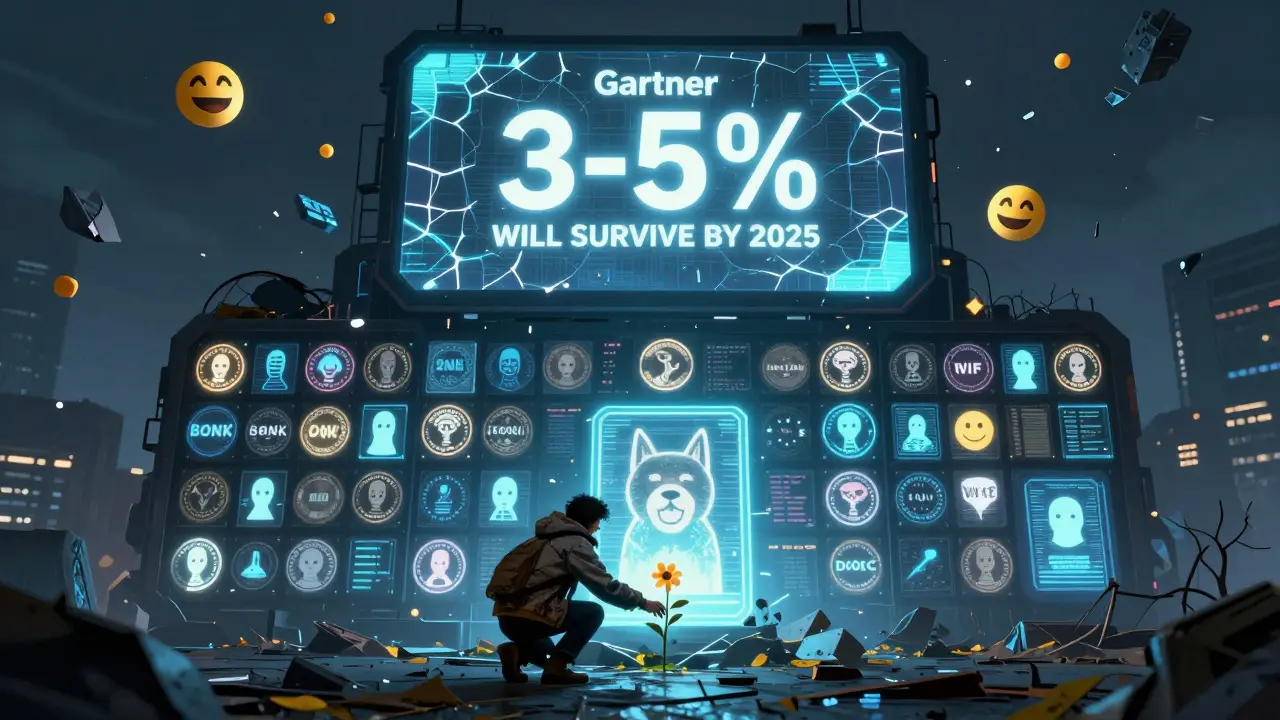
The truth? Most won’t survive. Gartner predicts only 3-5% of current memecoins will still matter by 2025. The rest? Forgotten. Like Beanie Babies in the late ’90s.
How to Buy a Memecoin - And Not Lose Everything
If you still want to try, here’s how to do it without getting wiped out.
- Use a trusted exchange: Kraken, Coinbase, or Binance. Avoid random apps you find on TikTok.
- Never invest more than you can afford to lose: If losing $50 would stress you out, don’t put in $50.
- Set profit targets: If your coin doubles, sell half. That way, you protect your original money and let the rest ride.
- Watch the news: Elon Musk tweets. A celebrity posts a meme. The price spikes. That’s your signal to sell - not buy.
- Avoid new coins with no history: If a memecoin launched last week and already has a $100 million market cap? That’s a red flag. Most of these die within days.
Experienced traders on Reddit say the same thing: ‘Take profits early.’ One user, u/MemeMaster420, turned $1,000 into $3,000 on DOGE in 2021. He sold half at 2x. The rest crashed. He walked away with $2,000 profit - and no regrets.
The Future of Memecoins
Memecoins aren’t going away. They’re too fun. Too viral. Too tied to how people connect online. Even if Dogecoin fades, another will rise. Maybe one built on a cat meme. Or a TikTok dance. The next one might even have a real app - a tipping tool, a social network, a game. That’s already happening with WIF on Solana, which now lets users send tips directly through Twitter.
But here’s the hard truth: if a memecoin doesn’t build something useful, it will die. The community can keep it alive for a while. But without utility, it’s just noise. The ones that survive will be the ones that stop being memes - and start being tools.
For now, memecoins are the wild west of crypto. No rules. No safety nets. Just hype, humor, and heartbreak. If you jump in, go in with your eyes open. And never, ever believe the hype.
Are memecoins a good investment?
Most memecoins are not good investments. They have no underlying value, no technical use, and extreme price swings. While some people have made money, far more have lost it. Treat them like lottery tickets - not stocks. Only risk money you’re okay with losing completely.
Why is Dogecoin still worth billions?
Dogecoin is still valuable because of its massive, loyal community and cultural staying power. It was the first memecoin, and it’s been around longer than most. Elon Musk’s support, its use in tipping, and its low entry price keep it alive. But its value comes from perception, not technology.
Can memecoins crash to zero?
Yes. Many have. Over 1,200 memecoins have been launched since 2013. Most are already worthless. If a project’s creators abandon it, or if the hype dies, the price collapses. There’s no safety net. If no one buys it, it’s worth nothing.
How do I avoid getting scammed with memecoins?
Never invest in a memecoin you can’t research. Check the team behind it - if they’re anonymous, walk away. Look for locked liquidity (meaning the creators can’t pull the money). Avoid coins promoted only on TikTok or Twitter. Use trusted exchanges. And never invest more than you can afford to lose.
Do memecoins have any real-world use?
Most don’t. But Dogecoin is now accepted for some Tesla merchandise. Some Solana memecoins let users tip each other on social media. These are small steps toward utility, but they’re rare. For now, the only real use is trading and community engagement.
Why do people keep buying memecoins if they’re so risky?
Because they’re fun, social, and addictive. The low price makes it feel like you’re getting something for free. The community feels welcoming. And the stories of people making quick money are everywhere. It’s human nature to chase excitement - even when the odds are terrible.
Allen Dometita
January 8, 2026 AT 15:08Brittany Slick
January 10, 2026 AT 08:23Sherry Giles
January 10, 2026 AT 09:21Jon Martín
January 11, 2026 AT 15:19Tracey Grammer-Porter
January 13, 2026 AT 04:50sathish kumar
January 14, 2026 AT 12:21Don Grissett
January 15, 2026 AT 02:48Katrina Recto
January 16, 2026 AT 01:05Mollie Williams
January 17, 2026 AT 10:18Surendra Chopde
January 18, 2026 AT 11:13Tiffani Frey
January 20, 2026 AT 06:41Tre Smith
January 22, 2026 AT 04:18Ritu Singh
January 23, 2026 AT 07:04kris serafin
January 24, 2026 AT 19:40Jordan Leon
January 25, 2026 AT 11:27Rahul Sharma
January 25, 2026 AT 15:27