
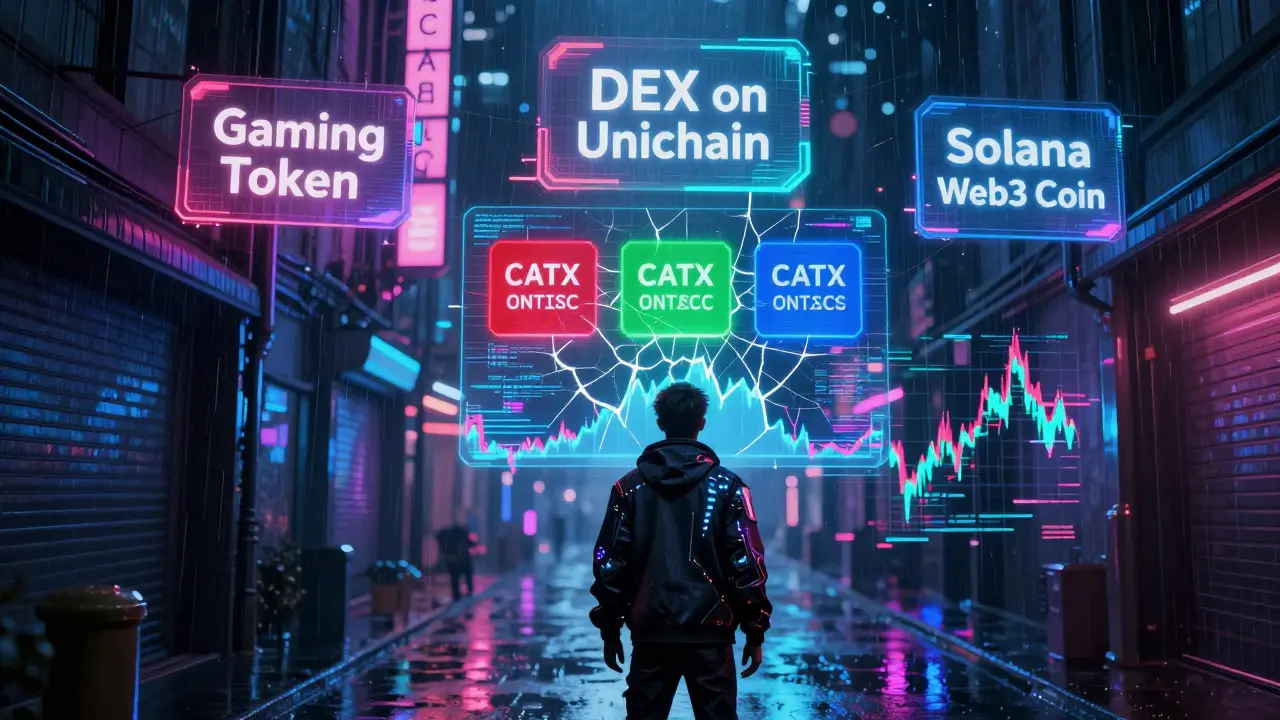
When you search for CATX (CATX), you’re not getting one clear answer-you’re getting five conflicting stories. One source says it’s a gaming token. Another says it’s a decentralized exchange. A third claims it runs on Solana. Meanwhile, your price chart shows a 4,500% spike one day and a 12% crash the next. If this sounds like chaos, that’s because it is. CATX isn’t just another obscure crypto-it’s a case study in how misinformation spreads in the crypto world.
What even is CATX?
The short answer: nobody really knows. Different platforms describe CATX as completely different things. CoinPaprika calls it a token built for gaming microtransactions. Cryptorank says it’s the native token of a DEX called Catex, built on Unichain. CoinSwitch claims it’s a Solana-based Web3 coin. And CoinGecko, CoinMarketCap, and CoinStats all report wildly different prices, market caps, and supply numbers. You could spend hours trying to reconcile these contradictions-and still walk away confused.This isn’t a case of technical complexity. This is a case of unclear identity. Most legitimate tokens have one blockchain, one whitepaper, one team, and one clear purpose. CATX has none of that. Instead, it has multiple contract addresses, conflicting descriptions, and no official website that stays consistent across sources. That’s a red flag.
Price chaos: Why does CATX jump 4,500% overnight?
The price swings of CATX aren’t just volatile-they’re statistically impossible without manipulation. On January 18, 2025, CoinGecko recorded an all-time high of $0.058739. A few days later, CoinPaprika reported an ATH of $0.000029. That’s a 2,000x difference in reported highs from two major platforms. Meanwhile, CoinMarketCap listed the price at $0.000000253, while CoinStats showed $0.00000475. That’s not data lag. That’s data corruption.These discrepancies aren’t accidental. They’re symptoms of low liquidity and high manipulation. The 24-hour trading volume for CATX ranges from $75K to $111K across platforms-tiny for a token with a supposed 1 trillion supply. Most of this trading happens on Uniswap V2/V3, with almost no presence on centralized exchanges like Binance or Coinbase. That means only a few wallets are moving the price, likely through wash trading: buying and selling between accounts they control to create fake demand.
And yet, people still trade it. Why? Because the hype works. On January 6, 2026, CATX surged 1,736% in 24 hours. No news. No update. No product launch. Just a pump. People who bought in early made money. Those who bought after? They got burned. This pattern repeats every few weeks. It’s not investing. It’s gambling.

The blockchain mess: Solana? Unichain? Or something else?
CATX’s blockchain identity is a mess. CoinSwitch says it’s on Solana. Cryptorank says it’s on Unichain-a Layer 2 built on Ethereum. CoinPaprika doesn’t even say. And here’s the kicker: each blockchain has a different contract address for CATX. If you send funds to the wrong one, your money is gone forever.Trust Wallet and MetaMask list CATX as “partially supported,” meaning you have to manually enter the contract address. But which one? There are at least three active ones floating around. Reddit threads like “Is CATX a gaming token or DEX token?” have hundreds of confused users asking the same question. The top comment? “I bought thinking it was a gaming token like advertised on CoinPaprika, but their website just redirects to a generic Uniswap pool-total mess.”
There’s no official GitHub repo. No team bio. No roadmap with dates. No developer updates. Just a bunch of Telegram groups with fewer than 500 members and a Twitter account that hasn’t posted since January 3, 2026. If this were a startup, it would’ve been shut down by now. But in crypto, confusion can be a business model.
Why experts call it a red flag
Dr. Elena Rodriguez from Delphi Digital called CATX “a textbook example of misleading project marketing.” Messari labeled it a “High-Risk Speculative Asset” with price discrepancies exceeding 10,000x across platforms. The SEC’s January 2026 Token Verification Framework flagged tokens with “multiple conflicting project descriptions” as potential enforcement targets. That’s not just a warning-it’s a legal risk.Compare CATX to real projects. Enjin (ENJ) powers over 200 gaming applications with clear token utility. Uniswap (UNI) has a $4.2 billion market cap and transparent governance. CATX has no ecosystem, no partnerships, no real use case. Its only “utility” is being a ticker symbol that gets pumped by bots.

What users actually experience
Real users aren’t building games or trading on DEXs with CATX. They’re losing money. Trustpilot reviews for “Catex DEX” average 1.8/5. Common complaints: “I couldn’t verify the contract address,” “My wallet showed $0.000001, but my trading app said $0.06-I lost 95% of my investment,” and “No one answers questions on Telegram.”A CryptoTwitter poll found that 63% of users couldn’t determine the correct contract address. That’s not user error. That’s bad design-or worse, intentional obfuscation. The only people making money are the ones who bought before the pump and sold before the crash. Everyone else is collateral damage.
Is CATX worth anything?
Let’s be blunt: CATX has no intrinsic value. It doesn’t solve a problem. It doesn’t improve a system. It doesn’t have a team you can verify. It’s a symbol on a chart, fueled by social media hype and data manipulation.If you’re a trader who thrives on extreme volatility, you might play it. But don’t call it an investment. Call it a lottery ticket. If you’re looking for a token to hold, use, or build with-walk away. There are hundreds of better options with real teams, real code, and real transparency.
The crypto space is full of noise. CATX is one of the loudest-and one of the most dangerous.
Is CATX a real cryptocurrency or just a meme coin?
CATX isn’t a meme coin in the traditional sense-like Dogecoin or Shiba Inu-because it doesn’t have a cultural movement or community identity. Instead, it’s a speculative token with conflicting project descriptions across platforms. It lacks a clear team, whitepaper, or utility, making it more of a data anomaly than a legitimate project. Its value comes purely from short-term price swings, not adoption or innovation.
Can I buy CATX on Coinbase or Binance?
No, CATX is not listed on any major centralized exchange like Coinbase, Binance, or Kraken. All trading activity happens on decentralized exchanges, primarily Uniswap V2 and V3. This means you need a self-custody wallet like MetaMask or Trust Wallet, and you must manually input the contract address-which is risky because multiple addresses exist under the same ticker symbol. Buying CATX on a DEX is like buying a product without knowing the manufacturer.
Why do different sites show different prices for CATX?
Different price reports come from different liquidity pools and trading pairs. Some platforms pull data from a low-volume Uniswap pool, others from a different chain entirely. This creates massive discrepancies-sometimes over 10,000x. It’s not a glitch. It’s a sign that the market is artificially fragmented, likely due to wash trading. If a token’s price varies wildly across trusted aggregators, treat it as unreliable.
Is CATX built on Solana or Ethereum?
There is no consensus. CoinSwitch says Solana. Cryptorank says Unichain (an Ethereum Layer 2). CoinPaprika doesn’t specify. Multiple contract addresses exist across chains, meaning the same ticker symbol (CATX) is being used for different tokens on different blockchains. This is a major red flag. Legitimate tokens don’t operate this way. Always verify the contract address on Etherscan or Solscan before sending funds.
Should I invest in CATX?
No, you should not invest in CATX. It has no verifiable use case, no transparent team, no official documentation, and inconsistent data across platforms. It’s classified as a high-risk speculative asset by top analysts. Even if you make a quick profit from a pump, the risk of losing everything is extremely high. There are thousands of better tokens with real development, community, and utility. Don’t gamble on confusion.
Mohammed Tahseen Shaikh
March 23, 2026 AT 11:05CATX is a glorified ticker symbol with zero substance-like selling a blank check with a fancy logo and calling it a bank. People are losing money because they think ‘pump’ means ‘progress.’ Wake up. This isn’t crypto-it’s a casino with a whitepaper.
John Alde
March 24, 2026 AT 08:05It’s fascinating how the crypto ecosystem enables this level of structural ambiguity. Multiple contract addresses under a single ticker? That’s not a bug-it’s a feature of the permissionless, trust-minimized environment. But when liquidity is artificially fragmented across chains with no coordination, you’re not seeing market efficiency-you’re seeing predatory design. The fact that users are being forced to manually verify contracts instead of having a single canonical source speaks volumes about governance failure.
Compare this to how legitimate projects handle token deployment: one chain, one audit, one verified contract, one transparent team. CATX has none of that. It’s a ghost project with multiple identities, each feeding off the others’ confusion. The 10,000x price variance isn’t a data error-it’s a symptom of wash trading bots operating across isolated pools. No real user would build on this. No real developer would deploy here. And yet, people keep throwing money into the void.
Andrew Midwood
March 25, 2026 AT 09:14bro i just bought CATX on uniswap because the chart looked like a rocket and now my wallet says 0.0000001 and the app says 0.06?? i think i got scammed but also idk if im dumb or if its just the whole system being broken lmao
Anand Makawana
March 25, 2026 AT 23:05From a technical standpoint, CATX represents a profound failure in token standardization and metadata integrity. The absence of a singular, audited contract address, coupled with inconsistent on-chain metadata across aggregators, violates the foundational principle of blockchain transparency. Furthermore, the reliance on decentralized exchanges with negligible liquidity and no centralized listing suggests a deliberate obfuscation strategy aimed at circumventing regulatory scrutiny. The projected 4,500% volatility spikes are statistically inconsistent with natural market dynamics and are indicative of coordinated pump-and-dump operations leveraging low-liquidity pools. Investors must recognize that in the absence of a verifiable team, roadmap, or utility, any perceived value is purely speculative and entirely divorced from economic fundamentals.
Tammy Stevens
March 26, 2026 AT 22:01Y’all are so harsh, but honestly? I get it. I lost $800 on CATX last month. I thought it was a gaming token because CoinPaprika said so. Then I tried to use it in a game and realized the contract didn’t even connect. I didn’t know there were three different addresses floating around. I’m not a crypto expert-I just wanted to support something fun. But this isn’t fun. It’s like buying a toy with no instructions and then being told the box was wrong. I’m not mad, just sad. There’s so much good crypto out there. Why does this stuff keep happening?
Justin Credible
March 27, 2026 AT 03:55catx is just a meme but with fake docs lmao. i saw it on a tiktok ad saying ‘next 1000x’ and i was like ‘cool’ and bought it. now my balance is 0.0000000001 and i think i’m the only one who still believes in it. send help
Neil MacLeod
March 29, 2026 AT 01:47CATX isn’t even a scam. It’s worse. It’s a parody of a scam. A token with no team, no whitepaper, no utility, and five conflicting blockchain identities-that’s not malice. That’s incompetence dressed up as innovation. The fact that people still trade it suggests we’ve normalized chaos in crypto. We don’t demand transparency anymore. We just click ‘buy’ and hope. And when the price collapses? We blame the market. Not the project. Not the platforms. Not the aggregators who let this nonsense live. This isn’t finance. It’s performance art for the gullible.
Alice Clancy
March 30, 2026 AT 06:36USA has real crypto. India? China? You people let this garbage live. CATX is a joke. And you’re still trading it? Get a real wallet. Get a real coin. Stop being sheep. This isn’t freedom. It’s fraud. And you’re paying for it.
LOL 💩
Mike Yobra
March 31, 2026 AT 23:05You know what’s funny? The same people who scream about ‘decentralization’ when they lose money are the ones who built this whole mess. They don’t want transparency-they want anonymity. CATX isn’t a token. It’s a legal loophole with a ticker symbol. And the worst part? The platforms that report its price? They’re not fixing it. They’re profiting from the confusion. So we’re not just being scammed. We’re being monetized. By the very systems that claim to protect us.
Marie Mapilar
April 1, 2026 AT 22:08I used to think CATX was just a mess, but now I see it as a mirror. It reflects everything wrong with crypto right now-no accountability, no clarity, no responsibility. I’ve seen so many people get burned on this, and honestly? It breaks my heart. Not because they lost money, but because they believed in something that never existed. There’s a reason real projects have GitHub repos, team bios, and audits. CATX has none. And yet, we still give it attention. We need to stop rewarding chaos. We need to stop clicking ‘buy’ on tokens that look like typos.
Maybe next time, we ask: ‘Who built this?’ before we send our money.
Anna Lee
April 3, 2026 AT 01:57OMG I just found out CATX has 3 different contract addresses and I thought I was smart for finding it on uniswap 😭 i’m so sorry i spent my rent money on this i’m gonna start studying blockchain basics first next time!! thanks for the post!!
manoj kumar
April 3, 2026 AT 11:11Of course CATX is a scam. Every time someone says ‘it’s on Solana’ or ‘it’s a DEX token,’ they’re lying. The only thing consistent is the price manipulation. The devs don’t care. The aggregators don’t care. The traders don’t care. Only the victims care. And they’re too late. This isn’t crypto. It’s a Ponzi with a blockchain label. If you’re still holding, you’re not an investor-you’re a statistic.