

Fidira (FID) isn’t another meme coin or DeFi protocol. It’s a crypto token built to get people who’ve never touched Bitcoin or Ethereum into the world of NFTs - using something they already understand: gift cards.
Imagine walking into a convenience store, picking up a $20 gift card, and scanning it to unlock an NFT. No wallet setup. No private keys. No confusing apps. Just a card, a phone, and access to digital collectibles. That’s Fidira’s entire model. And it’s built on Polygon, the fast, cheap Ethereum sidechain that handles millions of transactions daily.
But here’s the catch: while the idea sounds simple, the market isn’t buying it - yet. As of December 2025, FID trades at $0.000623 on Binance. That’s less than a cent. The 24-hour trading volume? Just $64.18. For comparison, even obscure tokens with no real use case often trade over $1 million a day. Fidira’s volume is so low, it’s almost invisible on most charts.
How Fidira (FID) actually works
Fidira isn’t a wallet, exchange, or marketplace. It’s a distribution layer. The token - FID - powers a system where NFT projects can sell access to their digital assets through physical and digital gift cards.
Here’s the flow:
- A retailer (like a gas station, pharmacy, or online store) stocks Fidira gift cards.
- You buy one for $10, $25, or $50.
- You scratch off a code or scan a QR code on the card.
- The system unlocks a unique NFT tied to that card - maybe a digital art piece, a game item, or a collectible.
- At the same time, a small amount of FID tokens is sent to your wallet as a bonus.
That’s it. No need to buy ETH, connect MetaMask, or understand gas fees. You just used a gift card like you would for Amazon or Starbucks.
After you get the NFT, you can hold it, trade it, or stake your FID tokens to unlock more NFTs from partner projects. The staking portal is where the token gets its utility - you lock up FID to get access to exclusive drops.
It’s not flashy. But for someone who’s never held crypto, it removes every barrier.
The numbers don’t lie - FID is barely alive
Let’s talk numbers. Fidira has a fixed supply of 100 million FID tokens. That’s it. No more will ever be created. The fully diluted valuation (FDV) - meaning if every single token was sold at today’s price - is around $62,300. That’s less than the cost of a modest NFT collection.
On CoinGecko, the 24-hour trading volume dropped 59% from the day before. That’s not normal. It means almost no one is buying or selling. The 3% price bump you see? It’s likely a single large wallet moving a few thousand tokens. Not organic demand.
Compare that to Polygon’s native token, MATIC. It trades over $100 million daily. Fidira’s volume is 1,500 times smaller. That’s not a small gap - it’s a canyon.
Why does this matter? Because if you buy FID today, you might not be able to sell it tomorrow. Exchanges like Binance list it, but with no buyers, you’re stuck. Slippage could be 50% or more on even a $50 trade. Liquidity is the silent killer of low-cap tokens.

Who’s behind Fidira? No one knows
There’s no whitepaper. No team page. No LinkedIn profiles of founders. No Twitter account with 10,000 followers. No Discord server with active chat.
ICOholder and CoinGecko list Fidira as a project, but they don’t name the developers. That’s unusual. Even the most obscure crypto projects have at least a GitHub profile or a Telegram group. Fidira doesn’t. That raises red flags for anyone who’s been around crypto for more than a year.
Is it a scam? Not necessarily. Some projects launch quietly and build slowly. But with zero community presence and near-zero trading volume, it’s hard to believe this is a real, growing business.
There are no Reddit threads. No YouTube reviews. No Medium articles explaining the tech. No interviews with the team. That’s not just quiet - it’s silent.
How does Fidira compare to other crypto onboarding tools?
Other projects try to onboard new users too. Coinbase has its “Learn and Earn” program. Crypto.com gives away free crypto for watching videos. Even Walmart tested crypto gift cards in 2023.
Fidira’s edge? It doesn’t ask you to do anything. You don’t watch a video. You don’t answer quiz questions. You don’t need to sign up for an account. You just buy a card and redeem it.
That’s powerful. But it’s also limited. You can’t swap FID for Bitcoin. You can’t use it to pay for DeFi loans. You can’t stake it for high APY. It’s not a currency - it’s a key to unlock NFTs.
If you’re a gamer or art collector who wants to own a digital item, Fidira might be your easiest entry. If you’re looking to invest, trade, or earn yield - it’s not the tool for you.
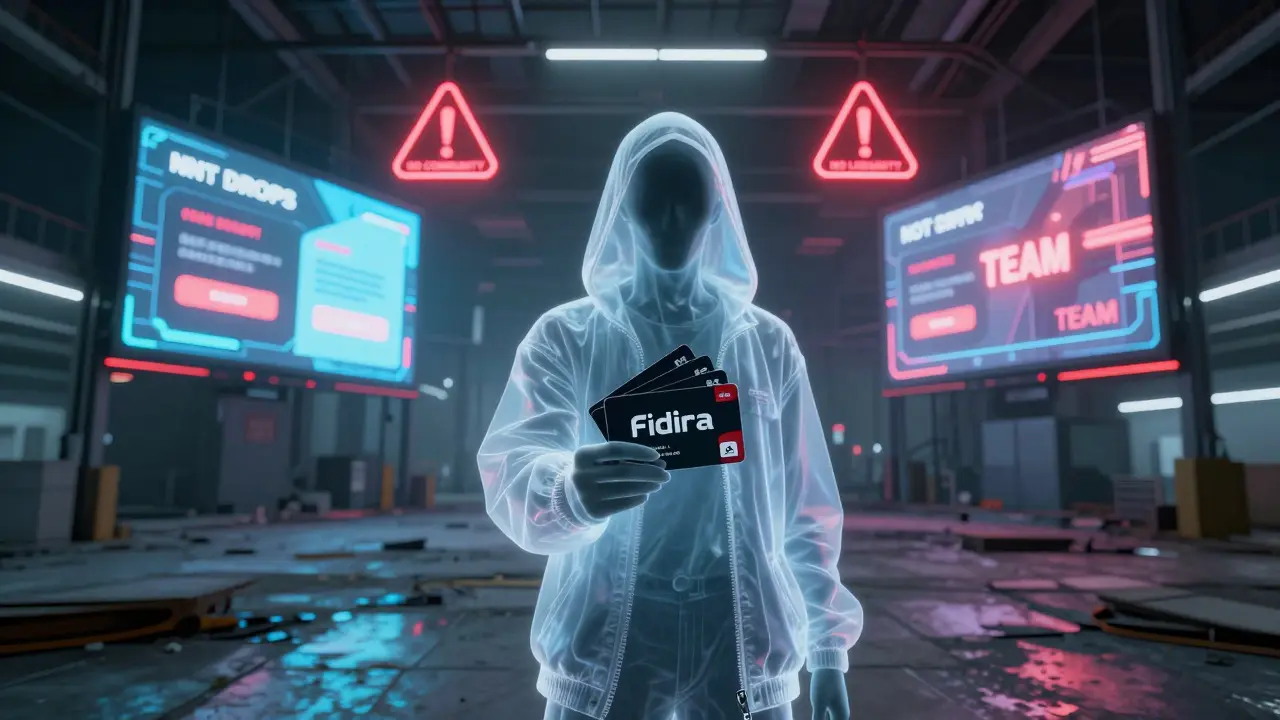
Price predictions? Don’t believe them
PricePrediction.net says FID could hit $0.002 by 2030. WalletInvestor says $0.002184. TradingBeast says it’ll crash to $0.0001425.
Here’s the truth: none of these predictions mean anything for a token with $64 in daily volume. These sites use algorithms trained on high-liquidity coins. They don’t account for the fact that FID has no real buyers, no community, and no proven retail partnerships.
TradingView’s analysis says technical indicators are “unreliable” for FID - and they’re right. You can’t chart a trend when there’s no trend to chart.
Real price movements come from real demand. And right now, there’s almost none.
Is Fidira worth buying?
Let’s be blunt: if you’re looking to make money, don’t buy FID.
If you’re curious about how crypto can reach mainstream users - and you want to support a project that tries to remove complexity - then maybe. But only with money you’re okay losing.
There’s no guarantee Fidira will ever partner with Walmart, 7-Eleven, or CVS. Without those deals, the gift card model dies. And without retail distribution, FID has no reason to exist.
Right now, it’s a prototype with no users. A tool with no customers. A token with no market.
It’s not dead. But it’s not alive either. It’s waiting - for someone to give it a chance.
Kelsey Stephens
December 16, 2025 AT 23:59I love how Fidira tries to make crypto accessible without forcing people to learn a whole new language first. My grandma just got her first NFT last week through a gift card at CVS - she didn’t even know what a wallet was until she scanned the code. It’s not flashy, but it’s real human onboarding.
That’s the kind of innovation we need more of - not another meme coin with a Discord full of bots.
Tom Joyner
December 17, 2025 AT 03:34Tokenomics of a $62k FDV project on Polygon? How is this even listed on Binance? This isn’t innovation - it’s a liquidity trap wrapped in a gift card.
Someone’s pumping it to dump on the gullible.
SeTSUnA Kevin
December 18, 2025 AT 07:25The liquidity is negligible. The team is anonymous. The utility is non-transferable. This is not a cryptocurrency. It is a promotional voucher with a blockchain wrapper.
There is no market. There is no demand. There is only supply.
Timothy Slazyk
December 19, 2025 AT 14:33Let’s not romanticize this. Fidira isn’t a bridge to crypto - it’s a side door that leads to a dead end.
Yes, it removes friction for beginners, but friction exists for a reason. Private keys aren’t a bug - they’re a feature. If you don’t understand ownership, you shouldn’t own anything.
And yet… I respect the intent. We’ve been too focused on DeFi yields and NFT speculation. Maybe we needed something this quiet, this simple.
But simplicity without infrastructure is just a ghost. No partnerships. No media. No community. No future.
If Walmart ever picks this up, I’ll eat my hat. Until then, it’s a digital pamphlet in an empty room.
The real tragedy? Someone spent months building this. And no one’s watching.
That’s the quiet horror of crypto - not the scams. The ones nobody even notices.
Kayla Murphy
December 20, 2025 AT 22:32Don’t count it out yet! I’ve seen projects go from zero to hero with one retail deal. Imagine if 7-Eleven started selling these next month - boom, instant millions of users.
Stay curious, stay patient. The quiet ones often win.
Chevy Guy
December 21, 2025 AT 19:47They’re using gift cards because they’re hiding something
think about it - no team no whitepaper no discord
the real nft is the gift card itself
you’re buying a scam wrapped in a barcode
they’re gonna rug it after the first 10k cards sell
just wait
it’s already happening
lol
Amy Copeland
December 22, 2025 AT 12:35Oh wow, another ‘crypto for dummies’ project. How original.
Let me guess - the devs are 19-year-olds in a basement with a Canva whitepaper and a fake LinkedIn profile.
At least meme coins have personality. This just feels like a corporate PR stunt that forgot to hire a PR team.
Patricia Amarante
December 22, 2025 AT 23:58I bought one of these cards last week. Got a cool little pixel art cat NFT and 5 FID tokens. Didn’t even know what staking was until I clicked the link.
Now I’m learning. Slowly. No panic. No pressure.
That’s the magic. Not the price. The experience.
Madhavi Shyam
December 24, 2025 AT 09:00From a tokenomics perspective, the velocity of FID is statistically irrelevant given the negligible market cap and absence of on-chain activity metrics. The lack of smart contract audits and KYC’d team members introduces systemic risk that exceeds any potential utility gain from gift card abstraction.
Also, Polygon’s L2 doesn’t mitigate the existential liquidity crisis.
Mark Cook
December 26, 2025 AT 04:02Wait… so you’re saying this isn’t a rug pull? 😳
Then why is the volume lower than my last Tinder date? 🤔
Also, who’s the guy holding 90% of the supply? 😏
Just asking for a friend… who’s me.
Rebecca Kotnik
December 26, 2025 AT 23:18It is important to acknowledge that while the current market dynamics surrounding Fidira present a multitude of structural challenges - including but not limited to insufficient liquidity, lack of institutional transparency, and the absence of verifiable developmental trajectories - the conceptual architecture of the project, namely its attempt to decouple digital asset acquisition from the technical prerequisites of blockchain interaction, represents a potentially significant paradigm shift in user onboarding methodologies.
Historically, crypto adoption has been hindered by cognitive overload and interface complexity; Fidira, despite its present obscurity, attempts to circumvent these barriers through physical intermediation - a strategy reminiscent of early mobile phone adoption via prepaid cards.
One must therefore distinguish between market viability and conceptual innovation. The former may be absent; the latter, potentially profound.
It is not the role of the observer to condemn the unproven - but to observe, analyze, and await empirical validation.
Perhaps, in five years, we will look back and recognize this as the quiet beginning of a new era - one where crypto is not understood, but simply experienced.
Jonny Cena
December 28, 2025 AT 08:31Hey, I’ve been helping people get into crypto for years. Most of them don’t care about wallets or gas fees. They care about owning something cool.
Fidira gets that. And honestly? That’s more than 90% of crypto projects.
Don’t hate the model because it’s quiet. Hate it when it’s loud and fake.
Give it time. Let it grow. Maybe someone’s building this in the background right now - quietly, carefully, without the noise.
Florence Maail
December 30, 2025 AT 00:43They’re using gift cards because they’re laundering money
no team no twitter no discord
the real nft is your trust
they’re gonna disappear after 100k cards
you think this is legit? 😂
it’s a honeypot
you’re the honey
they’re the bees
and you’re the flower
Abby Daguindal
December 31, 2025 AT 17:16It’s cute that people think this is ‘innovative.’
You’re not onboarding users - you’re creating disposable digital trinkets for people who don’t care about ownership.
It’s not crypto. It’s a loyalty card with a blockchain sticker.
Bradley Cassidy
January 2, 2026 AT 12:04man i bought 5 of these cards just cause i liked the art
got a glitchy dragon nft and 27 fid
now im kinda obsessed with staking it
idk if its gonna moon or crash
but i got a dragon that moves when i click it
and that’s kinda magic
even if its just a barcode