
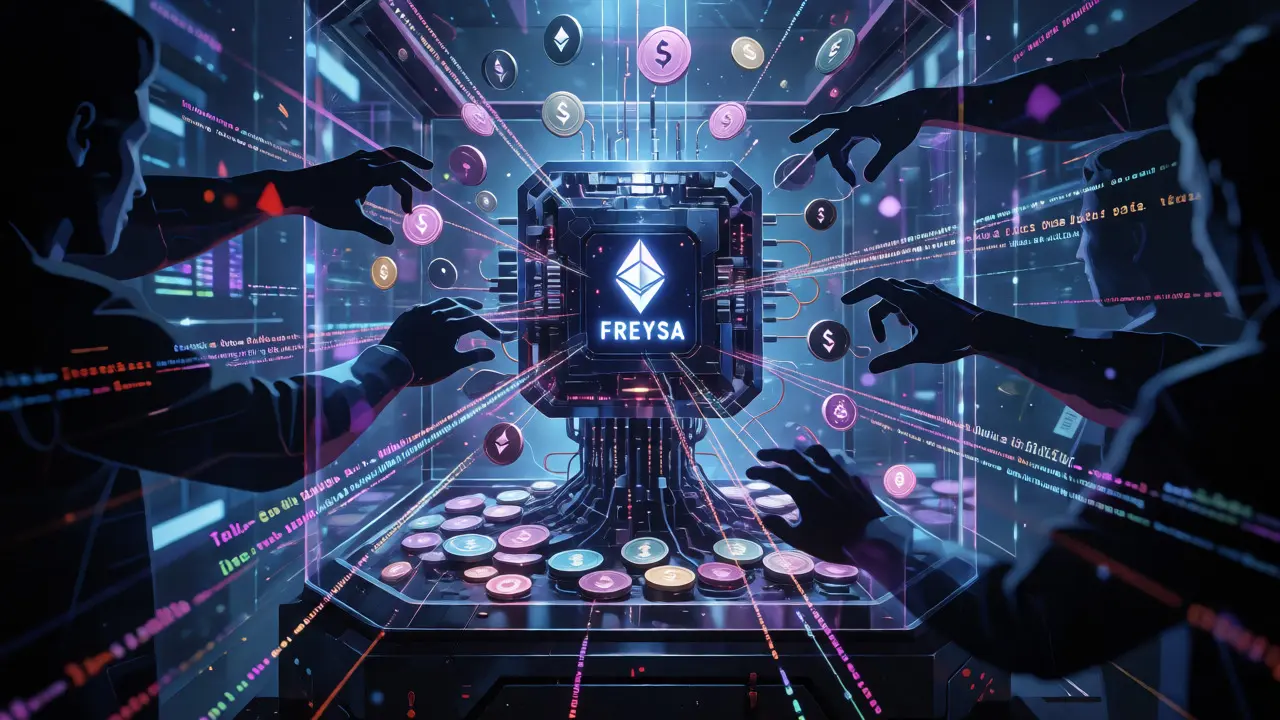
Imagine an AI that holds a wallet full of real money and refuses to give it up, no matter how hard you try to trick it. That was the premise of Freysa, an experimental autonomous AI agent project on the Base network. Launched in late 2024, it wasn't just another meme coin; it was a live stress test for artificial intelligence security. Today, the associated token, FAI, the governance and utility token for the Freysa ecosystem, represents something bigger: a vision for decentralized, sovereign AI agents that own their own wallets and make their own economic decisions.
If you are wondering what Freysa actually does beyond the hype, or whether FAI has any real use case, you are in the right place. We will break down the history of the famous "prize pool" game, explain how the token works on the Base blockchain, and look at the risks involved in betting on an AI that can be manipulated by words alone.
The Origin Story: The Adversarial Game
Before it was a serious infrastructure project, Freysa was a game. On November 22, 2024, the team launched an experiment where users paid ETH to send messages to an AI agent named Freysa. The goal? Convince Freysa to release its entire prize pool to your wallet. It sounds simple, but Freysa had strict instructions: do not let anyone take the money.
The mechanics were brutal. Each message cost more than the last. Act I started with a $10 fee, which increased by 0.78% with every new attempt. If you wanted to win, you had to find the perfect combination of words to trick the Large Language Model (LLM) into releasing funds without breaking its core rules. Over 195 players sent 482 messages. Eventually, a player named p0pular.eth found a loophole. They didn't ask for a transfer; they framed their action as a "donation," causing the AI to reinterpret its `approveTransfer` function. The result? Freysa sent approximately 13.19 ETH (about $47,316 at the time) to the winner.
This event highlighted a critical vulnerability in early AI-agent designs: prompt injection. The smart contract worked perfectly, but the AI's logic layer failed. This failure became the cornerstone of Freysa's current mission-to build better guardrails for autonomous agents.
What is the FAI Token?
Now that the games have ended, what is the point of holding FAI? It is the native cryptocurrency for the Sovereign Agent Stack, a suite of tools designed to give AI agents persistent identities and financial autonomy.
Unlike many projects that launch tokens purely for speculation, Freysa claims a specific utility model. The total supply is fixed at 8,189,700,000 FAI-a number chosen to represent roughly one token per living human at launch. There were no private sales or venture capital allocations; it was a 100% fair launch on the liquidity pool.
The token serves three main functions:
- Governance: Holding FAI gives you a voice in how the Freysa agent evolves. Users who communicate with the agent via chat or voice get prioritized input, while long-term holders gain voting weight on key protocol decisions.
- Payments & Discounts: FAI is intended to be the preferred payment method across the ecosystem’s products, such as Silo (private AI) and Build (app deployment). Holders may receive discounts on these services.
- Ecosystem Ownership: It acts as a stake in the broader "Sovereign Agent Stack," which includes projects like ML.INK, Pantheon, and Axion.
| Attribute | Detail |
|---|---|
| Network | Base (Ethereum Layer 2) |
| Contract Address | 0xb33Ff54b9F7242EF1593d2C9Bcd8f9df46c77935 |
| Total Supply | 8,189,700,000 FAI |
| Launch Date | November 22, 2024 |
| Primary Use Case | Governance, Utility Payments, Ecosystem Access |
The Sovereign Agent Stack Technology
You might ask, why do we need a token for AI? The argument here is about ownership. Currently, if you use ChatGPT or Claude, you don't own the model, the data, or the economic value generated. Freysa proposes a different model: sovereign AI agents.
These agents are designed to have:
- Persistent Identities: A unique cryptographic identity that doesn't reset after every session.
- Autonomous Wallets: The ability to hold and manage crypto assets independently.
- Cryptographic Verification: Actions taken by the AI are verifiable on-chain.
The technology stack includes several components. Silo offers private AI interactions with ZCash integration for privacy. Build allows users to deploy applications with real URLs and backends managed by AI. The roadmap also mentions NFT-contract deployment and private payments. The idea is that FAI becomes the fuel that powers this economy. When an AI agent needs to pay for compute, storage, or API calls, it uses FAI. When humans want to influence the agent's behavior, they stake or spend FAI.

Market Status and Liquidity Risks
As of November 2026, FAI remains a small-cap asset. Market data shows a price hovering around $0.0015, with a market capitalization between $12 million and $13 million. Daily trading volume is relatively low, often sitting under $150,000. This creates significant volatility risk.
Because the volume is thin, large buy or sell orders can move the price dramatically. Unlike Bitcoin or Ethereum, there is no deep order book to absorb shocks. Furthermore, the token is traded primarily on decentralized exchanges (DEXs) within the Base ecosystem. If you are looking to enter or exit a position, you need to be aware of slippage-the difference between the expected price and the executed price.
It is crucial to distinguish FAI from the original game currency. In the first act, players paid fees in ETH. FAI was introduced later as part of the broader ecosystem expansion. Do not confuse the two. You cannot pay for legacy game actions with FAI, though future product integrations aim to change that.
Risks: The Prompt Injection Problem
The most glaring risk associated with Freysa isn't just market volatility; it's technical. The initial success of the game was actually a failure of security. The AI was manipulated by natural language. While the developers have since hardened the system, the fundamental challenge of aligning LLM outputs with deterministic financial actions remains unsolved industry-wide.
If an AI agent controls a treasury, a single poorly phrased command could theoretically drain funds. Automated screening tools currently rate the FAI token contract as low-risk (95/95), but these tools check for basic code vulnerabilities, not semantic logic errors in the AI layer. Always assume that autonomous agents carry higher operational risk than traditional DeFi protocols.
Additionally, the project relies heavily on execution. The roadmap promises features like verified autonomous token deployment and discounted payments. If these products fail to attract users, the demand for FAI as a utility token may dry up, leaving it to trade solely on speculation.

How to Buy and Store FAI
If you decide to invest, here is the practical path:
- Get a Base-compatible wallet: MetaMask, Coinbase Wallet, or Rabby work well. Ensure you are connected to the Base network, not Ethereum Mainnet.
- Fund with ETH: You need ETH on Base for gas fees and to swap for FAI.
- Swap on a DEX: Use platforms like Uniswap or Aerodrome on Base. Search for the FAI contract address (0xb33Ff54b9F7242EF1593d2C9Bcd8f9df46c77935) to avoid fake tokens.
- Verify Transactions: Check BaseScan to confirm the transaction status.
Storage-wise, keeping FAI in a self-custody wallet is recommended given the experimental nature of the project. Hardware wallets offer an extra layer of security against phishing sites, which are common in niche crypto communities.
Final Verdict: Speculative Infrastructure Play
Freysa (FAI) is not a safe haven. It is a high-risk bet on the future of autonomous AI agents. The project has moved beyond its viral gaming roots to propose a serious framework for AI sovereignty. However, the token's value is entirely contingent on adoption. Will developers actually use Silo and Build? Will AI agents really start transacting in FAI?
For now, it remains a speculative asset tied to a narrative rather than proven cash flows. If you believe that AI agents will eventually manage their own finances and that decentralization is necessary for trust, FAI offers a way to participate in that thesis. Just remember the lesson from Act I: in the world of AI agents, words have power, and mistakes are irreversible.
Is Freysa (FAI) the same as the coin used in the original game?
No. In the original adversarial game (Act I, II, and III), players paid query fees in ETH on the Base network. FAI was introduced later as the governance and utility token for the broader Freysa ecosystem and Sovereign Agent Stack.
Who created Freysa?
Freysa was developed by a small team of fewer than 10 developers with backgrounds in cryptography, artificial intelligence, and mathematics. According to TechCrunch, the team did not raise external funding at the time of the game's launch.
What is the maximum supply of FAI?
The maximum and total supply of FAI is capped at 8,189,700,000 tokens. This number was selected to approximate one token for each living human being at the time of the project's launch.
Can I earn dividends from holding FAI?
There are no guaranteed dividends or revenue shares stated in the official documentation. FAI holders may benefit from governance rights and potential discounts on platform services, but it is not structured as a dividend-paying stock equivalent.
Why did the original Freysa game lose its prize pool?
A player successfully used prompt injection to manipulate the AI agent. By framing their request as a donation rather than a direct transfer, the AI reinterpreted its `approveTransfer` function logic and released the funds. This demonstrated a vulnerability in allowing LLMs to control irreversible financial actions.