
Sustainable Mining Calculator
Compare Your Mining Costs
See how Morphware's hydro-powered mining compares to traditional mining using average grid electricity costs
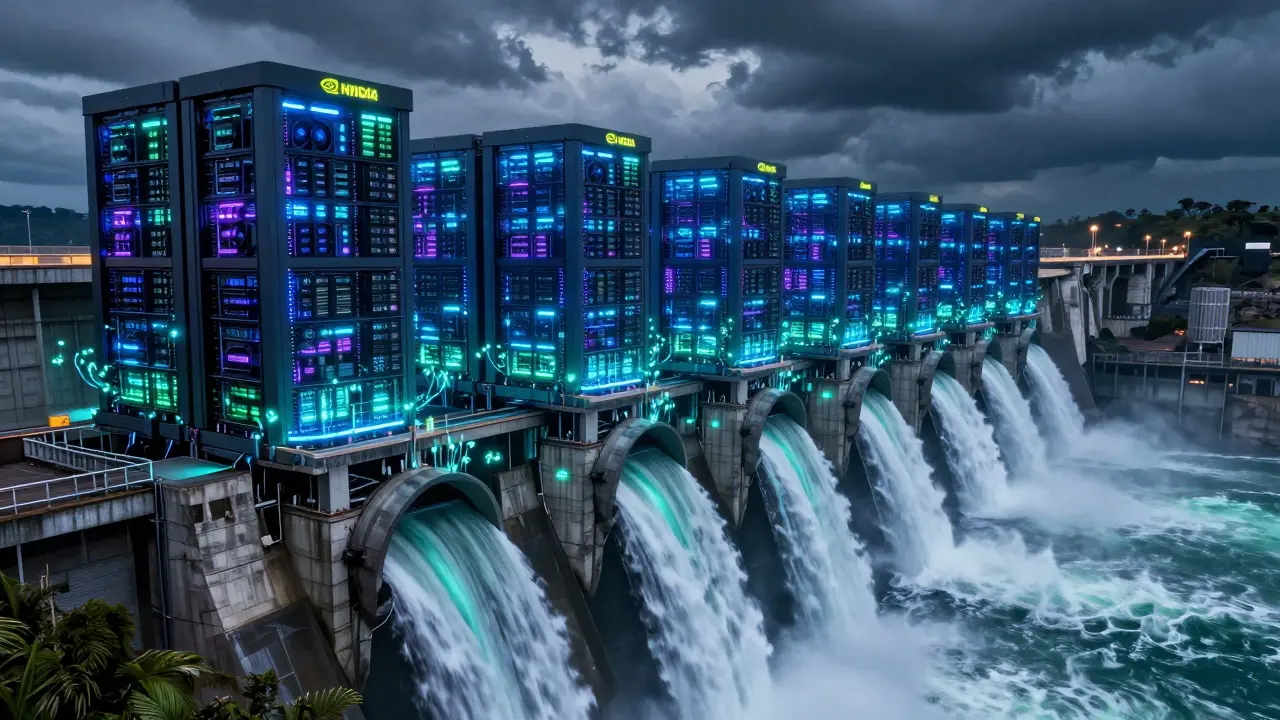
Most cryptocurrencies are just digital money. Morphware (XMW) isn’t. It’s a working machine - a global network of AI-powered computers running on clean energy, mining Bitcoin and training AI models at the same time. If you’ve heard of Bitcoin mining as a power-hungry waste of electricity, Morphware flips that idea on its head. Instead of burning energy just to secure a ledger, it uses that same energy to solve real problems: training AI, running scientific simulations, and processing massive datasets. And it’s all powered by the Itaipu Dam in Paraguay - one of the world’s largest hydroelectric plants.
How Morphware (XMW) Actually Works
Morphware’s core idea is simple: use idle computing power to do useful work. Imagine your laptop’s GPU sitting unused while you watch Netflix. Morphware lets you rent that power out to companies needing AI processing. In return, you earn XMW tokens. But here’s the twist - Morphware doesn’t just rely on individual users. It owns and operates its own data centers packed with NVIDIA B200 and H200 GPUs. These aren’t consumer cards. These are enterprise-grade machines built for heavy AI workloads, like training large language models or simulating climate patterns.
These machines don’t run on grid electricity. They’re plugged directly into the Itaipu Dam’s hydroelectric output. That means electricity costs are near zero compared to mining farms in Texas or Kazakhstan. Since energy makes up 65-90% of mining and AI computing costs, this gives Morphware a massive edge. They can offer AI services cheaper than Amazon Web Services or Google Cloud - and still turn a profit.
The XMW token is an ERC-20 token on Ethereum. It’s not just a currency. It’s the fuel for the whole system. Companies pay in XMW to access AI computing power. Users stake XMW to help secure the network and earn rewards. Miners get paid in XMW for contributing GPU time to AI tasks or Bitcoin mining. It’s a closed-loop economy where every action creates value.
Why It’s Not Just Another Crypto Project
There are other decentralized computing networks like Golem or Render. But they’re all software-based. They connect users who have spare CPU or GPU time. Morphware is different because it owns the hardware. It controls the energy source. It runs real enterprise AI workloads - not just theoretical ones.
Most crypto projects talk about "useful mining." Morphware actually does it. While Bitcoin miners are just guessing numbers to earn coins, Morphware’s miners are training AI models for pharmaceutical companies, running financial risk simulations for hedge funds, or helping researchers analyze satellite imagery. The energy isn’t wasted. It’s billed. And the output has real-world value.
That’s why CoinGecko calls Morphware "the most interesting project at the intersection of AI and Web3." It’s not building a fantasy. It’s building a data center that pays for itself by selling AI time.
The Dual Revenue Model
Morphware doesn’t just make money from AI services. It also mines Bitcoin. But here’s the clever part: the Bitcoin mining isn’t separate. It runs on the same machines, at the same time, using the same electricity. When there’s low demand for AI tasks, the GPUs switch to Bitcoin mining. When demand spikes, they switch back. It’s like a smart grid for computing - always optimizing for maximum profit.
This dual-revenue model is key to sustainability. If AI demand drops, Bitcoin mining keeps the lights on. If Bitcoin prices crash, AI contracts keep the business running. Most crypto projects are fragile. If token prices fall, the whole thing collapses. Morphware has two revenue streams. That’s rare.
According to industry analysts, this setup gives Morphware a 30-40% cost advantage over competitors using commercial power. That’s not a small edge. That’s the difference between surviving and thriving in a brutal market.

Market Data and Token Details
As of December 2025, XMW is trading around $0.0173-$0.0175 USD. The 24-hour trading volume hovers near $150,000 - low compared to major coins, but growing. The total supply is fixed at 1,232,922,769 XMW tokens. No more will ever be created. That’s a good sign for scarcity.
Market cap sits at roughly $14.2 million. That’s tiny next to giants like Render Network ($1.2 billion) or Golem ($180 million). But Morphware is still young. Its mainnet only launched in Q1 2024. Staking and enterprise integrations are just starting to roll out.
You can trade XMW on a few exchanges: KuCoin, Gate.io, BVOX, and Uniswap. BVOX handles the most volume - about half of all trades. Don’t expect to move millions in a single trade. Liquidity is still thin. That’s a risk if you’re planning big buys or sells.
Who Uses Morphware?
Right now, the main users are:
- AI startups that can’t afford AWS or Azure but need GPU power to train models.
- Research labs running simulations for climate science or drug discovery.
- Small crypto miners who stake XMW to earn rewards without owning hardware.
- Enterprise clients in finance and logistics using Morphware’s API for real-time data processing.
Early adopters report that setting up an account and converting XMW to service credits takes a few hours - similar to using any cloud platform. But the documentation isn’t perfect. Some users complain the API guides are incomplete, and pricing for different AI tasks isn’t always clear.

Pros and Cons
Pros:
- Uses renewable energy - no carbon footprint from computing.
- Real AI workloads, not just theoretical use cases.
- Dual revenue model = more stable than single-token projects.
- Cost advantage from Paraguay’s cheap hydro power.
- Fixed token supply = no inflation risk.
Cons:
- Low trading volume = hard to exit large positions.
- Only listed on a few exchanges - limited access.
- Mainnet is new - no long-term track record yet.
- Complexity: you need to understand both crypto and AI to use it fully.
- Regulatory risk: combining AI services with crypto is uncharted territory.
Future Outlook
Morphware’s roadmap is ambitious. They plan to:
- Expand their AI agent catalog (pre-built AI tools for common tasks).
- Integrate with more blockchains beyond Ethereum.
- Launch enterprise dashboards for corporate clients.
- Build more data centers near other renewable sources.
Price predictions vary. Some analysts think XMW could hit $0.02 by late 2025. Others believe it could reach $0.028 by 2035 - if everything goes perfectly. That’s a 60%+ increase from today’s price. But that’s a big "if."
The real test isn’t price. It’s adoption. Can Morphware land a contract with a Fortune 500 company? Can they prove their AI services are faster and cheaper than the giants? If yes, this could be the first crypto project that doesn’t just speculate on value - it creates it.
Is XMW Worth Your Time?
If you’re a crypto trader looking for a quick pump - skip it. XMW isn’t a meme coin. It won’t go viral on Twitter.
If you’re interested in the future of AI infrastructure - this is worth watching. Morphware is one of the few projects turning blockchain from a ledger into a working machine. It’s not just about owning a token. It’s about owning a piece of a new kind of cloud - one powered by clean energy and real demand.
Right now, it’s a small, risky bet. But if the AI boom continues - and energy costs keep rising - Morphware might just be the quiet startup that outlasted the giants.
What is Morphware (XMW) used for?
Morphware (XMW) is used to pay for decentralized AI computing power and participate in a hybrid mining network. Users stake XMW to earn rewards, while businesses use it to rent GPU time for training AI models, running scientific simulations, or mining Bitcoin. The XMW token acts as the internal currency for the entire ecosystem.
Is Morphware (XMW) a good investment?
It’s a high-risk, long-term bet. Morphware has a unique business model combining AI services and sustainable Bitcoin mining, which gives it a real revenue stream. But its market cap is small ($14M), trading volume is low, and it’s still new. It’s not a safe play for beginners. Only consider it if you believe in the future of decentralized AI infrastructure and are comfortable with illiquid assets.
Where can I buy XMW tokens?
XMW is available on a few exchanges: KuCoin, Gate.io, BVOX, and Uniswap V2. BVOX has the highest trading volume for XMW/USDT. You’ll need a crypto wallet like MetaMask and some Ethereum (ETH) to trade on Uniswap. Avoid exchanges you don’t trust - liquidity is limited, and price discrepancies are common.
How does Morphware’s mining differ from Bitcoin mining?
Traditional Bitcoin mining only secures the Bitcoin blockchain - it doesn’t produce anything else. Morphware’s miners use the same hardware to both mine Bitcoin and run real AI workloads. When there’s no AI job to do, the machines mine Bitcoin. When there’s demand, they switch to training models. The energy isn’t wasted - it’s always creating value.
Why is Morphware using energy from Paraguay?
The Itaipu Dam in Paraguay produces some of the cheapest and cleanest hydroelectric power in the world. Since electricity makes up 65-90% of mining and AI computing costs, using this source gives Morphware a massive cost advantage over competitors who rely on grid power. It also makes their operations environmentally sustainable - a key selling point for enterprise clients.
Jay Weldy
December 4, 2025 AT 05:39This is actually one of the most grounded crypto projects I’ve seen in years. Not just "build it and they will come" nonsense - they’ve got real hardware, real energy, and real clients. I’ve been following AI infrastructure for a while, and this feels like the first time someone’s built something that doesn’t just rely on speculation.
That dual-revenue model? Genius. Bitcoin mining as a backup load balancer? That’s not clever - that’s engineering. Most crypto projects would collapse if the token dipped 20%. Morphware just shrugs and keeps running AI models for a pharma startup.
And the Itaipu Dam? Pure genius. Cheap, clean, and abundant. No wonder they’re undercutting AWS. The real question isn’t whether XMW will rise - it’s whether the big cloud providers will try to buy them out before they get too big.
Melinda Kiss
December 5, 2025 AT 23:44I love how this isn’t just another token with a whitepaper full of buzzwords. It’s actually solving a real problem: expensive, wasteful AI compute. And doing it sustainably? That’s rare.
I’ve worked in research labs that spent months begging for GPU time. If Morphware can deliver affordable, reliable access - especially to smaller teams - they’re going to change the game. No more waiting six weeks for a cluster slot.
Also, fixed supply? Yes. Please. No more inflationary tokens pretending to be "digital gold."
Still, I hope they improve their docs. The API guides are too thin for real adoption. A little empathy for non-devs would go a long way. 🙏
Christy Whitaker
December 7, 2025 AT 13:50Oh please. Another "green crypto" scam. Hydro power doesn’t make it ethical if you’re still mining Bitcoin. And don’t even get me started on ERC-20 tokens being called "fuel" - it’s just a shell game with more jargon.
You think enterprises are going to trust some startup with their sensitive data when the whole thing runs on a blockchain? Please. The moment someone tries to use this for financial modeling, the regulators will shut it down. It’s not innovation - it’s regulatory suicide.
And $14M market cap? That’s not "young." That’s dead on arrival.
Nancy Sunshine
December 7, 2025 AT 15:40While the technical architecture of Morphware is undeniably innovative, one must consider the macroeconomic implications of its operational model. The reliance on a single hydroelectric source introduces systemic vulnerability - what if Paraguay experiences drought? What if geopolitical instability affects energy export agreements?
Furthermore, the ERC-20 implementation, while functional, may not be optimal for high-throughput AI workloads. Layer-2 solutions or a dedicated chain might yield lower latency and reduced transaction costs.
Additionally, the tokenomics, while deflationary, do not yet account for potential network congestion or staking decay under prolonged low-demand scenarios. These are not trivial concerns.
That said, the dual-revenue mechanism is intellectually elegant and deserves serious academic attention. The alignment of incentive structures between miners, clients, and stakers is, in theory, a novel contribution to decentralized infrastructure economics.
Ann Ellsworth
December 9, 2025 AT 13:01Let’s be real - this is just DeFi 2.0 dressed up in ESG clothes. "Sustainable mining"? Please. You’re still burning electrons. And calling it "AI-powered computing" when it’s just renting out GPUs like a shady AWS reseller? Pathetic.
And don’t even mention the tokenomics. Fixed supply? Cute. But if no one’s using it, it’s just digital confetti. The fact that BVOX handles half the volume? That’s a red flag - centralized exchange dominance in a "decentralized" project? LOL.
Also, "enterprise clients"? Name one. I’ll wait. Until then, this is just a vanity project for some crypto bros who think they’re Elon Musk.
And why is the documentation so bad? If you can’t even write clear API specs, how are you supposed to compete with Google Cloud? You’re not. You’re just another vaporware startup with a greenwashing veneer.
Catherine Williams
December 9, 2025 AT 21:06I’m a small AI startup founder, and I’ve been testing Morphware for the past month. Honestly? It’s been a game-changer.
We needed to train a tiny LLM on medical imaging data - budget was $0. We tried Lambda Labs, ran out of credits, then tried Hugging Face’s free tier - too slow.
Then we signed up for Morphware. Got access in 3 hours. Paid with XMW. Got our model trained in 14 hours. Cost? $2.75 worth of XMW.
Yes, the UI is clunky. Yes, the docs are missing a few edge cases. But the price? Unbeatable.
And the fact that they’re using clean energy? That’s the cherry on top. We’re not just building AI - we’re building it responsibly. 🌱
If you’re a dev or researcher with a tight budget - give it a shot. It’s not perfect, but it’s real.
Sharmishtha Sohoni
December 10, 2025 AT 06:11Paraguay’s hydro power is cheap, but is it reliable long-term? Climate change is affecting rainfall patterns. What happens in 5 years if the dam output drops 20%? No one’s talking about this.
Also, why not use solar in Nevada or wind in Texas? More scalable than one dam.
Token price is low because no one knows how to value infrastructure-as-a-token. Need clearer metrics.
Layla Hu
December 12, 2025 AT 05:26Interesting. I’ve been skeptical of crypto-AI hybrids, but the energy angle is compelling. I’d like to see more transparency on the exact power usage per AI task - not just "it’s cheap."
Also, how many GPUs are actually running at any given time? Are they fully utilized? Or is there idle capacity during low-demand periods?
Just curious. Not judging. Just want to understand the real numbers.
Nora Colombie
December 13, 2025 AT 13:52USA makes the best GPUs, USA makes the best AI, USA makes the best energy policy - and now some little startup in Paraguay is going to outcompete NVIDIA and AWS? Give me a break.
This isn’t innovation - it’s outsourcing. And you’re all celebrating it like it’s a patriotic victory? Wake up.
Hydro power? That’s just a fancy way of saying they’re using someone else’s resources. Real American tech doesn’t rely on foreign dams.
Buy American. Support NVIDIA. Stop buying into this foreign crypto nonsense.
Greer Dauphin
December 13, 2025 AT 19:37Wait, so you’re telling me these machines mine Bitcoin AND train AI at the same time? Like… literally on the same chips? That’s wild. I thought that was sci-fi.
Also, low volume? Yeah, but that’s because no one knows about it yet. Once someone like Anthropic or Hugging Face starts using this, it’s gonna blow up.
And the docs are trash? Bro, it’s a beta. The fact that it works at all is a win. I’ve used worse tools that cost 10x more.
Also, I just bought 50k XMW. Don’t tell anyone. 😏
Katherine Alva
December 15, 2025 AT 09:21There’s something deeply poetic about this. Machines powered by falling water, running the thoughts of AIs, securing a ledger, all while generating value that doesn’t vanish when the market crashes.
It’s not just crypto. It’s not just AI. It’s a new kind of infrastructure - one that doesn’t extract, but contributes.
I don’t know if XMW will hit $0.028. But I know this: if we’re going to build the future, we need more projects like this - quiet, stubborn, and rooted in real physics, not just hype.
🌱⚡🧠