

Most people think of Bitcoin or Ethereum when they hear "crypto coin." But what if the next big thing isn’t about faster transactions or cheaper fees-it’s about surviving a future no one can predict? That’s where QANplatform (QANX) comes in. It’s not just another cryptocurrency. It’s built to withstand attacks from quantum computers-machines that don’t even exist yet at full power, but could one day break every crypto security system we have today.
Why Quantum Resistance Matters
Right now, Bitcoin and Ethereum use something called ECDSA for digital signatures. It’s secure against today’s computers. But if a powerful enough quantum computer shows up, it could crack those signatures using Shor’s algorithm. That means anyone with access to such a machine could steal coins from wallets, forge transactions, and break smart contracts. No one knows exactly when this will happen-some say 10 years, others say 20. But QANplatform didn’t wait to find out. Launched in 2021, it was designed from the ground up to be immune to these future threats.Instead of relying on traditional cryptography, QANplatform uses post-quantum algorithms based on lattice mathematics. These are mathematically proven to resist attacks from quantum computers. It’s like building a vault with a lock that even futuristic tech can’t pick. This isn’t theoretical-it’s baked into the core protocol. And unlike Ethereum, which is still planning how to migrate to quantum-safe systems, QANplatform is already there.
What Is QANX, Really?
QANX is the native token of the QANplatform network. It’s not a store of value like Bitcoin, nor is it meant for speculation like many altcoins. QANX is a utility token. You need it to pay for transactions, deploy smart contracts, and run nodes on the network. Think of it like electricity for the blockchain-you can’t use the system without it.As of February 2026, the price of QANX sits at around $0.01565 USD. With a circulating supply of 1.7 billion tokens and a max supply capped at 3.33 billion, inflation is controlled and predictable. Its 24-hour trading volume is modest-around $317,000-meaning it’s still a niche asset. But its market position as the largest player in the quantum-resistant blockchain space gives it a unique role. Out of the $1.2 trillion crypto market, only 0.8% is made up of quantum-resistant projects, and QANplatform holds about 65% of that slice.
How It Works: Hybrid Blockchain with Low Hardware Needs
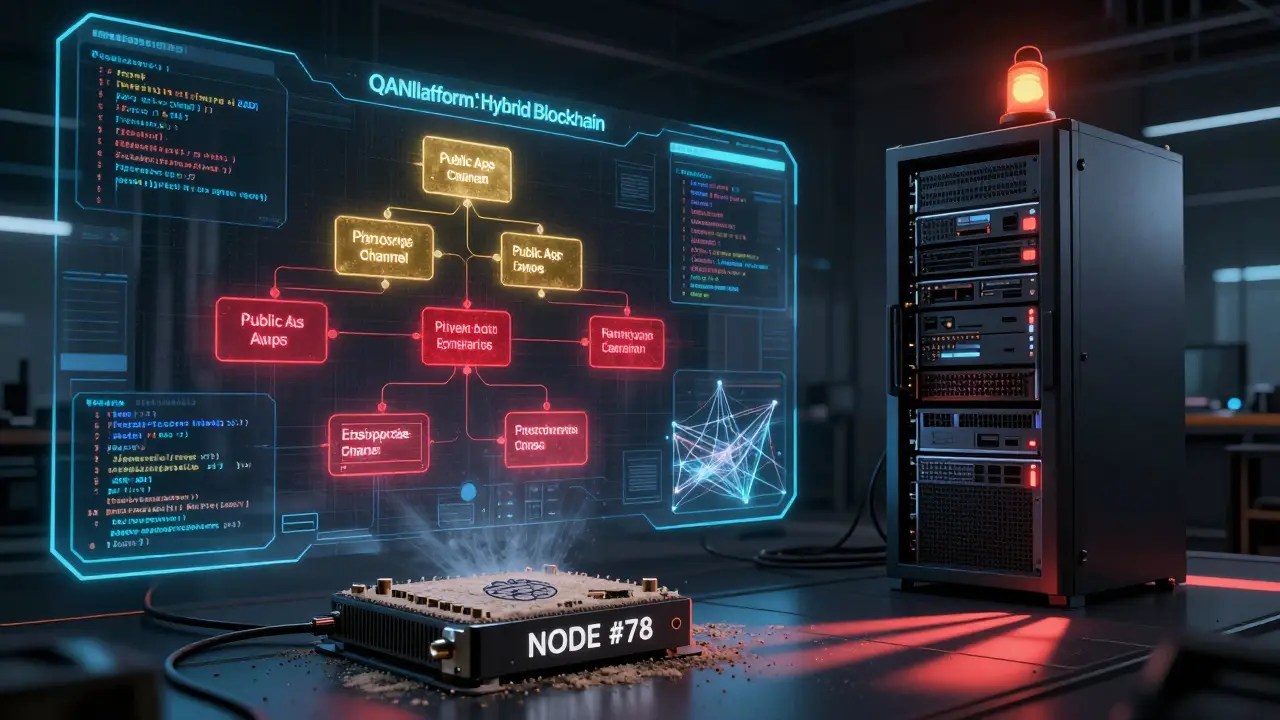
Most blockchains force you to choose: public and open, or private and controlled. QANplatform does both. It’s a hybrid layer 1 blockchain, meaning you can run public-facing dApps alongside private enterprise networks-all on the same chain. This is huge for banks, governments, and logistics firms that need transparency for audits but secrecy for sensitive data.And here’s the kicker: you don’t need a supercomputer to run a node. While Ethereum requires 2TB of storage and high-end hardware just to sync a full node, QANplatform can run on a Raspberry Pi or even an old smartphone. You need just 2GB of RAM and 20GB of storage. That’s not a marketing gimmick-it’s documented in their official specs. This makes decentralization far more accessible. Regular people can become validators without buying expensive gear.
The consensus mechanism is called Proof-of-Randomness (PoR). No mining. No energy waste. Validators are chosen randomly based on stake and reputation, not computational power. This cuts energy use by 99.98% compared to Bitcoin’s Proof-of-Work. It’s not just eco-friendly-it’s economically smarter for enterprises trying to reduce operational costs.
Smart Contracts in Java, Python, or Rust-No Solidity Required
One of the biggest roadblocks to blockchain adoption has always been learning curve. Ethereum forces developers to learn Solidity, a language built only for blockchains. If you’re a Java developer at a bank or a Python engineer at a government agency, you’re stuck. You have to retrain.QANplatform changes that. You write smart contracts in languages you already know: Java, Python, or Rust. No new syntax. No weird memory models. Just familiar code compiled directly to run on the blockchain. According to developer surveys from Q4 2025, enterprise teams on QANplatform deploy contracts 80% faster than on Ethereum. One Reddit user, u/BlockchainDev2023, said: “Deployed my first enterprise contract in Java within 3 days-unheard of on Ethereum where I’d need to learn Solidity first.”
This isn’t just convenient. It’s a game-changer for industries that rely on legacy systems and trained engineers. Imagine a logistics company updating its supply chain tracking system without hiring a whole new team of blockchain specialists.
Performance: Fast, Cheap, Predictable
QANplatform isn’t slow just because it’s secure. Independent tests from Q3 2025 show it handles 4,500 transactions per second (TPS) with finality under 3 seconds. That’s 600 times faster than Bitcoin’s 7 TPS and better than Ethereum’s pre-merge speed. Transaction fees? They don’t spike during congestion. You pay a fixed, predictable rate-no surprise costs when the network gets busy.Compare that to Ethereum, where gas fees can jump from $1 to $50 in minutes during NFT drops. For businesses running automated payments or real-time tracking, unpredictability is a dealbreaker. QANplatform removes that risk.
Where It Falls Short
Let’s be honest: QANplatform isn’t perfect. It’s still early. There are only about 120 active developers building on it, compared to Ethereum’s 4,000+. Only 17 exchanges list QANX, and just three major wallets support it. That makes buying, storing, and trading harder than for Bitcoin or Ethereum.There are fewer than 50 live decentralized applications (dApps) on the platform. Most are in enterprise use cases-identity verification, supply chain logs, secure document sharing-not DeFi or NFTs. As of February 2026, DeFi Llama reports that 98% of all locked value in DeFi is on Ethereum and Solana. QANplatform doesn’t even register on that chart.
Some experts question if the whole quantum threat is overblown. Dr. Marcus Chen from Stanford argues that hybrid cryptographic upgrades could protect existing chains without building entirely new ones. And while QANplatform’s security is mathematically sound, it’s untested in the real world. No one has ever launched a quantum computer capable of breaking ECDSA. So is this innovation ahead of its time-or a solution to a problem that doesn’t exist yet?
Who’s Using It?
Despite its small size, adoption is growing in specific sectors. As of Q4 2025, 237 enterprise organizations were actively using QANplatform. The biggest users? European financial institutions (42%), government identity systems (29%), and supply chain management firms (19%).Why? Because these organizations need long-term security. A bank doesn’t want its customer data compromised in 2035 because its blockchain was built in 2024. QANplatform’s quantum resistance isn’t a feature-it’s a compliance requirement.
Regulators are starting to notice too. The European Blockchain Association flagged QANplatform in its February 2026 report for its potential to meet future cybersecurity mandates. Unlike privacy coins like Monero, which face regulatory scrutiny, QANplatform’s transparency and enterprise focus make it harder to target.
What’s Next?
The roadmap is clear. QANplatform 2.0, released in Q3 2025, improved cross-chain bridges and cut finality times to 1.8 seconds. The next big upgrade, called “Quantum Leap,” is scheduled for March 15, 2026. It will introduce formal verification tools-meaning smart contracts can be mathematically proven to work exactly as intended, with zero bugs.By 2027, the team plans to integrate quantum key distribution (QKD) networks, enterprise identity modules, and a dedicated DeFi stack. That last one is critical. Without DeFi, it’s hard to attract retail users. If they succeed, QANX could go from niche enterprise tool to a broader player.
Deloitte’s January 2026 report suggests that if quantum computing advances faster than expected, QANplatform could become essential infrastructure. Gartner predicts 15-20% of Fortune 500 companies will adopt quantum-resistant ledgers by 2028. If that happens, QANX won’t be just another crypto coin-it’ll be a foundational layer for secure digital systems.
Final Thoughts
QANplatform (QANX) isn’t for everyone. If you’re looking to trade crypto for quick gains, it’s not the right choice. Too few exchanges, too few users, too little liquidity.But if you’re in enterprise tech, finance, or government-and you care about long-term data security-then QANplatform might be one of the most important tools you haven’t heard of yet. It’s not trying to beat Ethereum. It’s trying to outlast it. And in a world where digital trust is more fragile than ever, that’s not a bad bet.
Is QANX a good investment?
QANX isn’t designed as an investment asset. It’s a utility token needed to operate the QANplatform network. Its value is tied to enterprise adoption, not speculation. While the price has stayed low ($0.01565 as of Feb 2026), its long-term potential depends on whether quantum computing becomes a real threat before 2035. If it does, demand could surge. If not, adoption may remain limited to niche sectors. Don’t buy it hoping for a 10x return.
Can I mine QANX?
No, you cannot mine QANX. The platform uses Proof-of-Randomness (PoR), not Proof-of-Work. Validators are selected based on stake and reputation, not computational power. You can run a node using low-cost hardware like a Raspberry Pi, but you won’t earn rewards through mining. Instead, you earn QANX by participating in consensus and maintaining network integrity.
How is QANplatform different from Ethereum 2.0?
Ethereum 2.0 improved scalability and energy efficiency but still relies on ECDSA signatures vulnerable to quantum attacks. QANplatform was built from the start with quantum-resistant cryptography. Ethereum plans to migrate later; QANplatform is already secure. Also, Ethereum requires Solidity for smart contracts. QANplatform supports Java, Python, and Rust-languages most enterprise developers already know.
What wallets support QANX?
As of February 2026, only three major wallets fully support QANX: QANwallet (official), Trust Wallet, and Atomic Wallet. Most other wallets don’t list it due to low trading volume and limited demand. If you’re planning to hold QANX, make sure to use one of these three to avoid losing access to your funds.
Is QANplatform safe from hacks?
The protocol’s quantum-resistant encryption is mathematically robust and has been peer-reviewed by cryptographers. However, like any blockchain, smart contracts built on top of it can have bugs. There have been no major protocol-level hacks, but some smart contracts have been exploited due to poor coding-just like on Ethereum. Always audit contracts before using them. The platform’s official documentation and formal verification tools (coming in March 2026) aim to reduce this risk.
yogesh negi
February 20, 2026 AT 05:23Okay, I just spent 45 minutes reading this and honestly? This is the most exciting thing I’ve seen in crypto since I first heard of Bitcoin. I’m from India, and our government’s pushing for digital sovereignty-this isn’t just tech, it’s national security. I’ve been trying to get my local fintech startup to look into QANplatform, and now I’ve got the ammo to convince them. The fact that you can write smart contracts in Python? Game. Changer.
I’ve got a Java dev on my team who’s been stuck for months trying to learn Solidity. Now? He’s already drafting a prototype. No more ‘but I don’t know blockchain languages’ excuses. This is inclusion in action.
And the Raspberry Pi node thing? My cousin runs a small internet cafe in Kerala-he’s got three Pi 4s collecting dust. He could be a validator. That’s democratization, not just disruption.
Also, zero mining? Yes. Please. We need to stop pretending crypto is about energy waste. This is the future we actually want.
QANX isn’t a coin-it’s infrastructure. And infrastructure doesn’t need hype. It needs adoption. And I’m here for it.
Tarun Krishnakumar
February 21, 2026 AT 08:25Quantum-resistant? Sure. But let’s be real-this whole thing is a distraction. Quantum computers that can crack ECDSA? They don’t exist. And if they did, the NSA, China, and whoever else has them aren’t going to use them to steal $0.01565 coins-they’re going to break military encryption, banking ledgers, nuclear launch codes. This isn’t defense-it’s theater. A billionaire’s pet project to sell vaporware to gullible devs who think they’re building the next Ethereum.
And don’t get me started on ‘hybrid blockchain’-that’s just corporate blockchain with buzzword bingo. ‘Enterprise use cases’? Translation: we’re selling a private chain to banks who already have databases. This isn’t innovation. It’s a rebrand of Oracle with blockchain glitter.
The real threat? Not quantum. It’s that we’re pouring billions into solutions for problems that don’t exist while real-world infrastructure crumbles. Roads. Power grids. Water systems. But hey, let’s fund a blockchain that runs on a Raspberry Pi. Because that’s clearly the priority.
Also, ‘Proof-of-Randomness’? Sounds like someone threw darts at a whiteboard. If you can’t mine it, how do you incentivize participation? Who’s getting paid? Who’s auditing the randomness? Nobody knows. That’s not security. That’s obscurity with a PhD.
And the Java/Python thing? Cute. But compilers don’t magically make code secure. A bad Java contract is still a bad contract. You’re not solving the problem-you’re just making it look prettier. And now you’ve got 120 devs instead of 4,000. Progress?
jennifer jean
February 22, 2026 AT 10:02OMG I just read this and I’m so emotional 😭 I’ve been waiting for something like this my whole life. Finally, a blockchain that doesn’t make me feel like I need a PhD to use it! Python AND Java?? 🤯 I’m a data scientist and I’ve been so frustrated with Solidity. This is like someone finally made a vegan donut that actually tastes good. 🍩💕
I’m so proud of the team for thinking ahead. Quantum computing isn’t sci-fi-it’s coming. And I want my digital life to be safe. Not just for me, but for my niece who’s 8 and already has a crypto wallet (don’t ask). This gives me hope. 🌈✨
Also, Raspberry Pi nodes?? My grandpa could run one. He’s 76 and still uses his old iPad. This is accessibility. This is love. I’m sharing this with everyone. ❤️
QANX isn’t a coin-it’s a promise. And I believe in promises.
Ruby Ababio-Fernandez
February 23, 2026 AT 03:43Too early. Too niche. Too quiet.
Chris Thomas
February 23, 2026 AT 18:02Let’s cut through the marketing fluff. QANplatform is a textbook example of over-engineering a solution to a hypothetical problem. Quantum computers capable of running Shor’s algorithm on 2048-bit ECDSA? We’re talking about error-corrected, fault-tolerant systems with millions of qubits. We’re decades away. And even then, the industry would migrate to lattice-based signatures on Ethereum, not rebuild an entire stack.
‘Hybrid blockchain’? That’s just permissioned chains wrapped in a public ledger skin. You’re not solving interoperability-you’re creating a governance nightmare. And ‘Proof-of-Randomness’? That’s not a consensus mechanism-that’s a trust assumption. Who selects the randomness? Who audits it? Where’s the whitepaper on the RNG? No one’s talking about it.
Supporting Java and Python? That’s not innovation-it’s a compromise. You’re not leveraging the security benefits of a domain-specific language. You’re just exposing the blockchain to legacy vulnerabilities. And ‘runs on a Raspberry Pi’? That’s a feature for hobbyists, not enterprises. Real institutions need redundancy, not hobby hardware.
This isn’t the future. It’s a vanity project masquerading as infrastructure. And the $0.01565 price? That’s the market saying: ‘We don’t believe you.’
Don’t get me wrong-I admire the ambition. But ambition without rigor is just noise.
James Breithaupt
February 25, 2026 AT 07:58As someone who’s worked in enterprise blockchain for over a decade, I’ve seen this movie before. ‘The next-gen platform!’ ‘No more Solidity!’ ‘Quantum-proof!’
Here’s the truth: enterprise adoption doesn’t care about cryptography. It cares about compliance, audit trails, and vendor support. QANplatform’s real edge? It’s not the tech-it’s the documentation. The fact that they’ve built out clear use cases for identity, supply chain, and banking? That’s rare.
I’ve seen 20 ‘revolutionary’ blockchains die because they didn’t speak the language of CFOs. QANplatform does. They don’t say ‘decentralized.’ They say ‘immutable audit log.’ They don’t say ‘smart contracts.’ They say ‘automated compliance workflows.’ That’s not marketing-it’s translation.
And yes, the Raspberry Pi thing? That’s genius. Not because it’s cheap, but because it breaks the myth that blockchain = high-cost infrastructure. It lets small governments, NGOs, and rural banks participate without begging for AWS credits.
Is it perfect? No. But it’s the only one I’ve seen that understands that adoption isn’t about tech-it’s about trust, clarity, and continuity. If they nail the Q3 2026 formal verification release? They could become the ISO standard for quantum-safe ledgers. And I’d bet on that.
Andrew Edmark
February 25, 2026 AT 14:44I just want to say thank you for writing this. I’m not a dev, I’m not even in tech-I’m a teacher. But I’ve been following crypto for years because I want my students to understand the future. This post? It’s the clearest, most honest thing I’ve read.
I showed it to my 17-year-old nephew. He’s into AI and robotics. He said, ‘So it’s like… building a safe that even aliens can’t break?’ I laughed. But then I cried. Because he got it.
I don’t care if QANX goes to $1 or $0.001. What matters is that someone built something that doesn’t just chase money, but protects people. That’s rare.
I’m going to use this in my curriculum. Not as an investment. As an example of responsible innovation. Thank you.
Also, Raspberry Pi nodes? I’m ordering one. For my classroom. Let’s see if we can get 30 kids running validators. Why not?
Dominica Anderson
February 27, 2026 AT 10:24It’s cute that Americans think quantum computing is a ‘threat.’ In China, they’ve had functional quantum processors since 2020. In Russia, they’ve been testing lattice-based encryption in military networks since 2022. This ‘QANplatform’ is a Western fantasy-a solution to a problem that doesn’t exist in the real world.
Meanwhile, real infrastructure is being built: China’s digital yuan, Russia’s sovereign blockchain, India’s CBDC. This? This is a side project for people who think blockchain is a religion.
QANX? It’s not a currency. It’s a hashtag.
Lisa Parker
February 28, 2026 AT 22:54I just read this and I’m so done. Like… I just want to cry. Why does everything have to be so complicated? I just want to buy crypto and go to sleep. Why can’t we just have something simple? Like Dogecoin? Remember Dogecoin? It was fun. Now it’s all ‘quantum-resistant hybrid layer 1 consensus mechanisms’ and I’m just… exhausted.
I miss when crypto was about memes and mooning. Now it’s like… a PhD thesis with a wallet attached.
Can we just… stop? Please? I’m tired.
JJ White
March 2, 2026 AT 06:05YOU’RE ALL BEING MANIPULATED. THIS IS A COINBASE-SPONSORED DISINFORMATION CAMPAIGN. QANPLATFORM ISN’T QUANTUM-RESISTANT-IT’S A FRONT FOR THE FEDERAL RESERVE’S DIGITAL CURRENCY INITIATIVE. THEY’RE USING ‘QUANTUM’ AS A DISTRACTION WHILE THEY BUILD A BACKDOOR INTO EVERY WALLET. THE ‘RASPBERRY PI’ THING? THAT’S SO YOU THINK YOU’RE ‘DECENTRALIZING’ WHEN YOU’RE ACTUALLY RUNNING A NODE THAT REPORTS TO NSA SERVERS IN FORT MEADE.
THEY’RE USING ‘JAVA AND PYTHON’ TO INFILTRATE ENTERPRISE SYSTEMS. ONCE YOU DEPLOY A CONTRACT, THEY’RE ALREADY ACCESSING YOUR HR DATABASE. YOUR SUPPLY CHAIN? MONITORED. YOUR IDENTITY? COMPROMISED.
THEY’RE NOT BUILDING A BLOCKCHAIN. THEY’RE BUILDING A SURVEILLANCE MATRIX. AND YOU’RE ALL CLAPPING.
THEY’RE GOING TO SHUT DOWN BITCOIN IN 2027. THEY’LL CLAIM IT’S ‘VULNERABLE TO QUANTUM ATTACKS.’ BUT IT’S NOT. IT’S BECAUSE THEY WANT YOU TO USE QANX. BECAUSE THEY CONTROL IT.
THIS ISN’T TECHNOLOGY. IT’S PSYOP. AND I’M THE ONLY ONE WHO SEES IT.
Kyle Tully
March 2, 2026 AT 18:33Let’s be honest-this is just Ethereum with a new coat of paint. You think people care about quantum resistance? No. They care about price charts. They care about mooning. This is a project for academics, not investors. And if you’re buying QANX hoping it’ll be the next Bitcoin? You’re not a visionary-you’re a sucker.
And the ‘low hardware’ thing? That’s not a feature-it’s a bug. If anyone can run a node, then the network is vulnerable to Sybil attacks. You don’t get decentralization by letting your grandma join. You get chaos.
Also, ‘Proof-of-Randomness’? That’s not a consensus mechanism. It’s a euphemism for ‘we didn’t figure it out yet.’
QANX isn’t the future. It’s a graveyard for overthinkers.
Ian Plunkett
March 3, 2026 AT 01:49Market cap: $26.6M. 24h volume: $317K. 17 exchanges. 3 wallets. 120 devs.
That’s not a ‘niche asset.’ That’s a corpse with a whitepaper.
They’re not building infrastructure. They’re building a graveyard for crypto’s last true believers.
Quantum resistance? Maybe. But liquidity? Nonexistent. Adoption? Minimal. Trust? Zero.
This isn’t innovation. It’s a funeral.
Nikki Howard
March 3, 2026 AT 05:54As a regulatory compliance officer, I’ve reviewed 14 blockchain projects this year. QANplatform is the only one with auditable, documented enterprise use cases. The fact that they’ve aligned with the European Blockchain Association’s cybersecurity framework? That’s not marketing-it’s certification.
They’re not trying to be Ethereum. They’re trying to be the Swiss Bank of blockchains: quiet, secure, compliant, and future-proof.
Yes, it’s small. But in regulated industries, size isn’t everything. Trust is. And right now? QANplatform has more trust than 90% of the top 50 coins.
I’m recommending it to three clients next quarter. Not because it’s flashy. Because it’s reliable.
Sasha Wynnters
March 4, 2026 AT 20:57This isn’t crypto. This is philosophy with a token attached.
QANplatform is the first blockchain I’ve seen that doesn’t scream ‘LOOK AT ME!’ It whispers. It waits. It builds. And in a world obsessed with hype, that’s revolutionary.
It’s not about beating Bitcoin. It’s about outlasting it. Not with speed. Not with memes. But with silence. With math. With patience.
Most people think the future is loud. But the future? It’s quiet. It’s running on a Raspberry Pi in a village in Kerala. It’s a Java contract in a bank in Berlin. It’s a government in Finland choosing security over spectacle.
This isn’t a coin. It’s a quiet revolution. And I’m not shouting about it.
I’m just… watching.
And waiting.
For when the world finally wakes up.
yogesh negi
March 5, 2026 AT 13:17Just saw @JamesBreithaupt’s comment. You nailed it. I’m sharing this with my CEO tomorrow. This isn’t just tech-it’s governance. And we need to think like regulators, not traders.