
RTR Risk Calculator
Understand RTR Investment Risk
Based on historical data: RTR dropped 98.8% from its all-time high. This calculator demonstrates potential losses based on your investment.
Results
Current Price: $0.00039 (as of December 2025)
Historical Peak: $0.0545
Total Drop: 98.8% from all-time high
Your Potential Loss Scenarios
95% Loss: You'd have 5% of your investment remaining ($)
98.8% Loss (Historical): You'd have 1.2% of your investment remaining ($)
Restore The Republic, or RTR, isn’t a currency designed to change the economy. It’s a political statement wrapped in a token. Launched on the Solana blockchain, RTR was built not to store value or enable payments, but to rally a specific group of people around a political message. If you’re wondering whether this is a smart investment, the short answer is: no - unless you’re betting on political headlines, not market fundamentals.
What RTR actually is
RTR is a meme coin with a clear political identity. It’s marketed as the official token of the ‘Trump Hotspot’ community, a term used by its creators to tie the coin directly to a political movement. Unlike Dogecoin or Shiba Inu, which started as jokes and grew into communities, RTR was born with a slogan: ‘$RTR is a token that inspires change. Every purchase accelerates the cause.’
That’s not marketing fluff - it’s the entire premise. There’s no product, no service, no tech innovation behind it. It doesn’t solve a problem. It doesn’t improve blockchain efficiency. It exists to signal allegiance. The total supply is fixed at 999,999,647 tokens, and none have been burned. That means every single token ever created is still in circulation - a red flag for anyone looking for scarcity-driven value.
Where you can buy RTR (and why it’s hard)
You won’t find RTR on Coinbase’s main app. You won’t find it on Binance, Kraken, or any major exchange you’ve heard of. It’s only listed on a handful of small platforms: Bitget, Coinbase Advanced Trade, and a few Solana-based decentralized exchanges like Raydium. To buy it, you need a Solana wallet like Phantom, some SOL to pay for gas, and the technical know-how to navigate a low-liquidity trade.
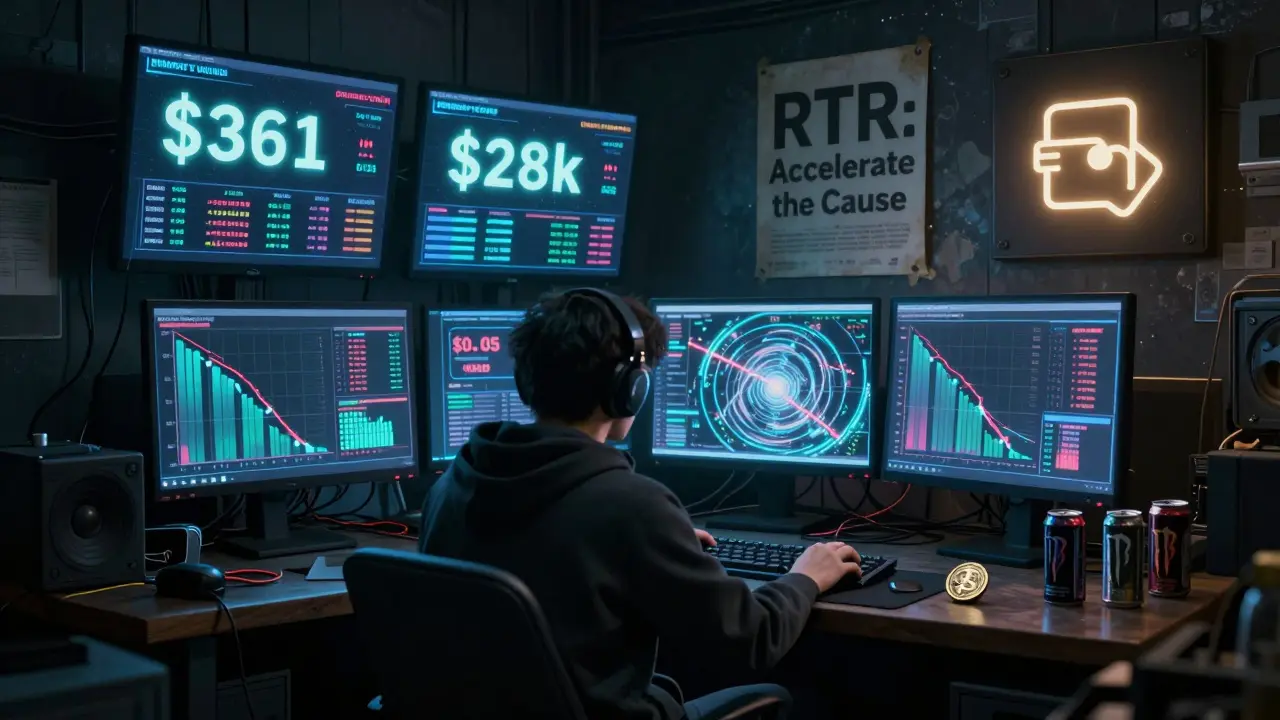
Even then, it’s risky. On December 14, 2025, CoinMarketCap reported a 24-hour trading volume of just $361.17. That’s less than what a single person might spend on a new phone case. Meanwhile, Coinbase listed volume at $28,640 - a 79x difference. That kind of inconsistency isn’t normal. It’s a sign of fragmented markets, possible manipulation, or bots inflating numbers on one platform while real buyers can’t find sellers elsewhere.
The price history: a rollercoaster with no safety rails
RTR hit its all-time high of $0.0545 on January 19, 2025. That was during a surge of political excitement around U.S. election news. Today, it trades around $0.00039 - down 98.8% from its peak. That’s not a correction. That’s a collapse.
What’s worse? The decline isn’t slowing. CoinCheckup’s November 2025 model predicted RTR would drop to $0.001255 by late November. It already fell below that in early December. CryptoRank’s analysis calls it ‘extreme volatility typical of politically motivated meme coins with no fundamental utility.’ That’s not an opinion - it’s a fact backed by data. There’s no revenue, no team, no roadmap. Just sentiment.
Who holds RTR - and why
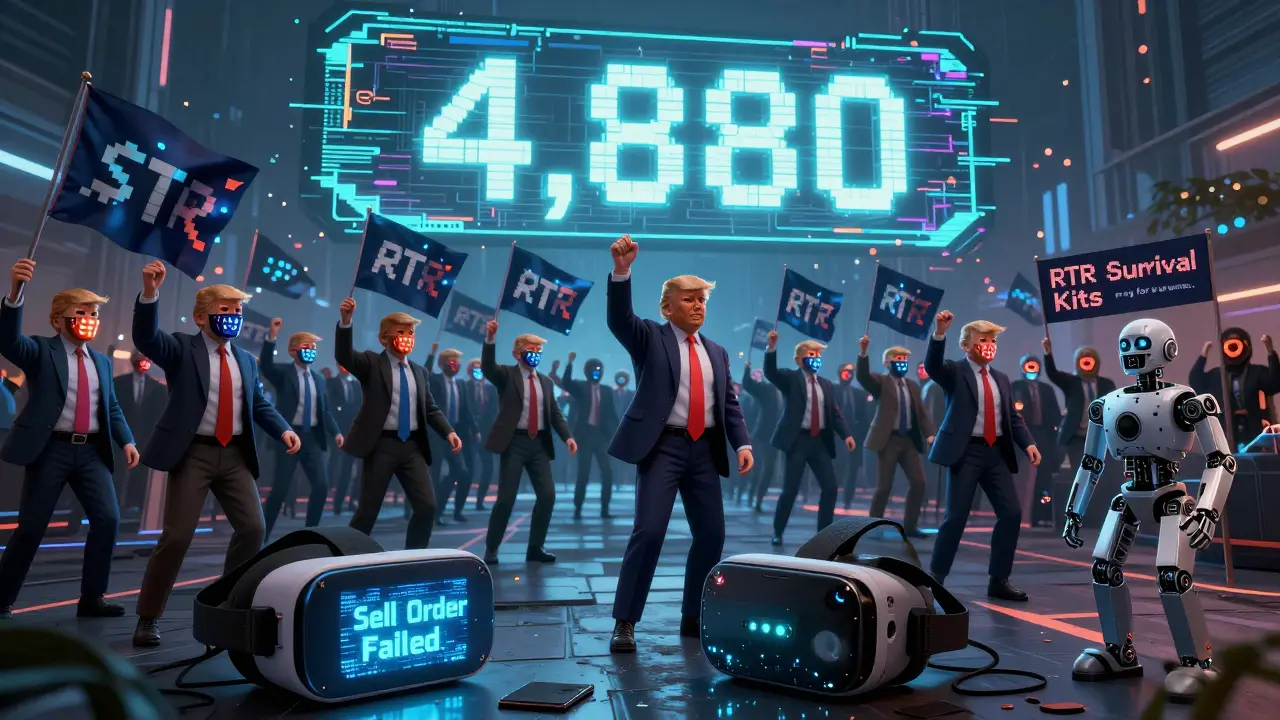
As of December 2025, there are only 4,880 unique holders of RTR. That’s tiny. For comparison, Dogecoin has over 1.5 million holders. Most RTR holders aren’t long-term investors. They’re political traders. Santiment data shows 78% of RTR holders also own other Solana meme coins like Bonk or Dogwifhat. Only 12% hold Bitcoin or Ethereum. This isn’t a diversified portfolio. It’s a political bet.
Reddit and Twitter are full of stories from people who bought during a rally, only to get stuck. One Reddit user wrote: ‘Bought during Trump rally hype, lost 95% in 3 weeks.’ Another said: ‘Pure political gambling, not an investment.’ Coinbase’s user reviews average just 1.7 out of 5, with comments like ‘zero utility beyond political signaling.’ LunarCrush found 68% negative sentiment on Twitter, mostly because people can’t sell.
Why liquidity is the silent killer
Liquidity is the lifeblood of any asset. If no one’s buying, you can’t sell. RTR’s liquidity is dangerously low. On some platforms, trading volume is nearly zero. That means even if you want to cash out, you might not find a buyer - or you’ll have to accept a price 30% below what you paid.
Why? Because the token’s value isn’t tied to anything real. It doesn’t earn interest. It doesn’t pay dividends. It doesn’t have a team building tools. Its only value comes from how many people believe in the political message right now. When the news cycle moves on - when the rally ends, when the debate fades - so does the demand.
The regulatory shadow
The SEC hasn’t cracked down on RTR yet - but it’s watching. In November 2025, the agency issued guidance warning that tokens with ‘explicit political advocacy’ could be classified as securities if they rely on centralized efforts to maintain value. RTR fits that description. It’s promoted by a specific community, tied to a political figure, and marketed as a tool to ‘accelerate the cause.’ That’s not just branding - it’s a promise of future value based on group action. That’s exactly what regulators look for when they suspect a security.
If the SEC ever decides to act, RTR could be frozen, delisted, or declared illegal. There’s no legal defense here. No whitepaper. No corporate structure. Just a smart contract on Solana and a slogan.
Is RTR worth buying?
Let’s be blunt: if you’re looking for a crypto investment, RTR is the wrong choice. It has none of the characteristics of a serious asset. No utility. No team. No adoption beyond a tiny political niche. No exchange support. No future roadmap. No liquidity. No regulatory safety.
But if you’re looking to make a political statement - to show support for a movement - and you’re okay with losing every dollar you put in? Then RTR might be your token. Just understand: you’re not investing. You’re donating to a meme.
Most people who bought RTR at its peak lost 95% of their money. Those who bought near the bottom? They’re still stuck. There’s no exit strategy. No plan B. Just a wallet address and a prayer.
What’s next for RTR?
Nothing, unless something big happens in U.S. politics. Historical data shows RTR spikes 47% during major rallies and crashes 83% during quiet periods. Its entire existence is tied to headlines. When the next election cycle heats up, you might see a short-lived rally. But when it cools? It’ll vanish again.
BeInCrypto’s analysts say RTR will stay irrelevant unless it integrates with actual political fundraising - like donating proceeds to campaigns or supporting voter registration. That’s not happening. The creators haven’t announced any such plans. The token is a digital flag, not a tool.
Bottom line: RTR is a political meme with no economic foundation. It’s not crypto. It’s not finance. It’s a digital protest sign. And like any protest sign, its value disappears the moment the crowd goes home.
Stanley Machuki
December 15, 2025 AT 11:08RTR isn't crypto it's a digital flag you wave when you're mad at the news
Candace Murangi
December 16, 2025 AT 17:39I bought some just to see what the hype was about. Thought it was a joke at first. Then I realized people were actually putting real money into it. Wild world we live in.
Lois Glavin
December 17, 2025 AT 10:47Low liquidity is the silent killer here. If you need to get out and no one's buying? You're just holding a digital poster. No one's coming to save you.
Abhishek Bansal
December 17, 2025 AT 22:22Actually I think this is genius. People are tired of boring crypto. At least this one has a soul. Who cares if it crashes? It made a point.
Lynne Kuper
December 19, 2025 AT 18:1598.8% drop? That’s not a correction, that’s a funeral. And the wake is still going on in the comments section.
Albert Chau
December 21, 2025 AT 15:52You people don’t get it. This isn’t about money. It’s about standing up. If you’re too scared to back a cause, maybe you shouldn’t be on the internet.
Ian Norton
December 22, 2025 AT 03:06Let me break this down for you: if your ‘investment’ relies on political rallies to maintain value, you’re not investing - you’re betting on a parade. And parades end. Always.
Trading volume under $400? That’s not a market. That’s a garage sale. And the only thing being sold is hope.
There’s zero utility. No team. No whitepaper. Just a slogan and a wallet address. If this were a startup, the SEC would shut it down before the first pitch.
And yet people are still buying it. Why? Because they think the next rally is just around the corner. It’s not. It’s a ghost town waiting for a politician to show up.
The fact that it’s only on Bitget and Raydium? That’s not exclusivity - that’s desperation. Major exchanges won’t touch it because they’re not suicidal.
And don’t even get me started on that 79x volume discrepancy. That’s not data manipulation - that’s outright fraud. Bots are inflating numbers to lure in the gullible.
People are calling it a meme coin. That’s too kind. Meme coins have communities. RTR has echo chambers.
There’s no roadmap because there’s nothing to build. No product. No service. Just a token that says ‘I believe’ - and then vanishes when the news cycle moves on.
It’s not crypto. It’s not finance. It’s not even art. It’s a digital protest sign someone sold as an NFT.
And now you’re holding it. Congrats. You’re the last one at the party.
Lloyd Cooke
December 22, 2025 AT 17:56The true tragedy of RTR is not its collapse - it’s that it ever existed as a proxy for political identity in the first place. We have reduced belief to a ticker symbol. We have commodified conviction. And now we wonder why the world feels hollow.
There was a time when a flag meant something. Now it’s a token. And the people who wave it don’t even know why.
Kurt Chambers
December 24, 2025 AT 03:06LOL look at all these nerds crying about liquidity. RTR is the real deal. You want to know what’s fake? The fed printing trillions while you cry over a 98% drop. We’re winning.
They can’t stop us. They can’t delist us. We’re the future. 💪🇺🇸
Madison Surface
December 25, 2025 AT 02:35I get why people bought it. I really do. It feels good to believe in something. But when you realize you’re holding a digital bumper sticker - that’s when the real pain starts.
Have you ever talked to someone who lost everything on RTR? They don’t talk about the money. They talk about how stupid they felt. Like they let themselves be fooled by a hashtag.
Tiffany M
December 26, 2025 AT 19:18Okay but… if you’re gonna gamble on politics, why not just buy a Trump hat? At least you get to wear it. RTR just sits in your wallet like a sad little ghost.
Also, 4,880 holders? That’s less than my high school class. This isn’t a movement - it’s a cult with a blockchain.
Jessica Petry
December 28, 2025 AT 05:53It’s hilarious that people think this is ‘crypto.’ This is a political stunt dressed up in smart contract clothes. Real crypto builds infrastructure. This builds outrage.
And the fact that people still defend it? That’s the real tragedy. Not the price drop. The delusion.
Rakesh Bhamu
December 28, 2025 AT 18:51Let’s not be too harsh. Even if it’s a meme, it’s still a reflection of real sentiment. People are angry. They want to feel heard. Maybe RTR is just the loudest voice in the room.
But yes - as an investment? Zero chance. Don’t put rent money into it. But if you want to show solidarity? Go ahead. Just know you’re donating, not investing.
Bridget Suhr
December 28, 2025 AT 19:44Wait so… if the SEC comes after it, does that mean I can’t even hold it anymore? Like… do they just freeze my wallet? That’s wild.
I didn’t even think about that. I just thought it was a dumb coin. Not a legal time bomb.
Eunice Chook
December 29, 2025 AT 18:21It’s not about the coin. It’s about the power of belief. You can’t quantify that. And you can’t regulate it either.
They tried to regulate faith once. It didn’t end well for them.
Andy Walton
December 29, 2025 AT 21:53Bro I bought at 0.05 and now I’m at 0.00039 😭 but at least I’m part of the movement 🤝🇺🇸🔥
Also I bought 3 more bags because I believe in the future 💎