

TKC Investment Risk Calculator
TKC Investment Risk Calculator
Calculate how much you could lose investing in TKC based on its historical collapse and low liquidity.
Investment Calculator
Risk Assessment
Enter your investment amount to see potential losses.
The Kingdom Coin (TKC) isn’t just another altcoin. It’s a cryptocurrency built for a very specific group: Christians who want a digital currency tied to their faith. Launched on April 30, 2023, TKC operates as a BEP-20 token on the BNB Smart Chain. Its creators claim it’s meant to be a legal tender for the global Christian community - used to fund missionaries, build shelters for the homeless, and support evangelism efforts. Sounds noble. But here’s the reality: the market doesn’t treat it like a movement. It treats it like a gamble with shaky foundations.
What TKC Claims to Do
The Kingdom Coin’s website and whitepaper talk about creating a "Prophetic Economic Goshen" - a biblical reference to a land of safety and abundance. In plain terms, they want to build a financial system where believers can send money to missionaries in remote villages, pay for outreach programs, or donate to churches without relying on traditional banks. They’ve built a Web3 wallet, a peer-to-peer trading platform, and even a card system to spend TKC like cash. All of this is designed to keep transactions within the Christian community, avoiding what they see as a secular financial system. But ambition doesn’t equal functionality. There’s no public evidence that TKC is actually being used for any of these purposes at scale. No major church network has adopted it. No missionary group has published case studies showing TKC payments. The tools exist on paper, but real-world use? Almost invisible.Price Chaos and Supply Confusion
If you check TKC’s price across different platforms, you’ll get wildly different numbers. On Coinbase, it’s around $0.0023. On Liquidity Finder, it’s $0.0293. CoinMarketCap says $0.01095. LiveCoinWatch shows $0.01494. That’s a 12x difference between the lowest and highest price. That kind of inconsistency doesn’t happen with real, liquid markets. It happens when there’s no real trading volume - just bots, pump-and-dump groups, or people manually entering fake prices. Even worse is the supply issue. The total supply is fixed at 240 million TKC. That’s clear. But here’s the problem: multiple trusted sites - CoinLore, Bitget, Liquidity Finder - all say the circulating supply is zero. Zero. That means not a single TKC is actively being traded or held by users. If no one owns it, how can it have a price? How can it be used to pay missionaries? The project claims the tokens are distributed, but if they’re not circulating, they might as well not exist.Where You Can Trade TKC - And Why You Should Think Twice
TKC trades almost entirely on PancakeSwap v2, a decentralized exchange on BNB Smart Chain. That’s not unusual for small tokens. But here’s the catch: the entire 24-hour trading volume is around $11,000. Compare that to Bitcoin, which trades over $20 billion daily. TKC’s volume is less than 0.00005% of Bitcoin’s. That’s not a market. That’s a whisper. If you try to buy or sell TKC, you’ll likely face slippage - meaning the price moves dramatically between when you click "buy" and when the trade executes. Liquidity is listed as $0.00 0% on LiveCoinWatch, meaning there’s virtually no pool of buyers or sellers to match your order. You might buy 10,000 TKC at $0.01 - but when you try to sell, you might only get $0.005 because there’s no one else willing to pay more.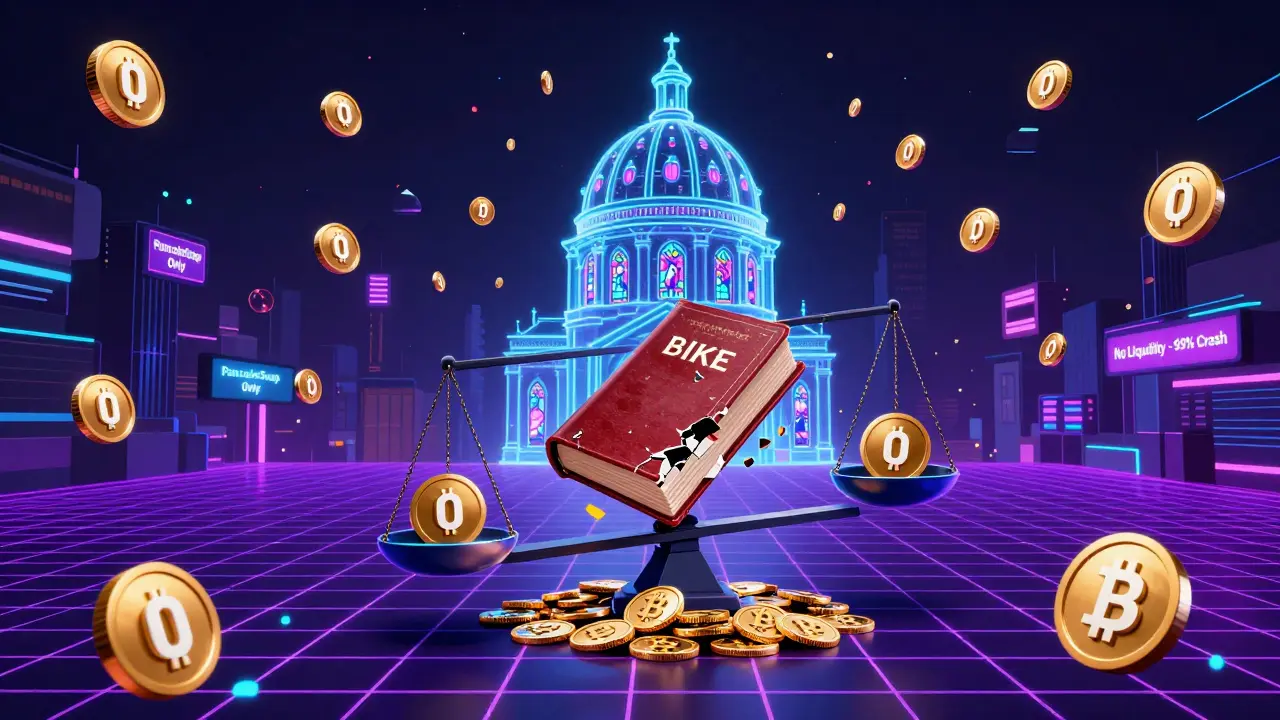
From From $0.25 to $0.0023: A 99% Crash
.25 to From $0.25 to $0.0023: A 99% Crash
.0023: A 99% Crash
TKC hit an all-time high of $0.25 on May 16, 2023 - just weeks after launch. That’s a classic pump. Hype from religious forums, influencer posts, and early buyers drove the price up. But then the reality set in: no real use case, no adoption, no liquidity. The price collapsed. Today, it’s trading at about 1% of its peak. CoinLore says it’s down 69% from its second-highest peak of $0.0885. That’s not market correction. That’s a death spiral.
There’s no technical reason for this crash. The token isn’t hacked. The smart contract isn’t flawed. The problem is trust. People bought TKC because they believed in its mission. When they realized it was mostly talk, they left. And when the early buyers sold, the price followed.
Is TKC Safe? The Red Flags
Let’s list the warning signs:- Circulating supply is zero - How can a currency have value if no one holds it?
- Price varies wildly - Different exchanges show prices 10x apart. That’s not normal.
- Trading volume is microscopic - $11,000 a day isn’t a market. It’s a sideshow.
- No institutional adoption - No churches, NGOs, or charities use it.
- Religious framing as a selling point - "Backed by God" isn’t a business model. It’s a marketing tactic that raises red flags with serious investors.
- No independent audits or technical updates - The whitepaper is the only source. No GitHub commits. No team disclosures.
Who Might Still Be Interested in TKC?
There are two groups who might still consider TKC:- Devout believers who see this as a spiritual investment, not a financial one. For them, owning TKC is an act of faith - not speculation.
- Speculators chasing volatility who hope for a pump from a small community. This is gambling, not investing.
How to Buy TKC (If You Still Want To)
If you decide to proceed, here’s how:- Get a Web3 wallet like MetaMask or Trust Wallet.
- Add the BNB Smart Chain network to your wallet.
- Buy BNB on a centralized exchange like Binance or Coinbase.
- Send BNB to your wallet.
- Go to PancakeSwap v2.
- Connect your wallet.
- Search for TKC using its contract address:
0x06dc293c250e2fb2416a4276d291803fc74fb9b5. - Swap BNB for TKC.
The Bigger Picture: Religious Crypto Is a Risky Experiment
TKC isn’t alone. There are other faith-based tokens - like Bitcoin Bible or Christian Coin. But none have succeeded. Why? Because money works on trust, utility, and liquidity. Faith can inspire people, but it doesn’t create demand. You can’t pay your rent with a prayer. You can’t buy groceries with a Bible verse. Cryptocurrencies thrive when they solve real problems: fast payments, low fees, censorship resistance. TKC doesn’t solve any of those better than existing options. It just wraps them in religious language. That’s not innovation. It’s repackaging.Final Verdict: Don’t Invest. Don’t Trust. Don’t Expect.
The Kingdom Coin is a cautionary tale. It started with a heartfelt mission. But without transparency, adoption, or liquidity, it became a ghost coin - visible on charts, but absent in reality. Its price is a mirage. Its supply is a mystery. Its future is uncertain. If you’re a Christian looking to support missions, donate directly. Use PayPal, bank transfer, or established crypto like Bitcoin. If you want to invest in crypto, pick projects with real users, real volume, and real teams. TKC has none of those. This isn’t about religion. It’s about money. And TKC, right now, is not money. It’s a symbol - and symbols don’t pay bills.Is The Kingdom Coin (TKC) a real cryptocurrency?
Technically, yes - it’s a BEP-20 token on the BNB Smart Chain with a contract address and blockchain records. But "real" in crypto means having liquidity, users, and utility. TKC lacks all three. It exists on paper and charts, but not in actual use. Its circulating supply is listed as zero by multiple trackers, meaning no one is actively holding or trading it. So while it’s technically a crypto token, it’s not a functioning currency.
Can I use TKC to pay for missionary work or church donations?
No, not in any practical way. While the project claims it’s designed for funding missions, shelters, and crusades, there’s zero public evidence that any church, NGO, or missionary group accepts TKC as payment. No official partnerships have been announced. No transaction logs show TKC being used for these purposes. The tools to do so - like a payment card or wallet integration - exist only as promises on the website. Until someone actually uses it for a real donation, it remains theoretical.
Why do different websites show different prices for TKC?
Because there’s almost no real trading. TKC trades almost entirely on PancakeSwap v2, with a 24-hour volume under $12,000. Most price data comes from manual entries or low-liquidity trades. Platforms like Coinbase, CoinMarketCap, and LiveCoinWatch pull data from different sources - some from exchanges, others from user-submitted prices. With so little actual trading, even a single large buy or sell can swing the price dramatically. This isn’t market pricing - it’s noise.
Is TKC a good investment?
No. TKC has lost 99% of its all-time high value since May 2023. It has near-zero trading volume, no circulating supply, and no adoption. It’s not a store of value, not a medium of exchange, and not a growth asset. Any potential upside is purely speculative - based on hope, not data. If you buy TKC, you’re betting that a small group of believers will suddenly start using it en masse. That’s not investing. That’s gambling on a prayer.
What’s the contract address for TKC?
The official contract address for The Kingdom Coin (TKC) is 0x06dc293c250e2fb2416a4276d291803fc74fb9b5. This is the address you need to use if you’re adding TKC to a wallet like MetaMask or trading it on PancakeSwap. Always verify this address manually - never copy it from an untrusted source, as fake tokens with similar names are common in low-liquidity markets.
Can I stake TKC to earn rewards?
The project claims to offer staking, but there’s no public information on how it works. No staking portal, no reward rates, no minimum requirements, and no verified staking contracts. If you’re told you can stake TKC, it’s likely a scam or a fake website. The official site doesn’t provide staking instructions, and no independent audits confirm its existence. Treat any staking offer for TKC with extreme caution.
Is TKC available on Coinbase or Binance?
TKC is not listed on Coinbase or Binance as a tradable asset. You can only trade it on decentralized exchanges like PancakeSwap v2. Some platforms like Coinbase show price data for TKC, but that’s just informational - you cannot buy or sell it directly on their platform. If someone tells you TKC is on Binance or Coinbase, they’re mistaken or misleading you.
Why is the circulating supply listed as zero?
This is one of the biggest red flags. The total supply is 240 million TKC, but CoinLore, Bitget, and Liquidity Finder all report circulating supply as zero. That means none of the tokens are in the hands of active users. It could mean the tokens are locked, not distributed, or held by a single entity. Either way, if no one owns or trades TKC, it can’t function as money. This inconsistency suggests either a technical error, poor token distribution, or intentional obfuscation - all of which are serious warning signs.
michael cuevas
December 8, 2025 AT 18:42Barb Pooley
December 9, 2025 AT 03:46Manish Yadav
December 9, 2025 AT 11:33Sandra Lee Beagan
December 9, 2025 AT 20:45Also, I tried to buy some on PancakeSwap - took me 20 mins to even find the contract. Then the gas fee was $17 for 10 TKC. I cried a little.
Doreen Ochodo
December 10, 2025 AT 16:46Holly Cute
December 11, 2025 AT 12:171. Zero circulating supply = the tokens are either locked in a dev's wallet, or they were never issued.
2. 12x price discrepancies across platforms? That’s not data - that’s someone typing numbers into Excel and hitting ‘send’.
3. $11k volume? That’s less than what I spent on coffee last month.
4. The contract address? Verified. The team? Ghosts. The whitepaper? Written by a seminary student who just learned what ‘tokenomics’ means.
5. The real red flag? The fact that they’re using biblical language to mask a rug-pull. It’s not ‘faith-based’ - it’s faith-weaponized.
And yet... people still buy it. Why? Because hope is cheaper than due diligence. And that’s the real tragedy.
Josh Rivera
December 12, 2025 AT 21:49Brooke Schmalbach
December 13, 2025 AT 02:21Ben VanDyk
December 14, 2025 AT 16:38Renelle Wilson
December 15, 2025 AT 01:03Real mission work doesn’t need blockchain. It needs volunteers, funds, and trust. If you want to support missionaries, give directly. Use PayPal. Use Zelle. Use Bitcoin if you must. But don’t confuse symbolism with substance. The Kingdom, as Jesus taught, is not of this world - and neither should its currency be.
Krista Hewes
December 15, 2025 AT 12:42Yzak victor
December 17, 2025 AT 06:12Tisha Berg
December 19, 2025 AT 04:14Billye Nipper
December 20, 2025 AT 17:00Annette LeRoux
December 21, 2025 AT 03:00TKC isn’t a failure of technology - it’s a failure of imagination. We could’ve built something beautiful. Instead, we built a mirror that reflects our greed.
Nina Meretoile
December 22, 2025 AT 14:57Also, if TKC is supposed to fund missionaries - why isn’t a single missionary talking about it? Why no testimonials? Why no receipts? Because there are none. It’s a church with no congregation and a wallet with no coins. Sad.
Brooke Schmalbach
December 24, 2025 AT 05:37