
You’ve probably heard the buzzwords: The Sandbox, metaverse, digital land. But if you’re looking at the price chart of its native token, SAND is an ERC-20 utility and governance token that powers a voxel-based virtual world where users create, own, and monetize gaming experiences, you might be wondering what it actually does. Is it just another speculative asset riding the hype wave, or does it have real utility in a functioning economy?
Here’s the short answer: SAND is the fuel for The Sandbox ecosystem. It’s not just money; it’s your ticket to play, your tool to build, and your vote on how the platform evolves. If you want to understand whether this project has legs-or if it’s just a ghost town with expensive real estate-you need to look beyond the ticker symbol. Let’s break down exactly what SAND is, how it works, and why people are still buying it in 2026.
Key Takeaways
- Utility First: SAND is required for all transactions within The Sandbox, from buying avatar gear to purchasing virtual land parcels known as LAND.
- Fixed Supply: There will never be more than 3 billion SAND tokens, creating a scarcity model unlike inflationary fiat currencies.
- Governance Power: Holding SAND gives you voting rights in the Decentralized Autonomous Organization (DAO), letting you influence the platform’s future.
- Ethereum Native: As an ERC-20 token, SAND integrates seamlessly with Ethereum wallets like MetaMask and major decentralized finance protocols.
The Origin Story: From Mobile Game to Metaverse
To understand where SAND fits today, you have to look back. The Sandbox didn’t start as a blockchain experiment. In 2011, a company called Pixowl launched a mobile sandbox game that let kids build their own worlds using voxel-style blocks-think Minecraft but on a phone. It was popular, but it was centralized. You built stuff, but you didn’t really own it.
That changed when Animoca Brands acquired Pixowl in 2018. Under the leadership of co-founders Arthur Madrid and Sebastien Borget, the team decided to rebuild the game on the Ethereum blockchain. They wanted to solve the ownership problem. By 2020, they launched the blockchain version, introducing SAND as the economic backbone. This wasn’t just about graphics; it was about shifting power from the developers to the players. Today, The Sandbox stands as one of the few surviving projects from the 2021 metaverse boom, proving that infrastructure can outlast hype cycles.
How Does SAND Actually Work?
Technically, SAND is a fungible token, meaning every single unit is identical and interchangeable, unlike Non-Fungible Tokens (NFTs) which are unique. It runs on the Ethereum network, adhering to the ERC-20 standard. This is crucial because it means you don’t need a special wallet. If you have MetaMask, Coinbase Wallet, or Trust Wallet, you can store and send SAND immediately.
But being on Ethereum isn’t just about compatibility; it’s about security and transparency. Every transaction involving SAND is recorded on the public ledger. When you buy a piece of virtual land or trade a rare sword, the smart contract executes the swap automatically. No middleman takes a cut beyond the network gas fees. This architecture allows for a multi-token system where SAND interacts with two other key assets:
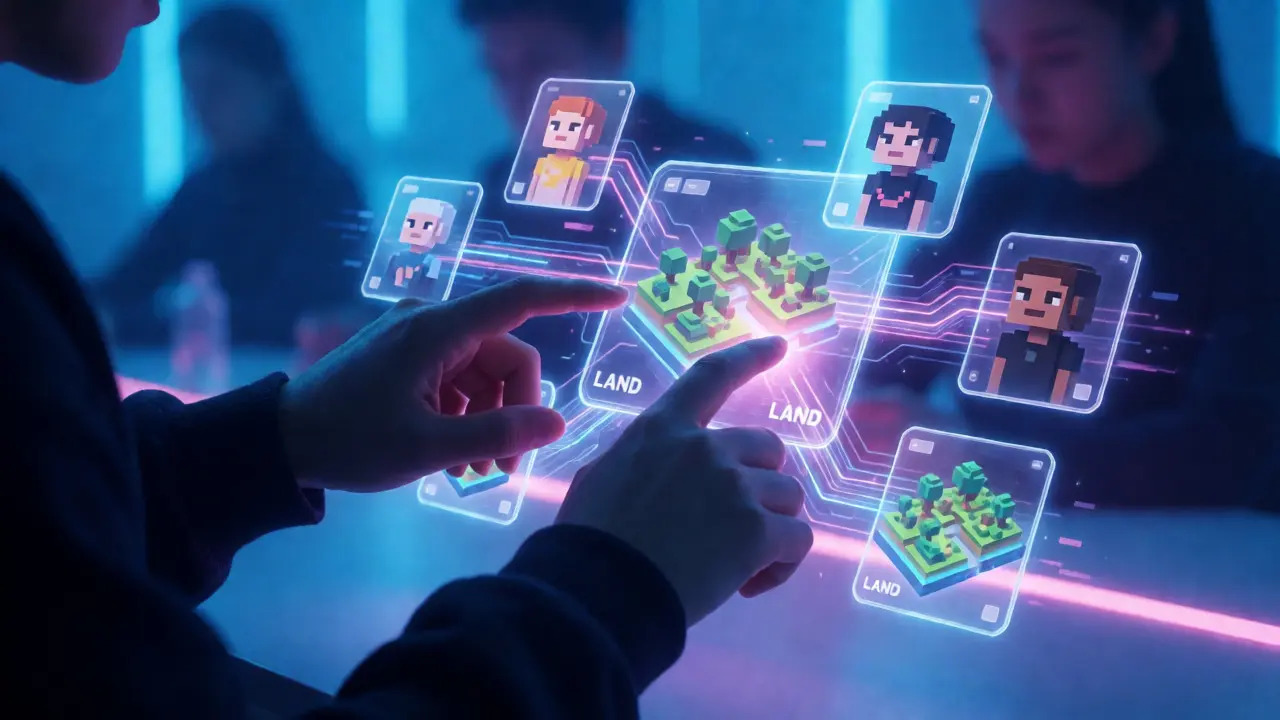
- LAND: These are NFTs representing plots of virtual real estate. You use SAND to buy them.
- ASSETS: These are also NFTs, representing items like avatars, equipment, and decorations created by users.
SAND acts as the glue. Without it, these pieces can’t move between hands efficiently. It creates a unified market where creators, players, and investors speak the same financial language.
The Four Pillars of SAND Utility
Why would anyone hold SAND instead of just holding Bitcoin or USDT? Because inside The Sandbox, SAND is king. Its value is derived from four specific jobs it performs within the ecosystem.
1. In-World Payments and Access
If you want to customize your avatar, buy a new outfit, or unlock a premium experience, you pay in SAND. Think of it like casino chips or arcade tokens. Some games within The Sandbox require an entry fee paid in SAND, while others offer rewards in SAND for completing tasks. This creates a circular economy: players spend SAND to play, and earn SAND by playing well or creating content that others enjoy.
2. Marketplace Trading
The Sandbox Marketplace is where users buy and sell ASSETS and LAND. While you can often see prices in USD, the actual settlement happens in SAND. If you design a cool voxel house and list it for sale, the buyer pays you in SAND. This demand for SAND to facilitate trades drives its liquidity. The more active the marketplace, the more SAND is needed to keep transactions flowing.
3. Staking for Rewards
Crypto natives love staking, and SAND offers robust options here. Users can lock up their SAND tokens in smart contracts to earn yield. This isn’t just passive income; it’s often tied to platform benefits. For example, stakers might get early access to new LAND sales or boosted visibility for their creations. This mechanism reduces circulating supply temporarily, potentially stabilizing the price while rewarding long-term holders.
4. Governance via DAO
This is where things get interesting for the ideologically inclined. The Sandbox operates through a Decentralized Autonomous Organization (DAO). Holding SAND grants you voting power. You can vote on proposals regarding feature prioritization, grant allocations for creators, and even changes to the platform’s rules. Your voice literally depends on your wallet balance. It transforms the token from a simple currency into a stake in the company’s direction.
Who Uses SAND? Players, Creators, and Landowners
The ecosystem isn’t monolithic. Different users interact with SAND in distinct ways, creating a layered economy.
| User Role | Primary Interaction with SAND | Goal |
|---|---|---|
| Players | Purchasing avatars, gear, and paying entry fees for experiences. | Entertainment and social interaction. |
| Creators (Artists) | Buying Gems to mint ASSETS, listing items on the Marketplace. | Monetizing artistic skills and generating passive income. |
| Landowners | Acquiring LAND parcels, hiring creators, hosting events. | Building communities and capturing traffic revenue. |
| Investors | Staking, trading on exchanges, voting in DAO. | Capital appreciation and yield generation. |
For casual players, the barrier to entry is low. You might only need a few dollars’ worth of SAND to try out a game. For professional creators and landowners, however, the stakes are higher. Developing a complex experience requires significant investment in tools and labor, often denominated in SAND. This tiered usage ensures that there is constant demand for the token across different levels of engagement.
Tokenomics: Scarcity and Supply
One of the most critical aspects of any crypto asset is its supply schedule. Unlike fiat money, central banks can print more whenever they feel like it. SAND cannot. The total maximum supply is capped at 3,000,000,000 tokens. This fixed cap is hard-coded into the smart contract.
However, not all 3 billion tokens are in circulation right now. The release schedule follows a vesting plan designed to prevent massive dumps by early investors and team members. As of late August 2026, a significant portion remains locked, gradually entering the market over time. This controlled release helps mitigate volatility shocks compared to projects that dump their entire supply on day one.
It’s important to note that while the supply is fixed, the circulating supply fluctuates based on staking activity and exchange reserves. Analysts often watch the "burn rate"-though The Sandbox doesn’t have an aggressive burn mechanism like some competitors-to see if demand is outpacing the slow trickle of new tokens entering the market.
Is The Sandbox Still Relevant in 2026?
Let’s address the elephant in the room. The metaverse hype peaked around 2021-2022. Since then, interest has cooled, and many competitors have folded. So, is SAND dead?
Not quite. While the frenzied speculation of 2021 is gone, The Sandbox has transitioned into a maturation phase. Major brands like Adidas, Snoop Dogg, and The Walking Dead have maintained their presence, building persistent experiences rather than one-off marketing stunts. The user base has shifted from pure speculators to dedicated gamers and creators who use the platform for its intended purpose.
Critics argue that without a breakthrough mainstream hit, SAND’s value may stagnate. Proponents counter that it is one of the few Web3 games with actual functional infrastructure, a working marketplace, and a live community. The question isn’t whether the tech works-it does-but whether the cultural momentum will return. For now, SAND serves as a bet on the eventual normalization of digital ownership in gaming.
How to Buy and Use SAND
Getting started is straightforward. Here is the typical path for a new user:
- Choose an Exchange: SAND is listed on almost all major centralized exchanges, including Binance, Coinbase, Kraken, and KuCoin.
- KYC Verification: Most regulated exchanges require identity verification. Have your ID ready.
- Buy SAND: Purchase using credit card, bank transfer, or stablecoins like USDC.
- Transfer to Wallet: Send your SAND to an Ethereum-compatible wallet like MetaMask. Never leave large amounts on an exchange if you plan to use them in-game.
- Connect to The Sandbox: Go to the official website, connect your wallet, and start exploring or building.
Keep in mind that moving funds on Ethereum incurs gas fees. During times of network congestion, these fees can spike. Always check current gas prices before making small transactions, or consider using Layer 2 solutions if supported for specific interactions.
Frequently Asked Questions
Is SAND the same as Bitcoin?
No. Bitcoin is a store of value and medium of exchange on its own blockchain. SAND is an ERC-20 token on Ethereum, specifically designed for utility within The Sandbox metaverse. It relies on Ethereum’s security and speed, whereas Bitcoin operates independently.
Can I mine SAND?
You cannot mine SAND in the traditional proof-of-work sense like Bitcoin. However, you can "earn" SAND by playing games, creating assets, or participating in events within The Sandbox. Additionally, you can stake SAND to earn yield, which functions similarly to earning interest.
What happens if The Sandbox shuts down?
Since SAND is an ERC-20 token on Ethereum, it exists independently of The Sandbox’s servers. Even if the game stops running, the token remains on the blockchain and can still be traded on exchanges. However, its utility-and likely its price-would plummet significantly without the underlying platform.
Do I need a lot of SAND to start?
No. You can start with very small amounts. Buying a basic avatar or accessing free-to-play experiences costs minimal SAND. Significant capital is only required if you plan to buy LAND or hire professional creators for large-scale projects.
Is SAND deflationary?
SAND has a fixed maximum supply of 3 billion, which prevents inflation from new issuance. However, it does not have an automatic burn mechanism that permanently removes tokens from circulation. Therefore, it is best described as having a capped supply rather than being strictly deflationary.
Matthew O'Neill
August 30, 2026 AT 19:36It is frankly embarrassing that this guide treats SAND as if it possesses intrinsic utility when, in reality, it is merely a speculative vehicle for liquidity mining schemes disguised as gaming infrastructure. The fixed supply of 3 billion tokens is irrelevant when the circulating velocity is near zero outside of DAO governance votes and staking rewards that are effectively paid out from the token itself-a classic Ponzi structure where new entrants fund the yield of early adopters.
The assertion that 'infrastructure can outlast hype cycles' is a naive misinterpretation of network effects; without a critical mass of organic user retention driven by gameplay loops rather than financial incentives, The Sandbox remains a ghost town with expensive real estate, exactly as the post admits but fails to adequately critique. The ERC-20 standard provides no competitive advantage over other L1s or L2s that offer lower gas fees and higher throughput, making the reliance on Ethereum's congested mainnet an architectural failure rather than a feature. Furthermore, the comparison to Bitcoin is intellectually lazy; Bitcoin has monetary premium due to its proof-of-work security model and scarcity narrative, whereas SAND has no such moat, relying entirely on the whims of Animoca Brands' marketing budget and brand partnerships that have largely failed to translate into sustained daily active users.
We must also consider the opportunity cost for investors who lock their capital in these metaverse projects while more robust DeFi protocols offer tangible yield backed by real-world assets or stablecoin arbitrage. The DAO governance model is equally flawed, as voting power is directly proportional to wallet balance, leading to plutocratic decision-making where whales dictate the roadmap regardless of community sentiment. This centralization of influence undermines the very decentralization ethos that Web3 proponents claim to champion. In conclusion, until The Sandbox demonstrates a sustainable economic model where value accrues from player engagement rather than token speculation, SAND will continue to trade at a discount to its theoretical utility, serving primarily as a hedge against the eventual collapse of centralized gaming platforms rather than a standalone asset class.
Aaliyah Simpson
September 1, 2026 AT 13:27They're just printing money for themselves and calling it innovation.
Edward Ogunfolaju
September 3, 2026 AT 06:28Listen up! You need to get off the sidelines and start building your own digital empire right now! The Sandbox isn't just a game, it's a revolution in how we interact with virtual spaces, and you cannot afford to miss this wave! Every single day you wait is another day someone else grabs a prime LAND parcel that could be generating passive income for them instead of you!
Think about the freedom of owning your assets, truly owning them, not just renting pixels from some corporate server farm that could shut down tomorrow! With SAND, you are taking control of your financial destiny in the metaverse, and that is powerful stuff! Don't let fear or uncertainty keep you from participating in one of the most exciting technological shifts of our lifetime. The community is growing, the tools are getting better, and the opportunities are endless if you just take the first step!
Go download MetaMask, buy some SAND, and start exploring today because your future self will thank you for being brave enough to dive in!
Laine Van Sickle
September 3, 2026 AT 11:30ugh so much work just to play a game
i dont wanna learn about smart contracts and gas fees and all that jazz
it feels like they made it hard on purpose so only rich people can enjoy it
and honestly the graphics look kinda outdated compared to what i see on roblox
my cousin tried it and said he got bored after ten minutes because there was nothing to do
why cant games just be fun without needing me to understand blockchain tech?
its exhausting trying to keep up with all these new crypto things
i just want to relax after work, not study economics
plus the price goes up and down so fast its scary
i lost money last time i tried something similar and im still mad about it
liam & the bees
September 4, 2026 AT 00:29Hey everyone! Great breakdown here. I think it's important to highlight that while the technical aspects are crucial, the cultural aspect of The Sandbox is often overlooked. As someone who loves connecting different communities, I've seen how events in The Sandbox bring together artists from completely different backgrounds who might never have met otherwise.
The voxel art style is actually quite charming and accessible, allowing creators who aren't professional 3D modelers to express themselves. It lowers the barrier to entry for creativity, which is a huge win for inclusivity. Plus, the collaboration between major brands like Adidas and independent creators creates a unique blend of high fashion and grassroots artistry that is really inspiring to watch.
I encourage anyone feeling hesitant to just try out the free experiences first. You don't need to buy land immediately. Just explore, chat with other players, and see if the vibe resonates with you. The community is generally very welcoming and helpful to newcomers, so don't be shy!
Liam Grimes
September 5, 2026 AT 19:35yeah nice point liam, the accessibility thing is underrated
also worth mentioning that using Layer 2 solutions like Polygon (if supported) or waiting for low gas times makes buying small amounts way less painful
people get scared off by $50 fees on a $10 transaction but its manageable if u plan ahead
the learning curve is real but once u get the hang of meta mask its pretty smooth sailing
dont let the jargon scare u off, its mostly just fancy words for simple banking concepts
nic c
September 6, 2026 AT 22:07Oh, sweet summer child, do you truly believe that a pixelated avatar wearing a digital Gucci hat constitutes a fundamental shift in human interaction? We are witnessing the grandest theater of absurdity, where men and women spend actual fiat currency-money earned through blood, sweat, and tears-to acquire virtual trinkets that hold no physical weight, no historical significance, and no inherent beauty beyond the collective hallucination of a Discord server.
The entire premise of 'owning' digital land is a philosophical farce, akin to selling deeds to clouds or shares in the sunset. You cannot fence off a concept. You cannot build a house on a dream. Yet, here we are, watching billions of dollars evaporate into the ether, consumed by the insatiable hunger for status symbols that exist only on a ledger maintained by nodes run by people who likely haven't touched grass since 2019.
And the governance! Oh, the glorious DAO, where democracy is measured in gigabytes and voting rights are purchased rather than earned. It is feudalism dressed up in hoodie and sneakers. The lords of the blockchain sit atop their stacks of SAND, deciding the fate of the peasants who toil in the digital fields, hoping for a drop of yield to sustain their morale.
This isn't innovation; it's escapism weaponized by venture capitalists. They saw our loneliness, our desire for connection, and our boredom, and they monetized it. They took the sandbox toys of our childhood and put a price tag on every grain of sand. And we bought it. We bought it hook, line, and sinker, because we were terrified of missing out on the next big thing, even if that thing was just a slightly shinier version of the same old emptiness.
Melanie Armijo
September 7, 2026 AT 12:59There is a profound irony in seeking ownership in a realm defined by its intangibility. Perhaps the true value of SAND lies not in the coin itself, but in the collective belief system that sustains it. We are creating meaning out of nothing, weaving narratives around code, and finding community in shared delusions. Is that not what civilization has always done?
Linda Jevne
September 9, 2026 AT 05:34I find the intersection of technology and culture fascinating here. It reminds me of how the printing press democratized knowledge, though perhaps in a more fragmented way. The ability for anyone to create and monetize content challenges traditional gatekeepers in the gaming industry. However, I wonder about the long-term sustainability of such economies when the primary driver is speculation rather than pure enjoyment. It raises questions about what we value in leisure activities.
Ashwin Bhandurge
September 11, 2026 AT 00:51Absolutely! Think of it as a training ground for the future economy. Even if you don't make millions, understanding how decentralized systems work is a skill that will pay dividends in your career and personal life. Embrace the discomfort of learning something new; it expands your mind and opens doors you didn't know existed. Keep pushing forward!