
Imagine spending three weeks waiting for a background check just to prove you actually graduated from college. That’s the reality for millions of job seekers today. But what if your degree existed as a cryptographic token that an employer could verify in fifteen seconds? Educational certificates as NFTs are no longer a sci-fi concept; they are becoming the standard for tamper-proof academic records. This shift isn't just about cool tech-it's about fixing a broken system where fraud is rampant and verification is painfully slow.
Why Paper Diplomas Are Failing Us
Let’s be honest: the current system for verifying education is clunky. When you apply for a job, especially across borders, employers often have to call your university or use third-party services like the National Student Clearinghouse. This process takes anywhere from three to five business days. Worse, it costs money. And despite all this effort, credential fraud remains stubbornly high. Industry reports estimate that 15-20% of credential verification cases uncover some form of exaggeration or outright forgery.
NFTs (Non-Fungible Tokens) solve this by creating a unique, unchangeable record on the blockchain. Unlike Bitcoin, where every coin is identical, each NFT is distinct. When a university issues an NFT diploma, it embeds specific data-your name, course, date, and accreditation status-into a smart contract. Once minted, this record cannot be altered without breaking the chain’s cryptographic link. You own it. You control who sees it. No more begging registrars for transcripts.
How It Actually Works Under the Hood
You might be thinking, "Do I need to become a crypto expert to get my diploma?" Not necessarily, but understanding the basics helps. Most educational NFTs don’t live directly on Ethereum because transaction fees (gas) can hit $1.50 per certificate. Instead, institutions like Duke University and various Singaporean polytechnics use layer-2 solutions like Polygon. On Polygon, the cost drops to roughly $0.001 per transaction.
The technical stack usually looks like this:
- Smart Contracts: These are self-executing codes on the blockchain that define the rules of the certificate (e.g., only the issuing university can mint it).
- IPFS Storage: The actual visual image or PDF of the certificate is stored on the InterPlanetary File System (IPFS). This ensures the file isn’t lost if one server goes down.
- Metadata: A JSON file containing hashed student identifiers and course details is linked to the NFT.
When an employer wants to verify your degree, they scan a QR code on your digital wallet. The request hits the blockchain, checks the signature against the university’s public key, and returns a "Verified" or "Invalid" status in under 15 seconds. No phone calls. No emails. Just math.
The Real Benefits for Students and Employers
The biggest win here is ownership. Traditionally, your transcript lives in the university’s database. If the school merges, closes, or loses its servers, accessing your records becomes a nightmare. With an NFT, the credential lives with you. You hold the private key. You decide when to share it.
For employers, the speed is transformative. A study by eLearningIndustry.com found that pilot programs reduced verification time from 72-120 hours to mere seconds. This matters most in global hiring. Checking a degree from Australia while sitting in New York used to take two weeks due to time zones and bureaucracy. Now, it’s instant. One Duke University graduate reported cutting his job application timeline from three months to six weeks simply because recruiters could instantly trust his NFT credential.
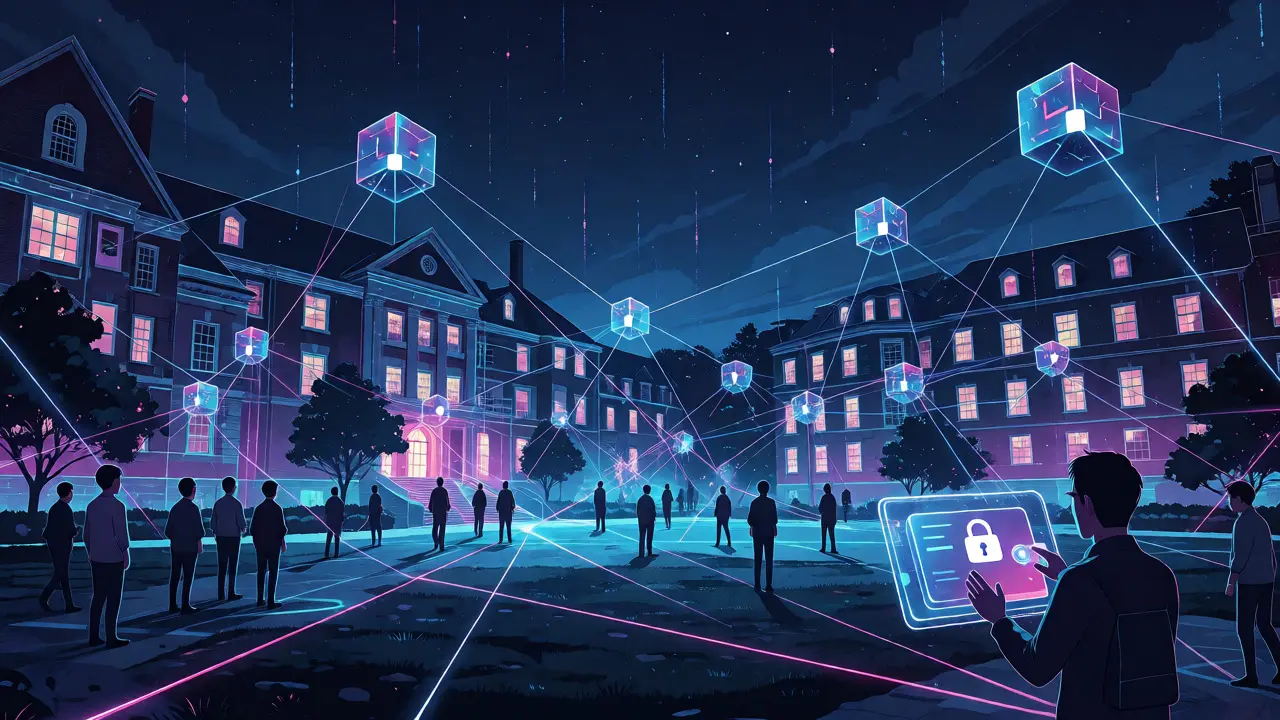
The Technical Hurdles Nobody Talks About
It’s not all smooth sailing. There is a significant barrier to entry: Web3 wallets. To receive an NFT diploma, you typically need software like MetaMask. For a non-tech-savvy art student or an older professional, setting up a wallet, backing up seed phrases, and understanding gas fees can be intimidating. A user study by BCDiploma.com noted that 68% of non-technology students struggled with this initial setup.
There’s also the issue of integration. Many Human Resources departments still use legacy systems that don’t talk to blockchains. Gartner’s 2023 survey indicated that 78% of Fortune 500 companies lack the infrastructure to natively accept NFT credentials. Until HR platforms build plugins to read these tokens, employers may still have to ask candidates to send screenshots or links, which defeats the purpose of seamless automation.
Global Adoption: Who Is Doing It Right?
Adoption is uneven but accelerating. Singapore is arguably the leader here. Through its SkillsFuture initiative, the country implemented NFT certificates across 23 polytechnics, reporting a 98% reduction in credential fraud. In the US, adoption is concentrated among research universities like MIT and Stanford, though broader uptake is slower due to regulatory caution.
Europe presents a different challenge. The General Data Protection Regulation (GDPR) requires strict privacy controls. Since blockchains are immutable, storing personal data directly on-chain can conflict with the "right to be forgotten." Solutions like OpenCerts address this by storing only hashes (digital fingerprints) on the chain, keeping the actual personal data off-chain and encrypted.
| Feature | Traditional Paper/PDF | NFT Certificate |
|---|---|---|
| Verification Time | 3-5 Business Days | < 15 Seconds |
| Fraud Risk | High (15-20%) | Negligible (Cryptographic Proof) |
| Ownership | Institutional Database | Student Wallet |
| Cost to Issue | Low (Printing/Mailing) | Very Low ($0.001 - $0.01) |
| Accessibility | Universal | Requires Digital Literacy |

Implementation Tips for Institutions
If you’re running a university or training center considering this shift, don’t underestimate the human element. Technology alone doesn’t drive adoption; ease of use does. Successful implementations follow a phased approach:
- Pilot Program: Start with a single department or program. Duke did this with their Financial Tech degree before scaling.
- User Education: Create simple guides. One European university failed because 68% of graduates couldn’t claim their NFTs due to poor instructions. Provide physical recovery cards for wallet seeds.
- Wallet Agnosticism: Don’t force students to use MetaMask. Use platforms that allow login via email or social media, abstracting the blockchain complexity until the user needs to transfer the asset.
- HR Integration: Work with major job boards to ensure they can parse NFT metadata. If LinkedIn can’t display your badge, your incentive to use it drops.
The Future Outlook
We are currently in the "Innovation Trigger" phase of this technology. Gartner predicts mainstream adoption by 2027, with 60% of universities offering NFT credentials by then. The market for digital credentials is projected to grow from $2.1 billion in 2022 to $11.3 billion by 2028.
However, long-term viability depends on interoperability. We need standards like ISO working group 35001 to ensure that an NFT issued in Hobart is readable in Helsinki. Until we have a universal language for blockchain credentials, we risk creating fragmented silos where your degree works on one platform but fails on another.
What happens if I lose my digital wallet?
Losing access to your wallet is similar to losing your house keys. If you haven't backed up your seed phrase, you technically lose control of the NFT. However, most educational platforms offer recovery services. Some institutions maintain a secondary copy of the credential in their database and can re-issue the NFT to a new wallet address after identity verification. Always back up your seed phrase offline immediately upon receipt.
Are NFT certificates legally recognized by governments?
Recognition varies by jurisdiction. In many countries, the legal weight of a credential comes from the issuing institution's accreditation, not the medium. As long as the university is accredited, an NFT serves as valid proof. However, some government sectors in countries with strict crypto regulations (like China) may still require paper backups. The EU's Digital Credentials Framework is actively working to harmonize this recognition across member states.
Can employers easily verify an NFT diploma?
Yes, provided they have a basic verification tool. Most issuers provide a public URL or QR code that directs to a blockchain explorer. The employer clicks the link, and the site displays the certificate's authenticity, issuer, and date. No specialized software is needed for the employer, just a web browser. As HR systems integrate blockchain APIs, this will become even more automated.
Is my personal data exposed on the blockchain?
Not typically. Best practices involve storing sensitive personal data (like your full name or student ID) off-chain or hashing it. The blockchain usually contains a hash (a string of characters) that points to the data stored on IPFS or a secure database. This ensures privacy compliance with laws like GDPR while maintaining the immutability of the credential's existence.
What is the environmental impact of issuing NFT degrees?
Early concerns about energy consumption were valid for Proof-of-Work chains like Ethereum pre-merge. However, most educational NFTs now run on Proof-of-Stake networks like Polygon, Tezos, or Ethereum post-merge. These consume negligible energy compared to traditional banking transactions. Issuing thousands of degrees has a carbon footprint comparable to sending a few hundred emails.