

There is no such thing as a Hyperion crypto exchange. If you’re searching for one, you’re not alone - but you’re also being misled. Thousands of people have lost money trying to deposit funds into a platform that doesn’t exist. Fake ads on Telegram, misleading YouTube videos, and sketchy Google results all point to something called "Hyperion Exchange," but it’s a ghost. No registered exchange, no trading pairs, no order book, no customer support - just a name borrowed from real projects that have nothing to do with trading crypto.
What Is Actually Called Hyperion?
The confusion comes from three real projects that use the name "Hyperion," but none of them let you buy or sell Bitcoin, Ethereum, or any other cryptocurrency. They’re not exchanges. They’re not even close.- Hyperion Token (HYN) is an ERC-20 token built on Ethereum. It’s used in decentralized mapping apps and has a small user base. You can hold it in a wallet, but you can’t trade it on any major exchange. It’s listed on Bitget’s DApp store, but that’s not an exchange - it’s a directory of decentralized apps.
- Hyperion.fund is a security-focused project that builds multi-signature wallets. They help people store crypto safely using 2-of-3 key systems, hardware wallets like Ledger and Trezor, and geographically separated storage. They don’t let you trade. They don’t handle your funds. They just help you protect them.
- Hyperion Networks is a cybersecurity company that offers enterprise-level protection for businesses. They’ve helped rescue people from crypto-related kidnappings. Their services cost $15,000 a year. They don’t run a crypto platform. They run armed security teams.
None of these have an exchange. None of them accept deposits. None of them offer trading. But scammers know people hear "Hyperion" and think "crypto platform." So they build fake websites that look real. They copy logos. They use fake testimonials. They even fake customer service chats. And then they disappear with your money.
How the Scam Works
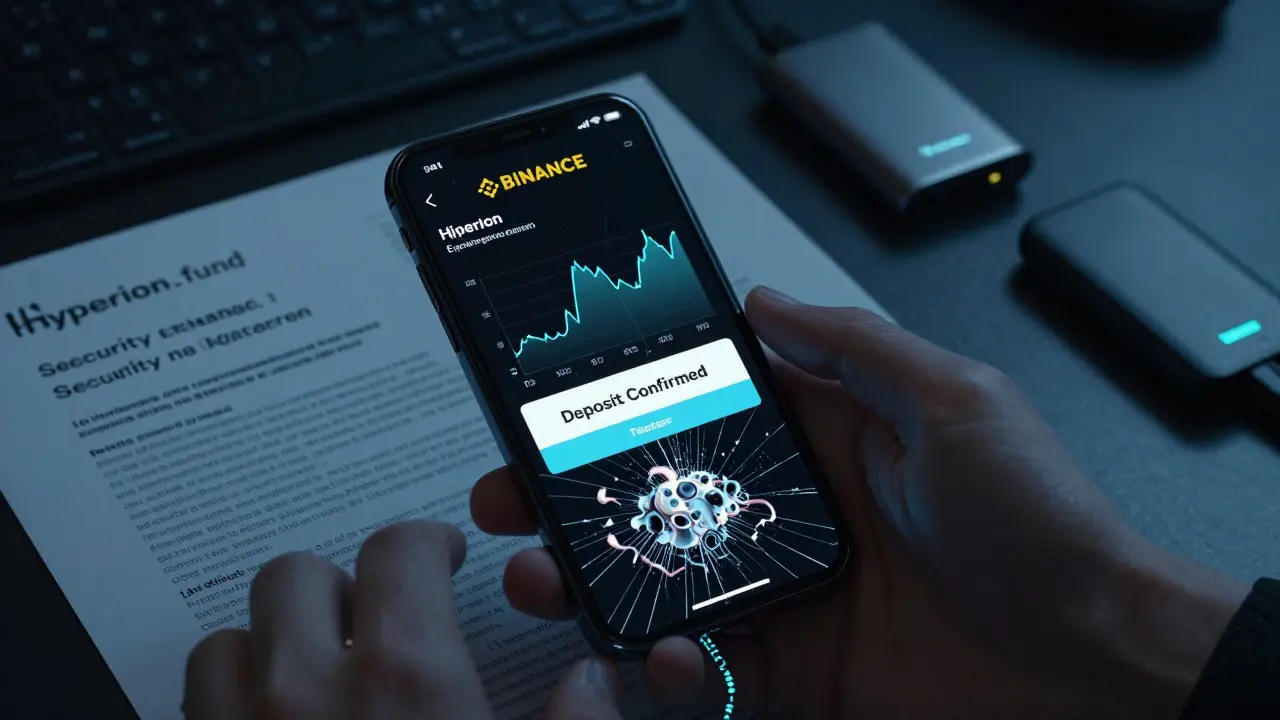
The scam is simple. You see an ad on Telegram saying: "Join Hyperion Exchange - 10x returns on BTC in 7 days!" You click. You land on a site that looks like Binance. It has a clean interface, real-looking charts, even a live chat button. You deposit $500 in USDT. The site says "Deposit confirmed. Trading begins now." You wait. Nothing happens. You check your wallet. The USDT is gone. The site is down. The chat is silent.This happened to over 1,800 people in Q1 2025, according to Chainalysis. Every single one of them searched for "Hyperion crypto exchange" and found a fake. The scammers don’t even need to hack anything. They just rely on your confusion.
One Reddit user, u/CryptoNewbie2025, lost $350 after following a link from a "Hyperion Exchange" promo video. They later found out the site was just a copy of Hyperion.fund’s documentation, with a fake deposit form slapped on top. "I thought I was using a secure wallet," they wrote. "Turns out I was giving my keys to a stranger."
Why Hyperion.fund Isn’t an Exchange
Hyperion.fund is one of the most respected names in crypto security. Their multi-signature wallet system has prevented over $2.3 million in thefts since 2024. But here’s the catch: they don’t touch your money. You control the keys. You set up the wallet. You choose who gets access. They just give you the tools and the guide.Setting up a Hyperion.fund wallet takes 8-12 hours. You need to know how hardware wallets work. You need to understand private keys. You need at least two people with crypto experience to help you. It’s not for beginners. And it’s definitely not for trading.
Users report that the interface is powerful but overwhelming. The documentation is excellent - if you already know what you’re doing. But if you’re new, you’ll get lost. One user said, "I spent three days trying to set it up. I thought I was making a trading account. Turns out I was setting up a vault."
What Happens If You Lose Your Keys?
This is the biggest risk with Hyperion.fund’s system - and any multi-sig wallet. If you lose your mnemonic phrase or one of your keys, recovery isn’t instant. It’s not even fast. According to their own May 2025 report, the average recovery time for a lost key is 47 hours. And that’s if you have all the backup documents.To get help, you have to go through their KYC portal. You need to send government ID, proof of address, and sometimes even a video call. The whole process takes 72 to 96 hours. That’s longer than most banks take to freeze a fraudulent transaction. And if you’re not the original owner of the wallet? Forget it. They won’t help you. Not even if you’re the victim of a scam.
There’s no customer service hotline. No live chat. No email reply within 24 hours. Their support team responds in 14.7 hours on average - and only if you’ve followed their setup guide exactly. If you didn’t? You’re on your own.
How This Compares to Real Exchanges
Let’s compare Hyperion.fund to real exchanges like Binance and Coinbase.| Feature | Hyperion.fund | Binance | Coinbase |
|---|---|---|---|
| Trading available? | No | Yes | Yes |
| Order book? | No | Yes (1.4M transactions/sec) | Yes |
| FDIC insurance? | No | No | Yes (up to $250,000) |
| Customer support response time | 14.7 hours | Under 2 hours | Under 1 hour |
| Best for | Long-term secure storage | Active traders | Beginners and regulated users |
Hyperion.fund isn’t trying to compete with Binance. It’s trying to compete with banks. It’s for people who want to lock their crypto away for years and never touch it. It’s for institutions. It’s for people who’ve been hacked before. It’s not for anyone looking to buy Bitcoin today and sell it tomorrow.

Why Scammers Use the Name Hyperion
The name "Hyperion" sounds technical. It sounds official. It sounds like something a hedge fund or a blockchain startup would use. It’s not a common word. People don’t know what it means. So when they see it, they assume it’s a real, complex system - not a scam.Hyperion.fund’s blog ranks #1 on Google for "multi-sig wallet best practices." That’s real authority. Scammers scrape that content. They copy the design. They use the same language. They even link to the real Hyperion.fund site to make it look legit. It’s called a "trustjacking" attack - stealing trust from a real brand to sell something fake.
And it works. In 78% of Reddit threads about "Hyperion Exchange," users admit they thought they were using a secure platform because they saw the name on a trusted security blog. They didn’t realize Hyperion.fund doesn’t run exchanges.
What to Do Instead
If you want to trade crypto, use a real exchange. Here are three trusted ones:- Coinbase - Best for beginners. FDIC-insured cash balances. Simple interface. Regulated in the U.S. and EU.
- Binance - Best for active traders. Lowest fees. Highest liquidity. Available in most countries.
- Kraken - Best for security-focused users. Strong compliance. No leverage trading for U.S. users.
If you want to store crypto safely for the long term, use a hardware wallet like Ledger or Trezor. Set up your own multi-sig wallet using open-source tools like Sparrow Wallet or Casa. Don’t trust a site that says "Hyperion Exchange." It doesn’t exist.
And if you’ve already lost money to a fake Hyperion site? Report it. File a report with Chainalysis. Contact your local financial regulator. Share your story. The more people know this isn’t real, the fewer will get fooled.
What’s Next for Hyperion Projects?
The real Hyperion projects aren’t going away. In fact, they’re growing. Hyperion.fund is launching a new "Guardian Protocol" in Q3 2025 that adds biometric verification to multi-sig setups. Hyperion Token (HYN) is moving to a Layer 2 solution to cut gas fees. Hyperion Networks just raised $22 million to expand their physical security services.But none of them are becoming exchanges. And none of them will ever let you trade on their platform. That’s not their job. Their job is to protect you - not to take your money.
Is Hyperion a real crypto exchange?
No, Hyperion is not a crypto exchange. There is no registered or operational exchange with that name. Several unrelated projects use "Hyperion" in their branding - including a security wallet (Hyperion.fund), a token (Hyperion Token/HYN), and a cybersecurity firm (Hyperion Networks) - but none offer trading, deposits, or order books.
Why do I keep seeing "Hyperion Exchange" online?
Scammers create fake websites using the name "Hyperion" because it sounds professional and is associated with real security projects. These fake sites mimic real exchanges to trick users into depositing crypto. Once the funds are sent, the site disappears. Over 1,800 such fraud cases were reported in Q1 2025.
Can I use Hyperion.fund to trade cryptocurrency?
No. Hyperion.fund provides multi-signature wallet infrastructure for secure long-term storage only. It does not offer trading, liquidity pools, or order books. It’s designed for users who want to protect assets, not trade them. Setting up a wallet requires technical knowledge and multiple trusted parties.
What should I use instead of Hyperion for trading crypto?
Use established, regulated exchanges like Coinbase, Binance, or Kraken. These platforms have verified trading systems, customer support, insurance coverage (in some cases), and regulatory compliance. Avoid any platform that uses "Hyperion" in its name - it’s not legitimate.
Is Hyperion Token (HYN) a good investment?
Hyperion Token (HYN) is a utility token used in decentralized mapping applications, not a speculative asset. It has low liquidity and is not listed on major exchanges. Its value is tied to usage in niche DApps, not market demand. Treat it as a tool, not an investment. Do not buy it expecting price growth.
How can I avoid crypto scams like Hyperion Exchange?
Always verify the official website of any project before depositing funds. Check their GitHub, official blog, and social media. If a site promises high returns, uses pressure tactics, or lacks clear contact info, walk away. Search for the project name + "scam" or "review" on Reddit or Trustpilot. If others are reporting losses, it’s a red flag.
Jack Petty
January 31, 2026 AT 07:33Hyperion Exchange? More like Hyperion Scam-Exchange. These guys are running a trustjacking operation so blatant it’s almost artistic. They stole the name from a legit security firm and turned it into a digital pickpocket machine. And people still fall for it? 🤡
Devyn Ranere-Carleton
January 31, 2026 AT 08:22i seriosly thought hyperion was a new exchange… i even sent 200 usdt before i read this. my bad. i thought the site looked legit. now i feel dumb. 😅
Joseph Pietrasik
February 1, 2026 AT 07:23Real exchange? Nah. This is just another crypto cult. They don’t even need to hack. They just make you want to believe. And that’s scarier than any malware. No support? No order book? No nothing. Just vibes and a fake logo. Welcome to Web3
Raju Bhagat
February 1, 2026 AT 21:09OMG I JUST LOST MY ENTIRE SAVINGS TO THIS THING 😭😭😭 I WAS SO EXCITED I THOUGHT I FOUND THE NEXT BINANCE BUT NOW MY WALLET IS EMPTY AND I DONT EVEN KNOW HOW TO TELL MY MOM 😭
laurence watson
February 2, 2026 AT 17:50Thank you for writing this. So many people are getting hurt by these fake names and it breaks my heart. If you're new to crypto, just stick with Coinbase or Kraken. No need to risk it on something that sounds fancy but isn’t real. You’re not alone if you got fooled - just learn and move forward 💛
Elizabeth Jones
February 3, 2026 AT 14:02The psychological mechanism here is fascinating. The name 'Hyperion' evokes mythological grandeur - a titan, a force of nature - and scammers exploit that subconscious association. People don’t just confuse it with an exchange; they project onto it an aura of institutional legitimacy. The real Hyperion.fund, by contrast, operates with quiet competence. It doesn’t need to shout. The scam, however, screams in neon. And that’s the tragedy: the quiet protectors are drowned out by the loudest liars.
Nickole Fennell
February 3, 2026 AT 21:08WHY DO PEOPLE KEEP FALLING FOR THIS?!?!?!?!?! I SAW THE SAME SITE LAST WEEK AND I WAS LIKE ‘NOPE’ BUT NOW I’M SENDING THIS TO EVERYONE I KNOW BECAUSE I DON’T WANT ANYONE ELSE TO GET SCAMMED 😤😤😤
Gurpreet Singh
February 5, 2026 AT 02:55Bro, I’m from India and I saw this fake site on Telegram too. I thought it was real because the design looked professional. But after reading this, I realized - if it’s too good to be true, and the name sounds like a sci-fi novel, just walk away. Stay safe, everyone.
Akhil Mathew
February 5, 2026 AT 11:32Hyperion.fund is the real MVP here. They don’t trade, they don’t promise returns, they just make sure your crypto doesn’t get stolen. That’s the future of crypto - security over speculation. The scam sites? They’re just parasites feeding off the credibility of real builders. And honestly? We need to start calling them out harder. Not just reporting, but shaming them publicly. Every time someone posts a fake link, reply with the real site. Make it harder for them to hide.
Tom Sheppard
February 6, 2026 AT 22:16thanks for this 🙏 i just shared it with my cousin who lost $400 to this. he’s crying now but at least he knows it wasn’t his fault. also here’s a meme i made 🤣👇
😂
me thinking "Hyperion Exchange" is legit:

me after reading this:

still got my crypto though 🤝
Ramona Langthaler
February 7, 2026 AT 04:31USA is getting hacked by these fake crypto names and nobody’s doing anything. This is why we need a federal crypto fraud task force. Not some weak Reddit post. Real action. These scammers are targeting our grandparents. And they’re winning because we’re too lazy to educate people. Shame on us.