
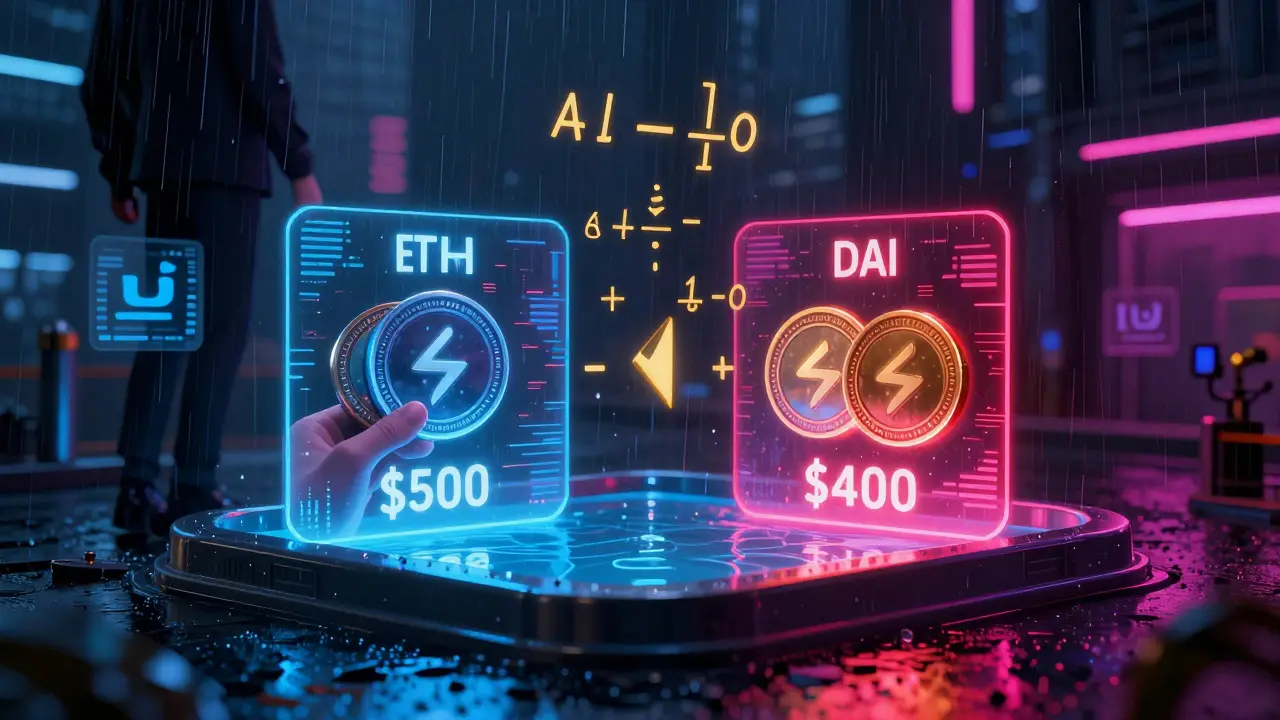
Imagine putting $1,000 worth of ETH and DAI into a DeFi pool, only to find out later that your share is worth less than $1,000-even though both ETH and DAI went up in price. That’s impermanent loss. It’s not a hack, not a scam, and not a mistake. It’s just math. And if you’re thinking about providing liquidity in DeFi, you need to understand it before you click "Confirm."
How Impermanent Loss Happens
Impermanent loss shows up because of how automated market makers (AMMs) work. Unlike traditional exchanges that match buyers and sellers through order books, AMMs like Uniswap, SushiSwap, and Balancer use a simple formula: x * y = k. This means the product of the two assets in a pool must always stay the same. If one asset gets bought up, its price goes up, and the other gets sold to keep the math balanced. Let’s say you add 1 ETH and 100 DAI to a pool when ETH is $100. Your total deposit is $200. The pool now holds 10 ETH and 1,000 DAI total, so you own 10% of it. Everything’s fine. Now ETH spikes to $400. Traders rush to buy ETH from the pool. To keep the formula working, the pool sells ETH and buys DAI. Now the pool has 5 ETH and 2,000 DAI. The price of ETH is $400, so the pool’s total value is $4,000. Your 10% share is worth $400-but you only have 0.5 ETH (worth $200) and 200 DAI (worth $200). That’s $400 total. Sounds good, right? But here’s the catch: if you’d just held your 1 ETH and 100 DAI in your wallet instead of putting them in the pool, you’d now have 1 ETH ($400) + 100 DAI ($100) = $500. You lost $100 by providing liquidity. That’s impermanent loss.Why It’s Called "Impermanent"
The word "impermanent" is misleading. It doesn’t mean the loss disappears on its own. It means the loss only exists as long as you keep your funds in the pool. If ETH drops back to $100, your share in the pool will return to $200, and your loss vanishes. But if you withdraw your funds while ETH is at $400, the loss becomes permanent. You’re not losing money because the market is crashing. You’re losing money because the market moved while your assets were tied up in the pool. The pool rebalanced automatically, and you ended up with less of the asset that went up. That’s the trade-off for earning trading fees.When Impermanent Loss Is Worst
Not all pairs are equal. The bigger the price swing between the two assets, the worse the loss. Here’s how it breaks down:- Stablecoin pairs (USDC/USDT, DAI/USDC): Price changes are tiny. Impermanent loss is almost zero. These are the safest pools for beginners.
- ETH/DAI, BTC/USDT: Moderate volatility. Losses can hit 5-15% during strong moves.
- ETH/ALT (like ETH/SHIB, ETH/MATIC): High risk. During a bull run, if your altcoin surges 5x while ETH only goes up 2x, you’ll lose a lot of your ETH exposure. Losses can hit 30-50% or more.
- Opposite-direction moves: If one asset crashes and the other stays flat, the loss can be brutal. For example, if ETH drops 50% and DAI stays at $1, your pool gets flooded with DAI and you’re left with too little ETH.
How to Spot It Before You Deposit
You don’t need to be a math wizard to estimate your risk. Use a free impermanent loss calculator-there are dozens online. Just plug in:- The two tokens you’re pairing
- The current price ratio
- The expected price change (e.g., "ETH goes up 200%")
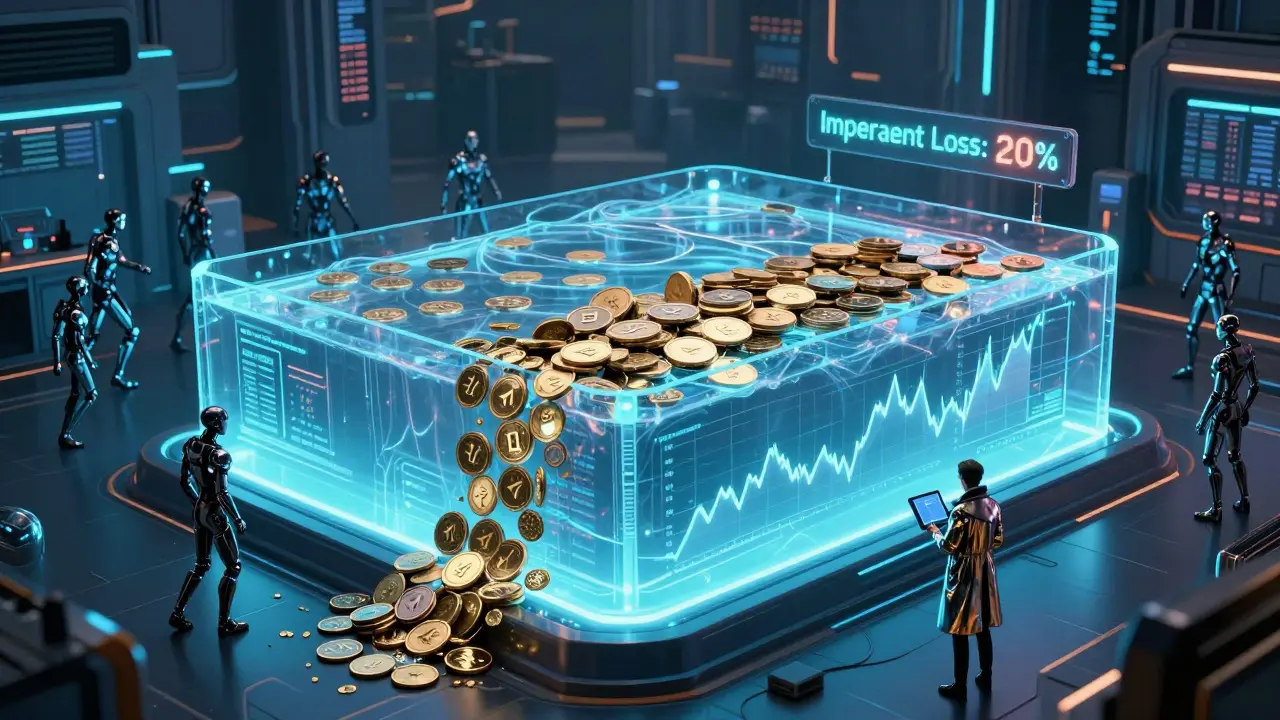
Are Fees Enough to Cover the Loss?
Most AMMs pay 0.05% to 1% in trading fees per trade. That sounds small, but if a pool has high volume, it adds up. For example:- USDC/USDT pool: 0.01% fee, $50 million daily volume → $5,000 daily fees. Split among thousands of LPs → maybe $0.50/day per $1,000 deposited.
- ETH/SHIB pool: 0.3% fee, $20 million daily volume → $60,000 daily fees. Fewer LPs → maybe $15/day per $1,000 deposited.
What About Yield Farming Rewards?
Many pools offer extra rewards-like $SUSHI, $UNI, or $BAL tokens-on top of trading fees. These can be huge. In 2021, some LPs earned 50% APR from rewards alone. But here’s the reality: token rewards are volatile. If the reward token crashes, your total return drops fast. A pool offering 100% APR in a token that drops 80% isn’t a win. Always calculate your return in USD terms, not in reward tokens.How to Reduce Your Risk
You can’t eliminate impermanent loss-but you can control it:- Stick to stablecoin pairs: USDC/USDT, DAI/USDC. These are the closest thing to a "safe" liquidity position.
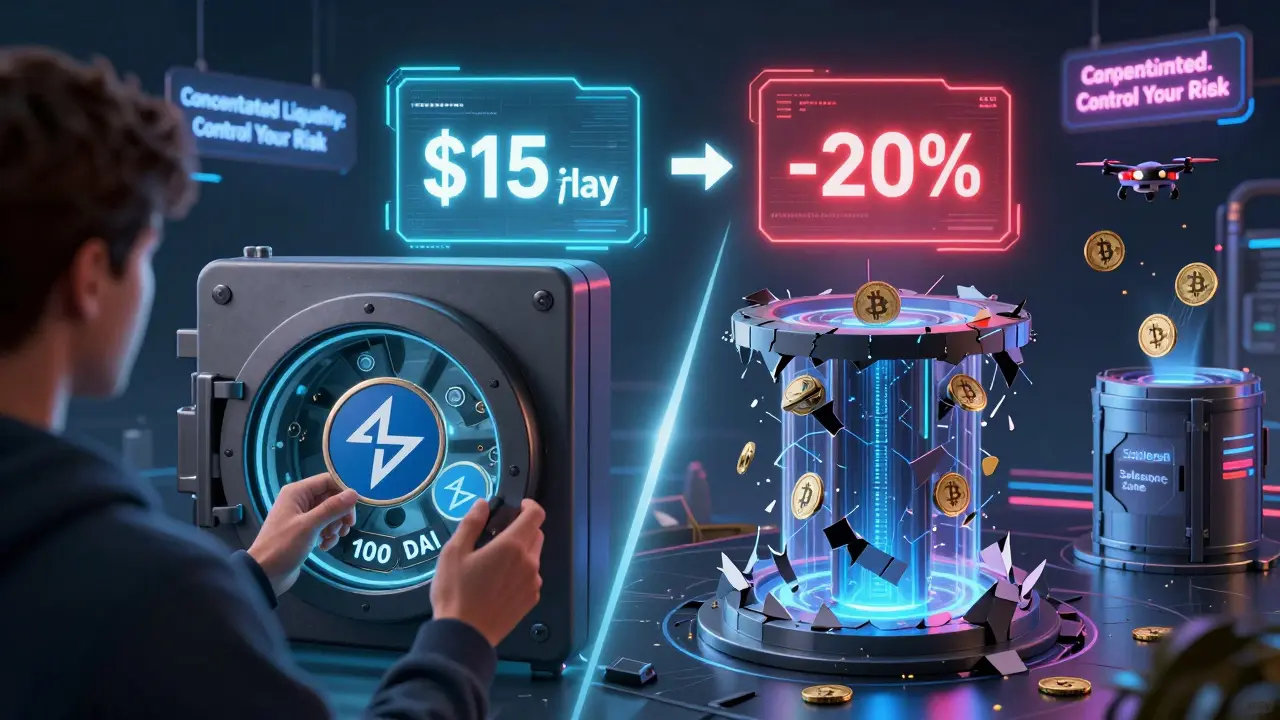
- Use concentrated liquidity (Uniswap V3): Instead of providing liquidity across all prices, you pick a price range. If ETH stays between $300-$500, you only deposit within that range. You earn more fees, and your exposure to extreme moves is cut in half.
- Avoid new or low-volume tokens: If a token has no history and low trading volume, its price can swing wildly. That’s a recipe for big losses.
- Don’t chase high APY: If a pool promises 1,000% APR, it’s usually because the risk is extreme. Check the token’s market cap, trading volume, and team history.
- Withdraw before big events: If you know a major token launch or ETF decision is coming, consider pulling your liquidity a few days before. Price swings are likely.
Is Impermanent Loss a Dealbreaker?
No. But it’s a filter. If you’re looking for passive income with low risk, stick to stablecoin pools. You won’t get rich, but you’ll earn steady fees without surprise losses. If you’re okay with volatility and want to bet on price movements, use concentrated liquidity or high-volume volatile pairs. But only if you understand the math and have a plan to exit before losses get too deep. And if you’re just trying to "make money from crypto" without learning how it works? Walk away. Impermanent loss isn’t something you can ignore. It’s built into the system.What’s Next for Impermanent Loss?
The DeFi world is trying to fix this. Uniswap V4 lets you create custom fee tiers and dynamic liquidity ranges. New protocols like Balancer let you use weighted pools (e.g., 80% ETH / 20% DAI) instead of 50/50. Some are even experimenting with insurance pools that pay out if you lose money. But none of these eliminate the core issue: if prices move, and you’re providing liquidity, you’re exposed. The best tools today still just help you manage it-not avoid it.Final Thought
Impermanent loss isn’t a bug. It’s a feature. It’s the price you pay for being part of a decentralized system that doesn’t rely on order books or market makers. You’re not just earning fees-you’re helping the whole network run. But like any financial trade, you need to know what you’re giving up. If you understand the math, you can use it to your advantage. If you don’t, you’ll end up with less than you started-even when the market goes up.Is impermanent loss real money I lose?
Yes, but only on paper until you withdraw. If you leave your funds in the pool, the loss can reverse if prices return to their original ratio. But once you withdraw, the loss becomes permanent. It’s measured against holding the assets outside the pool-not against your initial dollar value.
Can you make money even with impermanent loss?
Absolutely. Many liquidity providers earn more in trading fees and token rewards than they lose to impermanent loss. Stablecoin pools are the most reliable for this. Even in volatile pairs, high volume and strong rewards can turn a net profit. The key is calculating your break-even point before depositing.
Does impermanent loss happen on centralized exchanges?
No. Centralized exchanges like Binance or Coinbase use order books. When you buy or sell, you trade directly with another user. You don’t provide liquidity to a pool, so you don’t get exposed to the math behind AMMs. Impermanent loss only exists on decentralized exchanges.
What’s the difference between impermanent loss and slippage?
Slippage is what happens when you trade and the price moves between when you click "Swap" and when your transaction is confirmed. Impermanent loss is what happens to liquidity providers because the pool’s price adjusts to market changes over time. Slippage affects traders. Impermanent loss affects providers.
Should I avoid DeFi liquidity pools entirely?
No. But you should avoid them blindly. If you stick to stablecoin pairs, use concentrated liquidity, and only deposit what you can afford to lose, you can earn consistent returns. The key is understanding the trade-off: you’re giving up price exposure in exchange for fees and rewards. If that sounds like a fair deal to you, go ahead. If you want to hold and HODL, keep your assets in your wallet.
Jake Mepham
December 18, 2025 AT 17:28Man, I remember when I first got burned by impermanent loss on a ETH/SHIB pool. Thought I was gonna get rich off 200% APR. Ended up losing 37% even after fees. The math hits different when your wallet’s lighter than your ego. Now I only do stablecoin pairs - boring? Yeah. Safe? Hell yes. No more gambling with my crypto like it’s a slot machine.
Pro tip: Use Uniswap V3’s concentrated liquidity. Pick a tight range around where you think the price’ll sit. You earn way more fees and your exposure to wild swings drops like a rock. Game-changer.
SHEFFIN ANTONY
December 20, 2025 AT 16:25LOL you guys act like impermanent loss is some secret villain. It’s literally just arbitrage in slow motion. If you can’t handle the math, don’t touch DeFi. And stop pretending stablecoins are ‘safe’ - USDC got depegged once, remember? You’re all just chasing yields like pigeons after breadcrumbs. At least I’m honest about my greed.
Vyas Koduvayur
December 22, 2025 AT 08:31Let’s break this down properly. Impermanent loss isn’t even the real issue - it’s the misalignment between expected yield and actual risk exposure. Most retail LPs don’t calculate the opportunity cost of locking assets versus HODLing. They see a 50% APR and assume it’s free money. But if the price ratio shifts by 150%, even a 3% fee APY won’t compensate for the gamma decay in your position. And don’t get me started on reward token depreciation - you’re effectively paying 80% tax on your ‘profits’ if the governance token tanks.
Also, Uniswap V3’s concentrated liquidity only works if you’re actively rebalancing. Most people set it and forget it, which defeats the whole purpose. You need to monitor price action like a hawk. If you’re not checking your positions daily, you’re not a liquidity provider - you’re a liability to the pool.
Lloyd Yang
December 22, 2025 AT 21:05I’ve been in DeFi since 2020, and let me tell you - impermanent loss was the hardest lesson I ever had to swallow. I cried over my wallet after losing $800 on an ETH/DAI pool during the 2021 bull run. But here’s the beautiful part: I didn’t quit. I learned. I started tracking my positions like a spreadsheet ninja. I now only enter pools where the fee revenue covers my expected loss over 30 days. And I use tools like DeFi Saver to auto-rebalance.
What changed everything for me? Thinking of LPing not as passive income, but as active trading. You’re not just depositing - you’re selling high and buying low, constantly. That’s the magic. And yeah, stablecoins are the gateway drug. Start there. Then graduate to V3. Don’t rush. Your future self will thank you.
Cathy Bounchareune
December 24, 2025 AT 11:11Okay but why is it called ‘impermanent’ if it’s permanent when you withdraw? Feels like a marketing lie. Like calling a ‘diet’ that only works if you never eat again. I get the math, but the name just adds confusion. Maybe they should’ve called it ‘liquidity tax’ or ‘price divergence penalty.’ Something that doesn’t sound like it’ll magically fix itself.
Also, I tried a pool with 100% APR and got a reward token that’s now worth 3% of its peak. So I earned $12 in fees but lost $400 in token value. Thanks, DeFi. 😅
Jordan Renaud
December 25, 2025 AT 00:29It’s funny - we treat impermanent loss like a bug, but it’s actually the system working exactly as designed. The pool doesn’t care if you win or lose. It just keeps the math balanced. That’s the beauty of decentralized finance. No middleman. No bailouts. Just code and consequences.
Maybe the real question isn’t how to avoid loss, but whether you’re okay with being a part of the mechanism that makes the whole thing run. If yes, then the loss isn’t a cost - it’s your contribution. Fees are just the thank-you note.
vaibhav pushilkar
December 26, 2025 AT 06:55Stablecoins only. No exceptions.
Luke Steven
December 27, 2025 AT 10:08Been LPing since 2021. Lost money. Made money. Got scammed once. Learned everything the hard way.
Here’s what I do now: I only put in what I’m okay with losing. If I’d held my ETH instead, I’d be richer - but I wouldn’t be helping the network. So I see it as paying for participation. Like a gym membership for crypto. You don’t get ripped just by walking in. You gotta show up, learn, and adjust.
Also, if a pool has a logo that looks like a cartoon dog, run.
Ellen Sales
December 29, 2025 AT 09:53So let me get this straight - you’re telling me I have to be a math wizard just to earn 5% on my crypto? And if I’m not, I’m just a dumb sheep getting fleeced by ‘decentralized’ algorithms? Wow. So this is what ‘financial freedom’ looks like now? 🙃
Can I just… put my money in a savings account? It’s boring, but at least I know my bank won’t auto-sell my ETH to buy DAI because some robot got bored.
Charles Freitas
December 30, 2025 AT 06:28You’re all missing the point. Impermanent loss exists because you’re too lazy to learn proper market-making. If you can’t hedge your positions, you don’t belong in DeFi. And stop pretending you’re ‘earning’ anything. You’re just the liquidity that lets whales arbitrage you. Your ‘fees’ are just the crumbs they leave after they’ve taken your lunch.
Also, V3? Please. Only degens with 3 monitors and a trading bot think that’s a solution. It’s just complexity for complexity’s sake.
Ashley Lewis
December 31, 2025 AT 04:32It is not a ‘guide.’ It is a misrepresentation of financial risk. The term ‘impermanent loss’ is semantically misleading and fosters dangerous misconceptions among retail participants. One does not ‘earn’ yield in AMMs - one surrenders directional exposure in exchange for transactional externality compensation. The entire construct is structurally inferior to order-book-based liquidity provision, and its proliferation represents a systemic degradation of financial literacy. One should avoid such instruments entirely unless one possesses a graduate-level understanding of arbitrage dynamics and market microstructure.