

Ever clicked on a crypto ticker only to find three different projects using the same name? That’s exactly what happens with Roko, or ROKO. While it sounds like a single asset, the reality is messier. There is an Ethereum-based infrastructure token aiming to solve timing problems for robots and sensors, and there are several unrelated meme coins on Solana sharing the exact same ticker. If you’re looking at price charts, you need to know which one you’re actually holding before you send a single dollar.
As of August 2026, the main Roko Network token trades in the sub-cent range, hovering around $0.000006 USD per coin. It’s not Bitcoin. It’s not even a top-100 altcoin. With a market cap sitting between $1 million and $2.2 million, ROKO is firmly in the "microcap" zone-high risk, high volatility, and extremely thin liquidity. But why does anyone care about a token that costs less than a tenth of a penny? The answer lies in its unique pitch: providing a "temporal layer" for Web3 applications that need nanosecond-level precision.
The Core Identity: What is Roko Network?
To understand the value proposition, you have to look past the confusing branding. The primary entity here is the Roko Network, a blockchain protocol designed to provide hardware-grade timing measurement and deterministic ordering for machine work. In simple terms, imagine two robots working on an assembly line. They need to know exactly when they moved their arms and in what order. Standard blockchains are great for recording who owns what, but they are terrible at recording *when* something happened with extreme precision. Roko aims to fix this by creating a layer where time itself is part of the transaction data.
This isn't just a tech buzzword. The project targets specific use cases like sensor data logging, industrial workflows, and physical-digital settlement. If you’ve ever wondered how to verify that an IoT device sent a signal at 14:02:05.000001 rather than just "yesterday," Roko is trying to be the answer. It operates as an EVM-compatible chain, meaning developers can use standard Ethereum tools like Solidity to build apps on it. However, it runs on its own network parameters, specifically Chain ID 52370, which distinguishes it from the main Ethereum network.
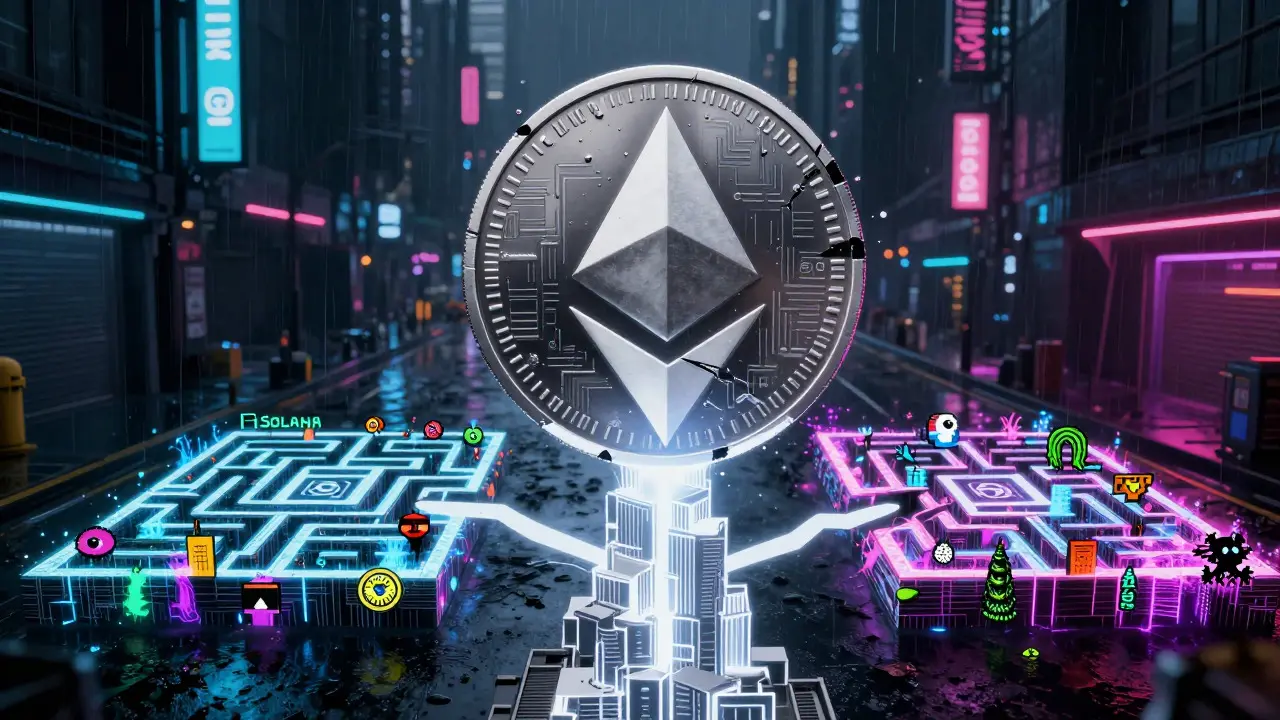
Navigating the Ticker Confusion: Ethereum vs. Solana
Here is where most new investors get tripped up. The ticker "ROKO" is not exclusive to the Ethereum-based infrastructure project. On the Solana blockchain, there are at least two other tokens using this symbol. One is called "Roko AI," a tiny experimental token with a total supply of only about 512,760 coins. Another is a meme-style asset sometimes referred to in community circles as "ROKO’s Basilisk." These Solana versions are completely separate from the Ethereum Roko Network. They have different contract addresses, different utilities (or lack thereof), and vastly different market dynamics.
If you buy the wrong one, you might end up holding a meme coin with a liquidity pool of under $25,000 instead of the infrastructure token with over $1 million in market cap. This distinction is critical. The Ethereum version is listed on major data aggregators and has a circulating supply of roughly 208 billion to 210 billion tokens. The Solana versions are niche, often trading with negligible volume. Always check the network and contract address before swapping.
Tokenomics and Market Data: The Numbers Behind ROKO
Let’s break down the financials of the main Ethereum-based Roko token. As of late August 2026, the price hovers around $0.000006 USD. The total maximum supply is capped at approximately 369.36 billion ROKO. Of this, about 56% to 57% is currently in circulation, meaning there are still significant tokens waiting to be released. This unissued supply creates what traders call "dilution risk." If the team releases more tokens into the market, the price per coin could drop unless demand increases proportionally.
| Metric | Value | Note |
|---|---|---|
| Current Price | $0.000006009 | Fluctuates heavily; check live feeds |
| Market Cap | ~$1.25 Million | Classified as Microcap |
| Fully Diluted Valuation (FDV) | ~$2.22 Million | Includes all locked/unreleased tokens |
| Circulating Supply | ~208 Billion ROKO | Approximately 56% of max supply |
| Max Supply | 369.36 Billion ROKO | Hard cap |
| Daily Volume | $1,200 - $100,000 | Extremely variable; low liquidity days common |
| Network Status | Public Testnet | Mainnet economic security not yet finalized |
Liquidity is the biggest red flag for many traders. On some days, the 24-hour trading volume is a mere $1,200. On others, during speculative bursts, it might hit $100,000. This inconsistency means that if you try to sell a large position, you might crash the price against yourself because there aren’t enough buyers in the order book. The bid-ask spread can also be wide, eating into your profits on every trade.
Utility: Why Hold ROKO?
So, what do you actually get for holding these fractions of a cent? The official documentation outlines three main uses for the token. First, it pays for transaction fees on the Roko Network. Second, it secures the validator network through staking. Third, it grants voting rights in the DAO (Decentralized Autonomous Organization) governance. This follows the standard pattern for Proof-of-Stake networks.
However, the narrative around the token has shifted over time. Early on, some analytics sites described Roko as a "meme + AI" project, leaning into viral culture and artificial intelligence branding. Later, the focus sharpened toward industrial robotics and DePIN (Decentralized Physical Infrastructure Networks). Currently, the project positions itself strictly as infrastructure. If you believe in the future of machine-to-machine coordination requiring precise timestamps, ROKO is the ticket. If you’re looking for a quick flip based on social media hype, the current testnet status suggests the groundwork is still being laid.
Risks and Volatility: The Fine Print
Investing in ROKO is not for the faint of heart. The historical price action shows massive swings. The all-time high was recorded around March 2024 at approximately $0.00015 USD. Since then, the price has retraced significantly, spending much of 2025 and 2026 in the $0.000004 to $0.000010 range. That’s a drop of nearly 90% from its peak. Such volatility is typical for microcaps, but it demands strict risk management.
Beyond price swings, there are structural risks. The project is currently operating on a public testnet. This means the network state can be reset, and contracts may change. Until the mainnet launches with full economic security, the "value" of the token is largely speculative. Furthermore, there is no publicly cited third-party audit of the smart contracts in the accessible data sources, nor are the founder identities widely verified. You are trusting a community-driven project that hasn’t yet proven its long-term viability in a production environment.
How to Get Started: Practical Steps
If you decide to dip your toes in, follow these steps to avoid common pitfalls:
- Verify the Contract Address: Do not rely on the ticker "ROKO" alone. Find the specific contract address for the Ethereum-based Roko Network token on a trusted aggregator like CoinGecko or CoinMarketCap. Cross-reference it with the official project documentation.
- Check the Network: Ensure your wallet is set to the correct network. For the main infrastructure token, you are interacting with an EVM-compatible chain (Chain ID 52370) or the Ethereum mainnet depending on where it is listed. Be careful not to confuse it with Solana SPL tokens.
- Start Small: Given the daily volume can be as low as $1,200, enter the position slowly. Buying too much at once can result in slippage, where your average entry price is worse than the displayed price.
- Monitor Liquidity Pools: Check the depth of the order book. If the spread is wider than 2%, wait for better conditions before trading.
- Follow Development Updates: Keep an eye on the transition from testnet to mainnet. This is the key catalyst that could either validate the technology or expose fundamental flaws.
Remember, this is an experimental asset. Treat it like venture capital betting on a pre-revenue startup, not like a stable store of value.