

Most people think HODL means never selling crypto. That’s not true. HODL isn’t about blind faith. It’s about patience with purpose. And knowing when to sell isn’t weakness - it’s discipline. If you bought Bitcoin at $18,000 in June 2022 and held through 2023’s swings, you likely doubled your money. But if you held onto a low-cap token that crashed 95%, you didn’t HODL - you got stuck. The real question isn’t whether to hold. It’s when to hold - and when to walk away.
What HODL Really Means (And What It Doesn’t)
The word HODL came from a 2013 forum post where someone misspelled "hold" while drunk. It stuck. Now, it’s used by institutional investors managing billions. But here’s the truth: HODL isn’t a rule. It’s a mindset. It’s choosing long-term growth over emotional reactions. Data from Binance Academy shows 68% of institutional investors still use HODL as their core strategy. Coinbase reports 73.5% of Bitcoin held since 2022 has never been moved. That’s not because people are lazy. It’s because they’ve seen the math.
Bitcoin’s history proves this. After the 2014 crash, when Bitcoin dropped 80%, those who held saw a 10,000% return by 2017. The same happened after 2018. And again after 2022. Each time, the market recovered - and then exploded. But here’s the catch: this only works if you’re holding the right assets.
Which Assets Should You HODL?
Not all crypto is created equal. HODLing a token with no utility, no developers, and no adoption is gambling. It’s not investing. Chainalysis found 94% of Bitcoin’s price rise from 2021 to 2023 came from real-world adoption - not hype. Ethereum? Same story. Its network processes millions of transactions daily. It powers DeFi, NFTs, and enterprise apps.
So what qualifies for HODL? Three things:
- Market cap over $100 million - Tokens below this are too risky. Most vanish within 18 months.
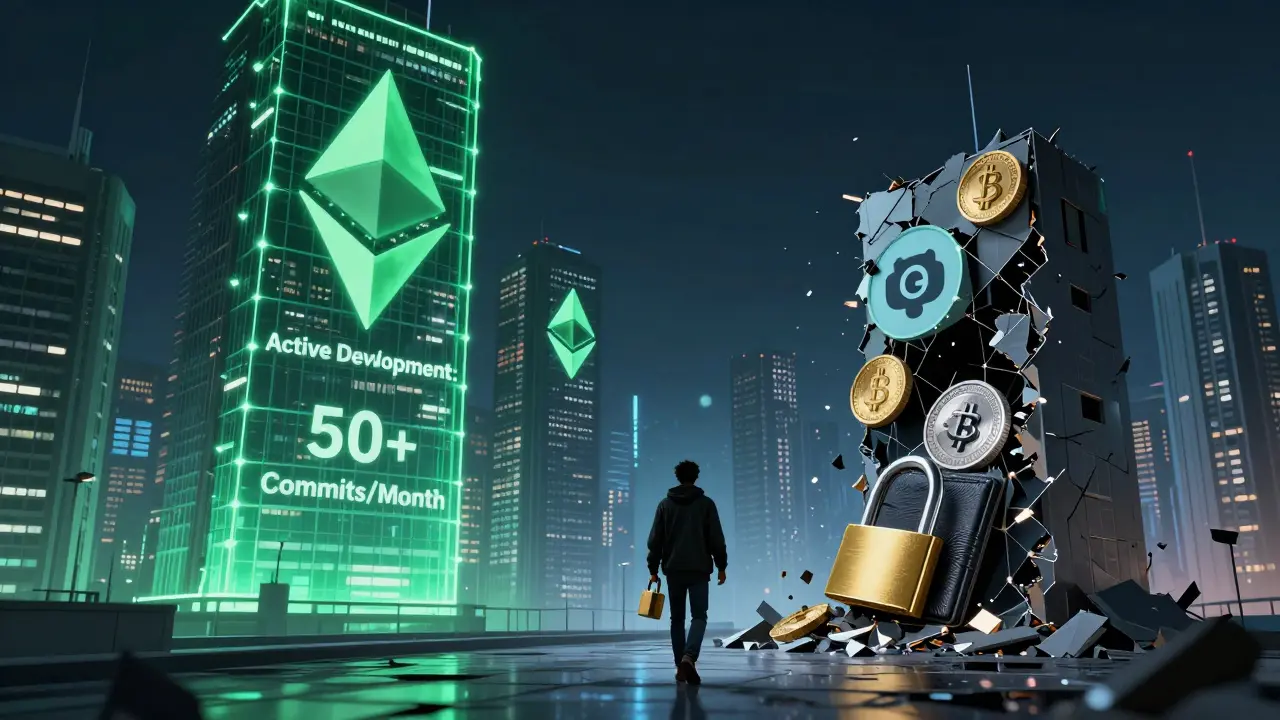
- Active development - At least 50 GitHub commits per month. No updates? No future.
- Real use case - Does it solve a problem? Or is it just a meme?
Bitwise’s 2024 report found that 60-70% of successful institutional portfolios are 90% Bitcoin and Ethereum. The rest? Maybe one or two solid altcoins. Everything else? Don’t HODL it. Sell it. Or never buy it.
When to Buy: Timing Your Entry
Buying at the top kills returns. Buying at the bottom? That’s how legends are made. The best time to enter isn’t when everyone’s excited. It’s when they’re scared.
Look at the Crypto Fear & Greed Index. When it drops below 25 for three weeks straight, that’s your signal. That happened in June 2022 (Bitcoin at $17,592) and December 2023. Both times, the market rallied over 90% within six months. Glassnode data shows buying when Bitcoin crosses above its 200-day moving average gives you 67% higher returns than random entries. That’s not magic. That’s math.
And don’t go all in. Use the 5% rule: never put more than 5% of your total portfolio into one crypto asset. That way, even if you pick a dud, you don’t blow up your whole account. SEC guidelines back this. So do experienced traders.
When to Sell: The Three Clear Triggers
HODL doesn’t mean "never sell." It means "don’t sell out of fear." But there are times when selling isn’t just okay - it’s smart.
1. Your Asset Hits a Fundamentals Breakdown
If a project stops updating. If developers disappear. If the community stops talking. That’s a red flag. The Terra/Luna collapse in 2022 wiped out 99.99% of HODLers because the whole system was built on a lie. No real utility. No real demand. Just hype. If your coin’s GitHub is dead, it’s time to go.
2. The Market Shows Signs of Terminal Decline
Raoul Pal warns: "HODLing through terminal decline risks permanent loss." He points to the MVRV Z-Score - a metric that compares market value to realized value. If it stays below -3.5 for 60+ days, the asset is in deep trouble. That’s not a dip. That’s a collapse. This happened to Solana in 2022. It dropped from $215 to $10. HODLers lost 95%. They didn’t fail because they held. They failed because they held the wrong thing.
3. You’ve Reached Your Profit Target
This is the one most people ignore. Successful sellers don’t wait for the moon. They take profits in stages. One Reddit user, u/ProfitTaker99, sold 50% of his Bitcoin at $45k, 25% at $50k, 15% at $52k, and 10% at $60k. He locked in 300% gains and still held some for the next run. That’s smart. That’s strategy.
TokenMetrics recommends the 15/50 rule: if any asset rises 50% above your original allocation, sell 15% of it. Rebalance. Lock in profit. Stay in the game.
How to Protect Your HODL
HODLing means nothing if you lose your coins. Ledger’s 2024 report says 99.3% of hacked funds came from single-signature wallets. That’s terrifying. If you hold more than $10,000, use a hardware wallet - Trezor or Ledger Nano X. For over $50,000, use multisig. It’s not hard. It’s not expensive. It’s essential.
And don’t store crypto on exchanges. Exchanges get hacked. Exchanges get shut down. Exchanges freeze accounts. Your keys - your crypto. Cold storage isn’t optional. It’s the foundation of HODL.
What to Do in a Sideways Market
Not every market goes up. Between 2018 and 2019, Bitcoin traded sideways for 15 months. HODLers lost 2.3%. Active traders using range strategies made 18.7%. That’s not a fluke. It’s a lesson.
If the market isn’t moving, don’t just sit there. Consider yield-generating strategies. Stake your Ethereum. Use a DeFi protocol. Earn interest. This is what "Smart HODL" is now: 70% core holding, 30% in income-generating assets. Binance’s new auto-compounding staking lets you earn rewards while holding. It’s not trading. It’s growing.
Why Most People Fail at HODL
The University of California study tracked 4,228 traders over five years. Day traders lost 36.4% annually. HODLers made 22.1%. So why do so many fail?
- Emotional selling - 74% sold during February 2024’s 30% Bitcoin drop.
- Overexposure - Putting 30% of their portfolio into one altcoin.
- No exit plan - Waiting for "all the way to the moon" instead of taking profit.
- Buying junk - HODLing tokens with no real use.
Most people treat crypto like a lottery. It’s not. It’s a long-term asset class. Treat it like stocks. Like real estate. Like gold. You don’t sell your house every time the market dips. You don’t sell your stocks because the news is scary. You hold - but you also know when to act.
The Future of HODL: 2026 and Beyond
By 2026, 60% of institutional crypto money will follow HODL strategies, according to Gartner. But regulation is changing. The EU’s MiCA rules require platforms to back assets 130%. The US SEC now treats assets held over a year as long-term investments - with lower taxes.
ARK Invest predicts Bitcoin will return 25% annually through 2030. The Bank for International Settlements warns that unbacked crypto has a 40% chance of total value loss over 10 years. The truth? HODL works - if you’re smart. If you pick strong assets. If you know when to sell.
The best HODLers aren’t the ones who never sell. They’re the ones who sell wisely - and keep holding what matters.
Should I HODL Bitcoin forever?
No one should HODL "forever" without a plan. Bitcoin has proven long-term value - it’s held up through four halving cycles and multiple crashes. But even Bitcoin can be part of a rebalanced portfolio. Many successful HODLers sell 10-20% when they’ve doubled or tripled their investment. They keep the rest. That’s not selling out - it’s securing gains while staying in the game.
Is HODLing altcoins a good idea?
Only if they meet three criteria: market cap over $100 million, active development (50+ GitHub commits/month), and real utility. Most altcoins fail. In 2022, over 90% of tokens under $100 million market cap dropped more than 80%. If you HODL an altcoin, treat it like a startup investment - not a guaranteed win. Never put more than 5% of your portfolio into any single altcoin.
What’s the best way to sell crypto without missing the next rally?
Use a tiered selling strategy. Sell in chunks - 25% at 100% profit, 25% at 200%, 25% at 300%, and keep 25% for the long run. This locks in gains while still letting you benefit from further upside. You don’t have to guess the top. You just need discipline. Reddit user u/ProfitTaker99 did this in Q1 2024 and locked in 300% returns without selling everything.
Can I HODL crypto stored on an exchange?
Technically, yes. But it’s risky. Exchanges can freeze withdrawals, get hacked, or go bankrupt. Ledger’s 2024 report showed 99.3% of stolen crypto came from exchange or software wallets. If you’re holding more than $1,000, move it to a hardware wallet. Trezor or Ledger Nano X. You’re not just protecting your money - you’re protecting your strategy.
How often should I check my HODL portfolio?
Once a quarter. That’s enough. Checking daily or weekly leads to emotional decisions. You’ll see every dip as a crisis. Use tools like Glassnode or CoinGecko to monitor trends, but don’t react to every 5% move. Rebalance once a year - sell 15% of any asset that grew over 50% above your original allocation. That keeps your portfolio balanced without forcing you to time the market.
What if I bought crypto at the top?
Don’t panic. The market cycles. Bitcoin has dropped 80%+ three times since 2011 - and each time, it came back stronger. If you bought at $68,000 in 2021 and it dropped to $16,000 in 2022, you didn’t lose - you just got a discount. Keep holding. Add more during dips. Use dollar-cost averaging. Over time, your average cost drops. The key isn’t when you bought. It’s whether you believe in the asset long-term.
Sriharsha Majety
February 21, 2026 AT 14:19Michelle Xu
February 22, 2026 AT 13:28Amanda Markwick
February 23, 2026 AT 04:12Neeti Sharma
February 25, 2026 AT 00:32Fiona Monroe
February 26, 2026 AT 15:51Lucy Simmonds
February 27, 2026 AT 10:04Maggie House
February 28, 2026 AT 19:12Dana Sikand
February 28, 2026 AT 21:23Elizabeth Smith
March 1, 2026 AT 17:53Robert Kromberg
March 2, 2026 AT 12:57Curtis Dunnett-Jones
March 2, 2026 AT 13:15Felicia Eriksson
March 2, 2026 AT 23:44Patrick Streeb
March 4, 2026 AT 21:10Tracy Whetsel
March 5, 2026 AT 11:16Tanvi Atal
March 6, 2026 AT 04:13Colin Lethem
March 7, 2026 AT 10:42Kaitlyn Clark
March 7, 2026 AT 17:24Jeremy buttoncollector
March 7, 2026 AT 23:38Derek Sasser
March 8, 2026 AT 13:38Nadia Shalaby
March 9, 2026 AT 20:34