

Imagine building a global wireless network without spending billions on cell towers. That is exactly what the Helium Network is doing. It is not just another crypto project promising future utility; it is a live, breathing infrastructure that connects real devices right now. As one of the most prominent examples of a Decentralized Physical Infrastructure Network (DePIN), Helium shows how blockchain can solve physical world problems.
You might have heard about DePIN before. It sounds complex, but the idea is simple: instead of a single company owning all the servers or cell towers, thousands of individuals own small pieces of the infrastructure. They get paid in cryptocurrency for sharing their resources. Helium takes this concept and applies it to wireless connectivity for Internet of Things (IoT) devices and mobile phones. By July 2026, this model has moved from experimental to essential, proving that decentralized networks can handle massive data loads.
What Is Helium Network Really?
At its core, Helium is a decentralized wireless network built for IoT devices and mobile connectivity. Founded by Amir Haleem in 2019, the project started with a vision to democratize telecommunications. Traditional telecom companies require hundreds of billions in capital expenditure to build 5G networks. In contrast, Helium lets anyone buy a hotspot device and contribute to the network.
The network operates on a principle called Proof-of-Coverage (PoC). This is a consensus mechanism designed specifically for wireless networks. Unlike Bitcoin’s Proof-of-Work, which consumes massive amounts of electricity, PoC verifies that a hotspot is actually providing wireless coverage. Hotspots beacon every six hours, and nearby hotspots act as witnesses to confirm the location and signal strength. This prevents people from faking coverage to earn rewards.
| Feature | Helium Network | Traditional Telecom |
|---|---|---|
| Infrastructure Owner | Distributed individuals | Centralized corporations |
| Capital Expenditure | Low (individual hardware) | High ($275B+ for US 5G) |
| Consensus Mechanism | Proof-of-Coverage (PoC) | N/A (Proprietary systems) |
| Blockchain Base | Solana | Private databases |
| Primary Use Case | IoT & Mobile Data | Voice, Broadband, Enterprise |
How DePIN Works in Practice
Decentralized Physical Infrastructure Networks (DePIN) represent a shift in how we build digital infrastructure. Helium is the benchmark for this category. Here is how the system works for an average participant:
- Purchase Hardware: You buy a Helium hotspot. These range from custom devices to converted routers like Ubiquiti or Eero. Prices typically sit between $300 and $800 for new units.
- Setup Location: Place the hotspot where it has good line-of-sight. Indoor placement near windows works best for LoRaWAN signals. For 5G, outdoor mounting is often preferred.
- Earn Rewards: Your hotspot earns HNT tokens by providing coverage and transferring data. The network uses a "lazy claiming" architecture, meaning earnings are tracked off-chain and you claim them on-demand, saving on transaction fees.
- Consume Data: Other users pay to use your hotspot’s bandwidth. This creates a real economy where supply meets demand.
This model eliminates the need for permissioned innovation. You do not need a government license to set up a Wi-Fi router. Helium leverages existing RF spectrum allocations, allowing rapid deployment in underserved areas. By Q4 2024, the network had over 400,000 active hotspots across 80 countries. This scale was achieved without a single entity funding the entire rollout.
Technology Behind the Signal: LongFi and Solana
Helium’s success relies on two key technological pillars: LongFi and the Solana blockchain.
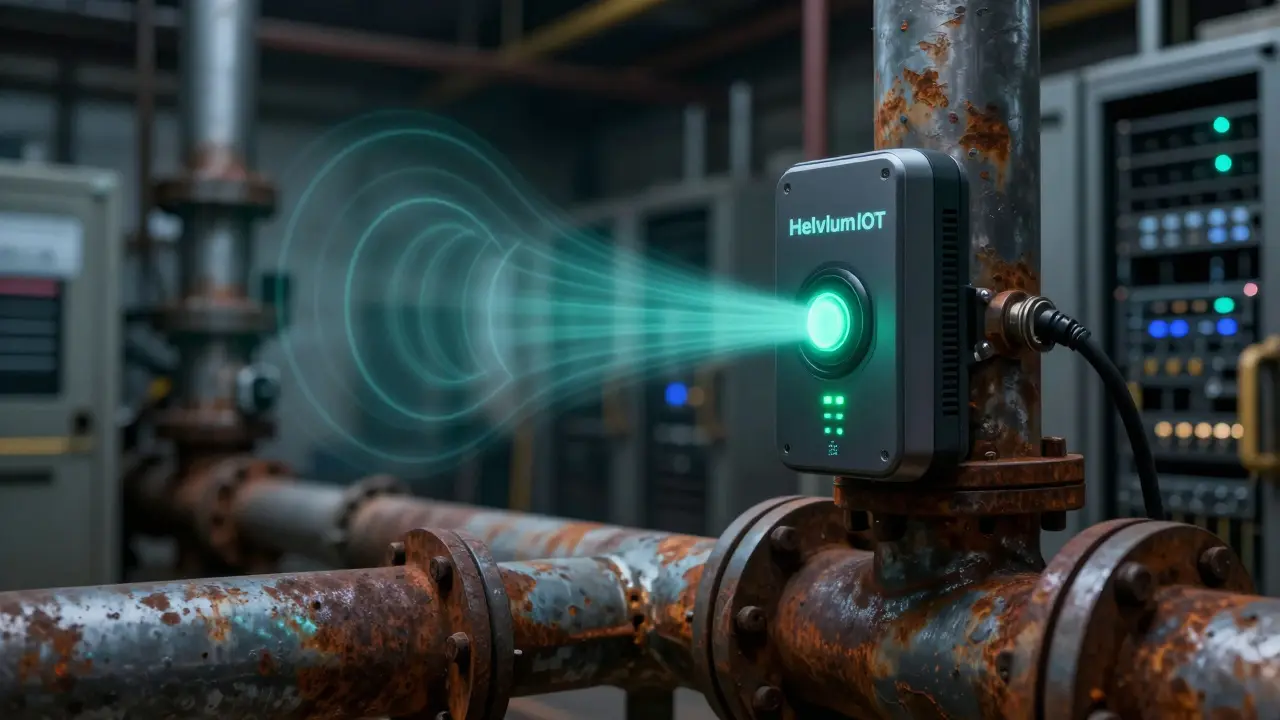
LongFi is a proprietary wireless protocol that combines LoRaWAN and 5G. LoRaWAN (Long Range Wide Area Network) is ideal for IoT devices because it offers long-range connectivity with low power consumption. A single LoRaWAN signal can cover miles, making it perfect for tracking shipments, monitoring agriculture, or managing smart city sensors. LongFi extends this reach significantly, offering up to 200 times the range of traditional Wi-Fi.
The second pillar is the move to Solana. In 2023, Helium migrated from its original blockchain to Solana. This was a critical decision. The old chain could only handle 10 transactions per second (TPS). Solana handles over 1,600 TPS. This migration reduced costs dramatically. Minting a hotspot as a compressed NFT now costs about $0.50 to $1.00, a 1,000x reduction compared to previous methods. Transaction fees dropped from an average of $0.30 to roughly $0.01 on Solana. This efficiency allows the network to process millions of micro-transactions daily without clogging the ledger.
Real-World Utility: Beyond Speculation
Crypto projects often struggle to prove they have real-world value. Helium excels here. It is not just about holding tokens; it is about moving data. In Q4 2024 alone, the network processed 576TB of data. That is a 555% quarter-over-quarter growth. More importantly, there are over 124,000 active mobile users paying for data plans through Helium Mobile.
These are not just crypto enthusiasts testing the waters. These are consumers using Helium as their primary or secondary data connection. Helium Mobile launched in July 2023, offering unlimited data plans that leverage the decentralized network. While coverage varies by location, the service provides a tangible alternative to expensive carrier contracts. For businesses, the appeal is even stronger. IoT manufacturers use Helium to connect devices globally without worrying about SIM card logistics or roaming fees.
Industry analysts, including those at a16z crypto, cite Helium as a prime example of censorship resistance and permissionless innovation. Because no single company owns the network, it cannot be easily shut down or manipulated. This resilience is crucial for applications ranging from environmental monitoring to emergency communications.
Challenges and Risks to Consider
No technology is perfect. Helium faces several challenges that participants must understand.
- Coverage Consistency: Since the network depends on individual hotspot owners, coverage can be spotty. Rural areas may have excellent LoRaWAN coverage but poor 5G signal if few operators have deployed cellular hotspots.
- Token Sustainability: Critics question whether the economic model will hold as the network matures. Early adopters earned high rewards due to scarcity. As more hotspots join, individual earnings decrease. The network must balance incentives to keep operators engaged while ensuring enough revenue from data usage to sustain token value.
- Hardware Complexity: Setting up a hotspot requires basic networking knowledge. Optimizing antenna placement and understanding local RF regulations can be daunting for non-technical users. However, the trend toward converting existing devices like Ubiquiti routers has lowered this barrier significantly.
- Regulatory Uncertainty: While Helium currently operates within existing spectrum rules, governments could change regulations regarding decentralized wireless transmission. This remains a potential risk for large-scale expansion.

Getting Started with Helium
If you want to participate in the Helium ecosystem, here is a practical guide. You do not need to be a coding expert, but you should be comfortable with technology.
Step 1: Choose Your Role
Are you a provider or a consumer? If you want to earn HNT, you become a provider by buying hardware. If you want cheap data, you sign up for Helium Mobile. Many people do both.
Step 2: Select Hardware
For LoRaWAN, look for hotspots with good indoor performance. For 5G, consider outdoor-rated units if you live in an area with high demand. Check the Helium Explorer map to see if your location already has dense coverage. Too many hotspots in one spot means lower earnings per device.
Step 3: Setup and Optimization
Use the Helium app to onboard your device. Ensure your internet connection is stable. Position the antenna high up and away from metal obstructions. Monitor your hotspot’s performance regularly. The community on Reddit and Discord is very active and helpful for troubleshooting.
Step 4: Manage Tokens
Your earnings come in HNT. You can stake these tokens to earn additional rewards or trade them on exchanges. Since the migration to Solana, managing your wallet is faster and cheaper. Use reputable wallets like Phantom or Backpack that support Solana assets.
The Future of Decentralized Wireless
By mid-2026, Helium has solidified its position as the leader in the DePIN space. The roadmap includes further expansion of 5G coverage and deeper integration with enterprise IoT solutions. Analysts predict the network could reach one million active hotspots by the end of 2026, driven by the growing demand for affordable connectivity.
The broader implication is significant. Helium proves that physical infrastructure can be built collectively. It challenges the monopoly of traditional telecom giants and offers a more resilient, cost-effective alternative. Whether you are a developer building IoT apps, a business looking to reduce connectivity costs, or an individual seeking passive income, Helium provides a unique entry point into the decentralized economy.
The question is no longer if DePIN will succeed, but how quickly it will replace centralized models. Helium is leading that charge, one hotspot at a time.
Is Helium Network still profitable in 2026?
Profitability depends on your location and hardware setup. With over 400,000 hotspots, competition has increased, reducing individual earnings compared to early years. However, the surge in data transfer (576TB in Q4 2024) indicates strong demand. Operators in areas with high data traffic and moderate hotspot density still report steady returns. Always check the Helium Explorer map before purchasing hardware to assess local competition.
What is the difference between Helium LoRaWAN and 5G?
LoRaWAN is designed for low-power, long-range IoT devices like trackers and sensors. It sends small amounts of data over long distances. Helium 5G provides high-speed cellular connectivity for smartphones and tablets. Both operate on the same blockchain but serve different use cases. LoRaWAN is better for static devices, while 5G is for mobile, high-bandwidth needs.
Why did Helium migrate to Solana?
The migration was necessary to scale the network. The original blockchain could only handle 10 transactions per second, causing congestion and high fees. Solana supports over 1,600 TPS with fees around $0.01. This allows Helium to process millions of data transfers and reward claims efficiently, making the network viable for mass adoption.
Can I use my existing router as a Helium hotspot?
Yes, if you have compatible hardware. Devices from manufacturers like Ubiquiti and Eero can be converted into Helium hotspots via software updates. This accounts for a significant portion of the mobile hotspots on the network. Converting existing devices reduces upfront costs and simplifies deployment for users who already own quality networking gear.
Is Helium Mobile a reliable replacement for major carriers?
It depends on your location. Helium Mobile offers unlimited data plans at a fraction of the cost of traditional carriers. However, coverage is decentralized, so it varies by region. In urban areas with many hotspots, it is highly reliable. In rural areas, you may experience gaps. Most users treat it as a secondary plan or use it alongside a traditional carrier for backup.
Kat Barr
July 10, 2026 AT 09:30omg this is actually so cool!! i have been looking for a way to save on my phone bill and this sounds perfect 😍 the fact that you can just plug in a hotspot and earn tokens while helping others is genius. i might try setting one up in my apartment soon 🏠✨
Michelle Walker
July 11, 2026 AT 06:09It is naive to assume coverage consistency will hold. The economic model is fundamentally flawed because it relies on speculative token value rather than actual utility revenue. Most users are losing money after hardware costs.
Kat Barr
July 12, 2026 AT 17:20oh no! don't be like that 😢 i think it's really promising if you do your research first. maybe not for everyone but for some people it works out nicely! 💕
Kristy Morrow
July 14, 2026 AT 16:24another crypto scheme wrapped in tech jargon. they call it 'decentralized' but it's just a pyramid of people buying overpriced routers hoping the next guy pays more. proof-of-coverage is a joke when half the hotspots are stacked in warehouses faking location data. the whole concept of DePIN is just buzzword salad designed to extract liquidity from retail investors who don't understand RF physics or blockchain economics. stop pretending this is innovation. it is parasitic.
Antony Lopez
July 15, 2026 AT 01:10Let me tell you something about infrastructure. You cannot build a reliable network with hobbyists. We need strong centralized control, American standards, and big corporations that answer to shareholders and regulations. This decentralized nonsense is a security risk. Who guarantees the signal? Who fixes it when it breaks? Nobody. It is chaotic and weak. We should ban these foreign-owned protocols and stick to our own domestic telecom giants that keep us safe and secure. This Helium stuff is just another way to undermine our national telecommunications sovereignty.
Shay Thomson
July 15, 2026 AT 15:23Wow, such intense reactions! I feel like we are all missing the forest for the trees here. Imagine a world where connectivity is a shared resource, not a commodity hoarded by monopolies. It is beautiful, isn't it? The potential for community empowerment is staggering. Let us embrace the chaos and find harmony in the noise. 🌿📡
DJ Maleko
July 17, 2026 AT 08:29I checked your IP address range and it looks like you are posting from a major ISP node. Interesting. Anyway, the migration to Solana was the only logical step. The original chain was a disaster. But honestly, most of you guys are too dumb to understand the technical nuances of compressed NFTs for hotspots. It is about efficiency, not just hype. 🤖💸
Logan Edmison
July 18, 2026 AT 19:04i mean its kinda interesting how they use solana now. the fees were crazy before. i tried to claim my rewards once and it cost me more than i earned lol. but yeah the new system seems better. just wish the earnings werent so low rn. feels like a grind for pennies sometimes. also my router keeps disconnecting every few hours which is annoying af.
Linda Hilliard
July 20, 2026 AT 13:03The paradigm shift towards Decentralized Physical Infrastructure Networks represents a fundamental reimagining of the telco landscape. However, one must critically assess the sustainability of the Proof-of-Coverage consensus mechanism in light of increasing saturation. The juxtaposition of LoRaWAN’s low-bandwidth efficacy against the high-throughput demands of 5G creates a dichotomy that challenges the monolithic narrative of Helium’s utility. Furthermore, the reliance on Solana’s throughput capabilities, while impressive at 1,600 TPS, introduces a single point of failure in terms of blockchain dependency. One must question whether the tokenomics can withstand the inevitable dilution as adoption scales. :/
Kristine Lawson
July 21, 2026 AT 07:36It is absolutely disheartening to see the lack of rigorous analysis in this thread. The notion that individual citizens can effectively replace state-regulated telecommunications infrastructure is not only technically unsound but ethically questionable. Who bears the liability when a critical IoT device fails due to spotty coverage? The current regulatory framework exists for a reason, to ensure reliability and safety. To suggest otherwise is to advocate for anarchy under the guise of innovation. One must adhere to established norms and respect the complexity of spectrum allocation laws.
Erika Pozzetto
July 22, 2026 AT 17:04In consideration of the aforementioned points regarding the technological architecture and the economic implications of the Helium Network, it is imperative to acknowledge the significant strides made in democratizing access to wireless connectivity. The integration of LongFi technology, which synergistically combines the long-range capabilities of LoRaWAN with the high-speed data transfer rates of 5G, presents a compelling argument for the viability of decentralized physical infrastructure networks in contemporary telecommunications landscapes. Furthermore, the migration to the Solana blockchain has undeniably enhanced transactional efficiency, thereby reducing operational costs for participants and facilitating a more scalable ecosystem for Internet of Things applications. Nevertheless, it is crucial to remain cognizant of the inherent challenges associated with coverage consistency and token sustainability, as these factors may significantly impact the long-term profitability and reliability of the network for both providers and consumers alike.
Winston Lacewing
July 24, 2026 AT 15:23This is the end of times for traditional carriers! 🚨😱 I told you all years ago that the system would collapse under its own greed. Now look at what is happening. People are waking up. They are connecting. It is divine intervention through code. Do not fight it. Embrace the change or be left behind in the dark ages of monthly bills. God speed to the decentralizers! ✝️📶